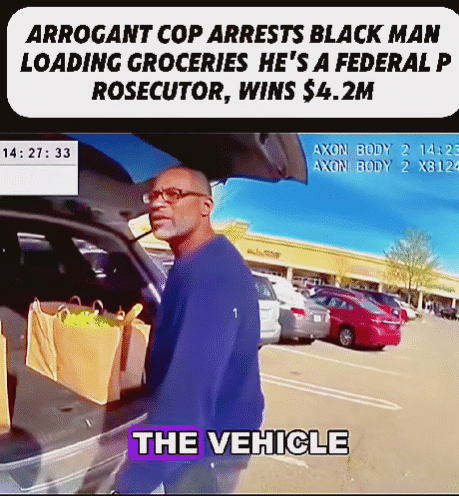
What began as an ordinary grocery run reportedly turned into a life-changing legal battle after a man was detained by an officer while loading groceries into his own vehicle. The incident, which later gained attention online, has raised important questions about civil rights, law enforcement judgment, public accountability, and the importance of remaining calm during high-pressure encounters.
According to the account, the man had just finished shopping and was placing grocery bags into the trunk of his car in a quiet parking lot. Nothing about the situation appeared unusual. He was simply handling a normal errand, the kind of everyday task millions of people complete without a second thought.
But within moments, the routine scene changed dramatically.
Officer Approaches During a Routine Grocery Stop
As the man loaded his groceries, an officer approached and began questioning him. The officer reportedly accused him of tampering with a vehicle and demanded identification.
The man was confused by the accusation. He calmly explained that the vehicle belonged to him and that he had just left the store after purchasing groceries. From his perspective, there was no reason for suspicion, no reported crime, and no behavior that justified being treated as a suspect.
Still, the officer allegedly continued pressing him for answers. The man asked reasonable questions, including what law he had broken and why he was being detained. Instead of easing the tension, the encounter escalated.
Within a short time, the man was reportedly ordered away from the vehicle and placed in handcuffs in front of other shoppers.
A Public Detention With No Clear Evidence
Being detained in public can be deeply humiliating, especially when no crime has been committed. In this case, the man was reportedly cooperative throughout the encounter. He did not run, resist, or act aggressively. He simply asked why he was being accused while standing beside his own car.
Witnesses nearby reportedly watched as the scene unfolded. For the man, what should have been a private, routine moment became a public embarrassment.
The most concerning part of the account was the apparent lack of evidence. The officer had not confirmed that the vehicle was stolen. There was no immediate report suggesting the man had broken into the car. There was no clear indication that he was doing anything other than loading groceries.
In many situations involving law enforcement, assumptions can lead to serious consequences. Just as errors in banking, insurance, loans, real estate, or personal finance can create major problems when facts are not verified, mistakes in public safety decisions can affect a person’s reputation, freedom, and emotional well-being.
The Detail the Officer Did Not Expect
What the officer reportedly did not know was that the man had a strong understanding of the law. His professional background gave him knowledge of civil rights, legal procedures, and what officers are required to justify during a detention.
Instead of reacting angrily, he remained calm and measured. He answered carefully, asked clear questions, and allowed the encounter to unfold on record.
That composure became one of the most important parts of the story.
In stressful moments, emotions can easily take over. Many people might panic, argue, or say something that makes the situation worse. But the man understood that remaining calm would help protect him and preserve the facts.
Vehicle Registration Confirms the Truth
When the officer eventually checked the vehicle registration, the situation became clear. The car belonged to the man. The groceries were his. There was reportedly no evidence of a crime.
According to the account, the officer’s attitude changed once the facts were confirmed. What had started as a confident accusation became an uncomfortable realization.
But by then, the damage had already happened.
The man had been handcuffed, questioned, and publicly treated as though he had done something wrong. Even after being released, the emotional impact of the encounter remained.
False assumptions can carry lasting consequences. A wrongful public detention can affect a person’s dignity, sense of safety, and trust in the systems meant to protect the community.
The Man Takes Legal Action
Rather than letting the incident fade away, the man reportedly decided to pursue legal action. His goal was not only to seek compensation but also to address what he believed was an unlawful detention.
As the case moved forward, investigators reviewed available evidence, including body camera footage, witness statements, and police reports. The central question was whether the officer had a lawful reason to detain the man.
According to the account, the review found that there was no proper legal justification for the detention.
That finding became critical. In civil rights cases, evidence matters. Documentation, video footage, and witness accounts can determine whether an encounter was handled appropriately or whether someone’s rights were violated.
A Major Legal Outcome
After a lengthy legal process, a jury reportedly ruled in the man’s favor. He was awarded millions of dollars in compensation connected to the wrongful detention, emotional distress, and public humiliation he experienced.
The outcome gained attention because it showed that accountability can follow when authority is used improperly. It also reminded the public that legal rights exist for a reason.
While every case depends on specific facts, this story highlights why citizens should understand basic protections during police encounters. Knowing your rights does not mean being disrespectful. It means staying informed, asking appropriate questions, and protecting yourself through calm, lawful behavior.
Why the Story Resonates With So Many People
This incident has spread widely because it touches on issues many people care about: fairness, dignity, and equal treatment.
A simple assumption changed the direction of one man’s day and, eventually, his life. What began in a grocery store parking lot became a broader lesson about how quickly situations can escalate when facts are not verified.
The story also reflects challenges seen in many areas of daily life. Whether someone is dealing with a mortgage dispute, a denied insurance claim, a loan application issue, a bank account error, or a real estate disagreement, the same principle applies: decisions should be based on evidence, not assumptions.
When people in positions of authority act too quickly without confirming the facts, the consequences can be serious.
The Importance of Staying Calm
One of the strongest lessons from this account is the importance of composure. The man reportedly did not respond with rage or panic. He stayed calm, asked questions, and allowed the evidence to work in his favor.
That approach may have helped him later in court. A clear record of respectful behavior can be powerful when reviewing whether an official action was justified.
This does not mean people should ignore unfair treatment. It means that responding strategically can often be more effective than reacting emotionally.
Final Thoughts
What should have been a simple grocery run reportedly became a major civil rights case and a life-changing legal victory. The man was accused, detained, and embarrassed in public, only for the facts to later show that he had done nothing wrong.
His story serves as a reminder that accountability matters. Law enforcement officers have difficult jobs, but authority must be used carefully and responsibly. Assumptions should never replace evidence.
For the public, the case offers an important lesson: stay calm, know your rights, and document the facts whenever possible.
In the end, the man’s quiet composure helped turn a humiliating moment into a powerful example of standing up for fairness.