For Earl Dawson, his 80-acre ranch in the Texas Hill Country was never just a piece of real estate. It was family history, financial security, and a legacy built through decades of hard work. His grandfather bought the land in 1947 after spending 15 years working in the oil fields. Over time, the property became more than soil, fences, barns, and pasture. It became a symbol of independence.
So when a nearby development began expanding and representatives connected to a homeowners association approached him with an offer to buy the ranch, Dawson had a simple answer.
No.
He did not want to sell. He did not want his family land turned into another subdivision. He believed the property was worth more than any check a developer could offer.
But according to the account, that refusal marked the beginning of a strange and troubling pattern.
Vehicles With Lights and Badges Enter the Ranch
At first, Dawson thought it was a mistake.
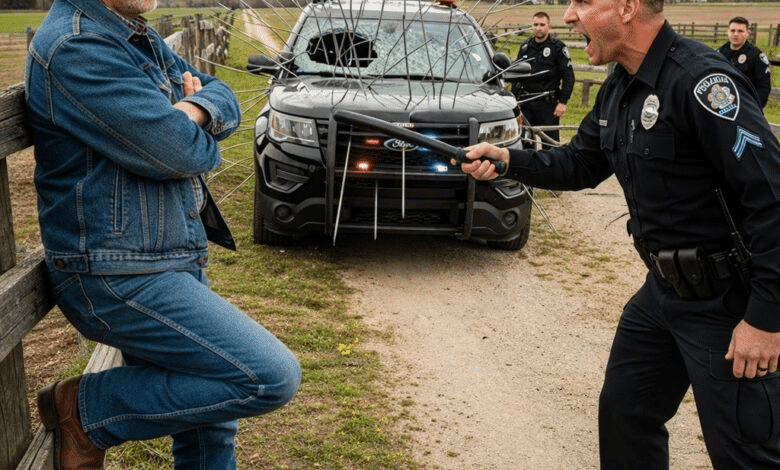
A vehicle with flashing red-and-blue lights drove across his ranch without permission. The people inside looked official enough to make him step aside. They had uniforms. They had badges. They carried themselves like law enforcement.
The first time, he assumed there had been some emergency or confusion about property boundaries.
Then it happened again.
And again.
By the sixth time, Dawson no longer believed it was accidental. The vehicles repeatedly crossed his private property, ignoring signs and acting as if they had a right to be there.
For any property owner, unauthorized entry is serious. For a ranch owner with livestock, equipment, fences, and liability concerns, it can also create major insurance risks. A single damaged gate, injured animal, or accident on private land can lead to financial consequences, legal claims, and costly repairs.
Dawson installed warning signs. The drivers ignored them.
He installed surveillance cameras. One of the uniformed men reportedly waved at the lens as if he knew exactly what he was doing.
That was when Dawson decided to call the sheriff’s office.
The Sheriff’s Office Gives a Chilling Answer
Dawson contacted local authorities and explained that vehicles appearing to be police units were driving through his ranch. He expected the dispatcher to confirm that deputies had been nearby.
Instead, the response changed everything.
“Sir, we have no units in your area.”
No units.
That meant the people crossing his ranch were not local law enforcement.
Dawson went back to his camera footage and looked more carefully. This time, the details stood out. The badges did not appear to have official serial numbers. The vehicles did not display a sheriff’s department name, police department markings, or standard public agency identification.
Instead, he noticed a small label on one vehicle: Ridgewood Security.
According to the story, the people driving through his property were not police officers. They were private security guards.
Private Security or Intimidation?
Private security companies can provide lawful services, including patrols, event security, and property monitoring. However, the concern in Dawson’s case was not simply that a security company existed. The problem was how the guards allegedly presented themselves.
Uniforms, badges, and flashing lights can create the appearance of government authority. If private personnel use that appearance to pressure, intimidate, or mislead property owners, the situation becomes far more serious.
Dawson believed the repeated entries were connected to his refusal to sell the land.
According to the account, the nearby Ridgewood development had been expanding, and Dawson’s ranch sat in a valuable location. In today’s real estate market, open land can attract strong interest from developers, especially in growing regions where housing demand, mortgage lending, and property investment are increasing.
But a landowner has the right to refuse an offer.
A developer may negotiate. A buyer may improve the price. But pressure tactics, trespassing, or intimidation have no place in lawful real estate dealings.
A Meeting With the Developer
Trying to resolve the issue directly, Dawson reportedly went to the Ridgewood Estates clubhouse and requested a meeting with Victor Harmon, the developer connected to the project.
Harmon allegedly described the repeated trespassing as a misunderstanding. He suggested that the security team may have been patrolling the area and crossed boundaries by mistake.
But Dawson was not convinced.
According to the account, the tone of the conversation changed when Harmon implied that the problem could go away if Dawson reconsidered the offer to sell.
To Dawson, the message was clear: his refusal to sell was the real issue.
After that meeting, the situation reportedly became worse. The vehicles continued entering his land, sometimes late at night. Dawson also noticed social pressure in the surrounding community. Neighbors seemed distant. Conversations stopped when he entered local businesses. Eventually, someone told him that Harmon had been describing him as difficult and hostile during community discussions.
For Dawson, it felt like the pressure was no longer just physical. It had become social and reputational as well.
Dawson Starts Building a Case
Instead of reacting angrily, Dawson took a careful approach. He began documenting everything.
He saved video clips. He recorded dates and times. He photographed tire tracks and access points. He installed additional cameras, including equipment capable of capturing activity at night.
This documentation mattered. In property disputes, clear records can be essential. Whether a person is dealing with trespassing, HOA conflict, insurance claims, land access issues, banking records, loan paperwork, or real estate negotiations, documentation can protect the owner’s position.
Dawson also searched public business records. According to the account, he discovered that Ridgewood Security Services LLC had been created only 18 months earlier and was owned by Victor Harmon himself.
That detail raised even more questions.
If the developer owned the security company, and that same company was repeatedly entering Dawson’s property after he refused to sell, the pattern looked less like a mistake and more like a strategy.
Legal Advice Leads to a Practical Solution
Dawson consulted the sheriff and an attorney. Law enforcement reportedly told him that stronger action would require catching the trespassers in the act. His attorney, however, suggested a practical and lawful step that could immediately protect the property.
Install steel bollards.
Steel bollards are reinforced posts often used in commercial real estate, parking lots, industrial sites, government properties, and high-security areas. They are designed to stop vehicles from entering restricted spaces.
For Dawson, they offered three advantages.
First, they created a physical barrier.
Second, they made the property boundary obvious.
Third, they showed that any future entry would be intentional, not accidental.
Dawson ordered six bright yellow steel bollards and had them installed at key access points. He documented the installation, placed clear warning signs, and sent formal notice to Harmon stating that unauthorized entry was prohibited.
No shouting. No threats. No confrontation.
Just a clear legal boundary.
A Larger Lesson About Property Rights
Dawson’s story reflects a bigger issue in modern real estate. As land values rise and development expands into rural areas, conflicts between long-term property owners and developers can become intense.
For many families, land is not just an asset. It may represent retirement planning, generational wealth, inheritance, farming income, business operations, and emotional history. Selling land can affect taxes, insurance, estate planning, personal finance, and long-term family stability.
That is why property owners should understand their rights before entering any negotiation.
A fair real estate offer should be transparent, voluntary, and respectful. If pressure begins to feel like harassment, property owners should document every incident, speak with local authorities, review legal options, and avoid emotional confrontations that could weaken their position.
Final Thoughts
Earl Dawson’s account is not simply a story about steel bollards. It is a story about boundaries, both physical and legal.
He refused to sell land that had belonged to his family for generations. When suspicious vehicles began crossing his ranch, he did not panic. He gathered evidence, asked questions, contacted authorities, and used lawful tools to protect his property.
His response offers a clear reminder: when pressure increases, strategy matters.
In a world where real estate development can move quickly and aggressively, property owners must stay informed, document everything, and protect what belongs to them through legal and practical action.
Sometimes, standing your ground does not require a fight.
Sometimes, it only requires drawing a line no one can ignore.