The Tuesday morning rush at Northgate International Airport seemed ordinary at first.
Travelers moved quickly through the terminal, dragging suitcases behind them. Flight announcements echoed overhead. Parents guided children through crowded lines while business travelers checked phones, boarding passes, and gate numbers.
In the middle of the noise and movement stood Officer Liam Mercer, an airport security officer assigned to the K9 unit. Beside him was Rex, his four-year-old German Shepherd partner.
Rex was trained, disciplined, and calm under pressure. He had spent years learning how to detect suspicious behavior, respond to danger, and support vulnerable people in high-stress environments. To most passengers, he looked like a focused working dog doing another routine shift.
But Liam knew Rex well enough to notice the smallest change in his body.
That morning, Rex suddenly froze.
His ears lifted.
His muscles tightened.
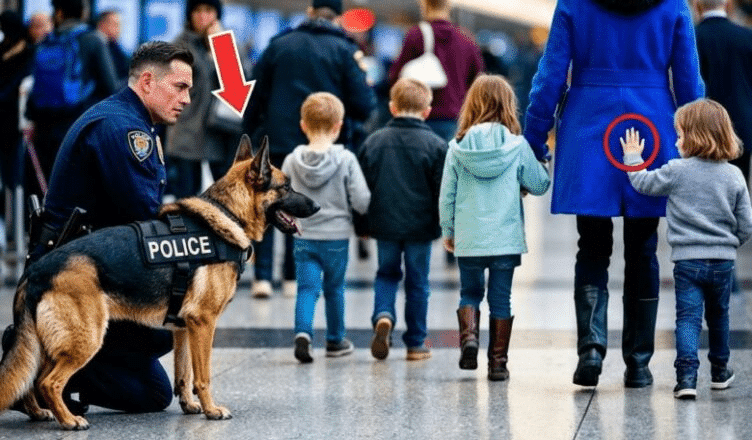
His attention locked onto a woman in a blue coat walking toward the security line with three children.
At first, nothing about the scene looked unusual.
But Rex knew something was wrong.
A Tiny Gesture in a Crowded Terminal
The woman moved with confidence, one hand gripping the wrist of a small boy while two older children walked close beside her. She appeared organized and determined, the way many adults look when rushing to catch a flight.
But Liam’s eyes shifted to one of the children.
She was a girl, maybe nine years old. Her head was lowered, and her shoulders were tense. She held one sleeve tightly in her small hand, as if trying to steady herself.
Then she glanced up.
For one brief second, Liam saw fear in her eyes.
The girl quickly looked away and tapped two fingers against her sleeve three times.
Tap.
Tap.
Tap.
The movement was so small that almost everyone around her missed it.
Rex did not.
The German Shepherd responded instantly, stepping forward with a low, controlled rumble. It was not an aggressive sound. It was an alert — the kind that told Liam this was no ordinary moment.
Liam’s posture changed immediately.
He understood that the dog had recognized distress.
Warning Signs Begin to Appear
Once Rex reacted, Liam looked more carefully at the group.
The details began adding up.
The children’s clothes did not seem to match in size or style. None of them carried backpacks, toys, jackets, or personal travel items. Their movements were stiff, as if they had been warned not to speak or draw attention.
The woman’s grip on the youngest boy’s wrist looked too tight.
The little girl kept her eyes down.
Something about the scene felt rehearsed, controlled, and deeply wrong.
Liam stepped forward calmly. In a crowded airport, panic could make a dangerous situation worse. He needed to keep his voice steady and his movements careful.
“Ma’am,” he said, “I need to ask you a few quick questions.”
The woman stiffened.
“We’re in a hurry,” she snapped. “Our flight is boarding.”
“It will only take a moment,” Liam replied.
She lifted a folder. “We have passports. What else do you need?”
Her tone was sharp enough to make the little girl flinch.
Rex moved closer to Liam’s leg, still focused, still alert.
The Situation Escalates
Before Liam could ask another question, his radio crackled.
A surveillance officer’s voice came through quietly but urgently.
The woman in the blue coat had been flagged for review. Similar travel patterns had reportedly appeared at other airports, with different children listed under questionable documentation.
Liam’s pulse quickened, but he did not let it show.
He stepped between the woman and the children.
“Ma’am,” he said firmly, “I need you to stop walking.”
For one second, the terminal seemed to hold its breath.
Then everything happened fast.
The woman tightened her grip on the youngest child and suddenly tried to run toward a side corridor.
Passengers gasped.
The children cried out.
Rex reacted with trained precision.
Rex Blocks the Escape
The German Shepherd lunged forward, not to harm, but to block.
Rex positioned himself between the woman and the exit route, forcing her to stop without reaching the restricted corridor. His body was low, controlled, and focused. He barked sharply, drawing immediate attention from nearby officers.
Within seconds, airport police moved in.
Liam reached the children first, pulling them safely away from the woman’s grip. Other officers secured the suspect while additional security personnel cleared space around the scene.
What had looked like a routine airport delay had turned into a major intervention.
The little girl stood shaking, tears streaming down her face.
Rex returned to her side and sat close, calm and steady.
For the first time, she reached out and touched his fur.
The Truth Behind the Signal
After the children were taken to a secure area, Liam gently asked the girl how she knew to use the silent signal.
Her answer was quiet.
“My dad taught me,” she said. “He told me if I was ever scared and couldn’t speak, I should make the signal. He said someone trained might see it.”
In the story, her father had worked around law enforcement and had taught her basic safety habits in case she was ever unable to call for help.
That small lesson became the turning point.
The girl had been too frightened to scream.
Too controlled to run.
Too watched to ask for help directly.
But she still found a way to speak.
And Rex understood.
Why This Story Resonates
Although this airport rescue account reads like a dramatic fictional safety story, the message behind it is powerful.
Children may not always be able to explain when they are afraid. In public places, danger can hide behind ordinary appearances: a calm adult, a crowded terminal, official-looking documents, or a child who seems quiet rather than distressed.
That is why awareness matters.
Security officers, teachers, parents, airline employees, hotel workers, and everyday bystanders can all play a role in noticing when something does not feel right. A child who avoids eye contact, appears unusually fearful, has no personal belongings, or seems controlled by an adult may need help.
Of course, no one should jump to conclusions based on appearance alone. But when multiple warning signs appear together, it is important to alert trained authorities rather than ignore the situation.
The Role of Working Dogs
K9 units are often associated with detecting explosives, drugs, or dangerous items, but working dogs can also provide important support in public safety environments.
Dogs like Rex are trained to focus in chaotic settings. Airports are loud, crowded, and filled with distractions, but a well-trained K9 can remain calm and responsive. Their presence can help officers detect changes in behavior, manage tense situations, and provide emotional comfort after a crisis.
In this story, Rex’s role was not simply about strength or speed.
It was about awareness.
He noticed what others missed.
Then he responded exactly when it mattered.
A Reminder for Parents and Families
Stories like this also remind families to talk with children about safety in age-appropriate ways.
Children should know how to identify trusted helpers, such as uniformed officers, airport staff, teachers, store employees, or parents with children. They should know their full name, a parent’s phone number when possible, and what to do if separated in a public place.
Families can also create simple emergency plans before traveling. That includes choosing a meeting spot, reviewing what to do if someone gets lost, keeping identification information secure, and making sure children understand they can ask for help if they feel unsafe.
These conversations do not need to frighten children.
They can empower them.
Just like financial planning, insurance coverage, travel documents, and home security, child safety works best when families prepare before a crisis happens.
More Than a Dramatic Moment
The most emotional part of the story is not the chase or the arrest.
It is the quiet signal.
A child who could not speak openly found a way to ask for help. A trained dog recognized the urgency. An officer trusted his partner and acted quickly.
That combination changed everything.
The story reminds readers that courage does not always look loud. Sometimes courage is a tiny movement of two fingers against a sleeve. Sometimes protection comes from a dog sitting calmly beside a frightened child. Sometimes the smallest action in the busiest place can become the one that saves lives.
Final Thoughts
The story of the little girl, Officer Liam Mercer, and Rex the police dog has captured attention because it combines fear, instinct, courage, and hope.
A crowded airport seemed ordinary until one child gave a silent signal most people missed. Rex noticed immediately. His response pushed Officer Mercer to look closer, and that quick action helped protect the children before the situation could become worse.
Whether read as a dramatic safety story or a reminder about real-world awareness, the message is clear:
Pay attention.
Trust trained instincts.
Teach children safe ways to ask for help.
And never underestimate the power of one small signal when someone is brave enough to use it.