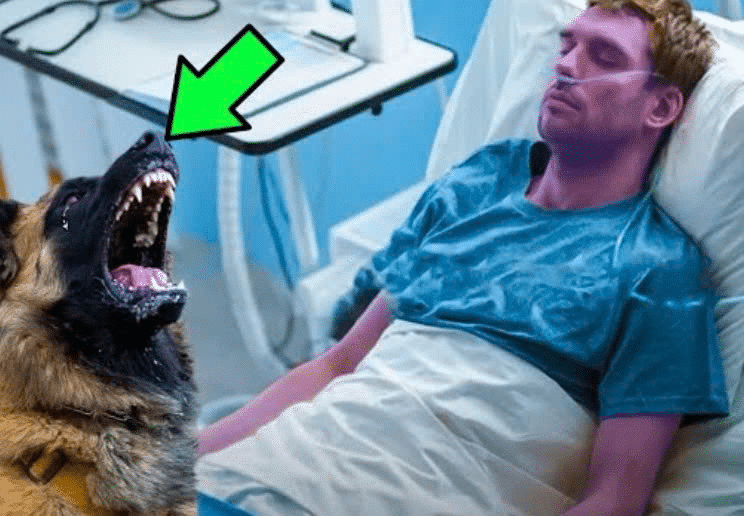
It was supposed to be a final goodbye.
Doctors and nurses had reportedly done everything they could. After months of fighting for his life, Officer Cory Masterson was said to be unresponsive again, with his condition appearing hopeless. The room was quiet, heavy with grief, and the medical staff prepared for the heartbreaking possibility that there was nothing more they could do.
Then someone made a compassionate decision.
They allowed Reno, the officer’s loyal K9 partner, to enter the room.
Reno was not just a working dog. According to the viral account, he had served beside Officer Masterson for years, responding to dangerous calls, standing beside him in tense situations, and building the kind of trust that can only come from daily partnership.
Everyone expected Reno to approach the bed quietly.
Instead, he began barking.
Then he jumped onto the officer’s hospital bed.
What happened next, according to the story, left nurses and doctors speechless.
Before going further, it is important to note that this specific story about “Officer Cory Masterson” and K9 “Reno” could not be verified through credible news reports or official law enforcement sources in available search results. The matching results appear mainly on Facebook reposts and viral storytelling videos, so this should be treated as an unverified or fictionalized inspirational story, not confirmed news.
A Bond Built in Service
In the story, Officer Masterson and Reno were more than handler and K9.
They were partners.
Police dogs are trained to follow commands, track scents, search buildings, detect danger, and protect their handlers when needed. But anyone who has worked closely with a dog knows the relationship often becomes deeper than training alone.
A K9 learns a handler’s voice, movements, stress signals, and routines. The handler learns the dog’s body language, alert patterns, habits, and instincts. Over time, that partnership becomes a form of communication that does not always require words.
That bond is what makes the hospital scene so emotional.
Reno was brought in to say goodbye.
But according to the account, the dog refused to accept that it was the end.
The Moment Reno Reacted
When Reno entered the hospital room, the mood was somber.
Medical staff expected a quiet farewell. Instead, Reno became agitated almost immediately. He barked loudly, moved toward the bed, and jumped beside his officer.
Nurses reportedly tried to calm him down, but the dog would not move.
He positioned himself near Officer Masterson and appeared to block the medical team from continuing. His barking was not described as random. It was urgent, focused, and persistent — as if he sensed something everyone else had missed.
At first, the behavior may have seemed disruptive.
But then the room changed.
A faint sound came from the bed.
A cough.
A small movement.
A sign of life.
According to the viral story, Officer Masterson’s chest moved, and medical staff rushed back into action.
The Medical Claim Behind the Story
The story describes the officer’s sudden return of vital signs as something similar to the “Lazarus effect,” also known medically as autoresuscitation.
The Lazarus effect is rare. Cleveland Clinic describes it as a situation in which the heart starts beating again without assistance, usually after CPR has ended. The medical term “autoresuscitation” is considered more accurate.
Medical literature also describes the Lazarus phenomenon as a spontaneous return of circulation after resuscitation efforts have stopped, though it remains unusual and not fully understood.
However, this does not mean dogs can “bring people back to life,” and it should not be presented that way.
In real medical emergencies, only trained healthcare professionals can evaluate vital signs, monitor a patient, perform resuscitation, and determine whether circulation or breathing has returned.
The emotional power of the story comes from Reno’s reaction, but the medical reality must be treated carefully.
Could a Dog Sense Something People Missed?
Dogs have remarkable senses.
They can detect subtle changes in scent, movement, breathing, posture, stress hormones, and human behavior. Some dogs are trained to alert to seizures, low blood sugar, panic episodes, or changes in a person’s physical condition.
That does not mean every dog reaction is medical proof.
But it does explain why stories like this feel believable to many people.
A dog may notice changes that humans overlook, especially in a quiet room where a slight movement, breath pattern, or sound is easy to miss. In this fictionalized account, Reno’s barking becomes the signal that causes everyone to look again.
Whether viewed as instinct, loyalty, training, or emotional connection, the dog’s refusal to leave his partner becomes the heart of the story.
Why the Story Resonates
This viral account touches people because it combines several powerful emotions.
A wounded officer.
A loyal dog.
A hospital room.
A goodbye that becomes a second chance.
People are naturally moved by stories where love refuses to surrender. The image of a K9 barking beside his partner’s bed is emotional because it reflects something many pet owners understand deeply: animals often seem to know when something is wrong.
They sit beside us when we are sick.
They become restless when routines change.
They watch our faces.
They react to our breathing, tone, and movement.
For families, service members, police officers, veterans, and pet owners, that loyalty can feel life-saving even when no miracle is involved.
The Importance of Verifying Viral “Miracle” Stories
While the story is moving, readers should be cautious with viral medical and law enforcement claims.
A real case involving a police officer, a hospital recovery, and a heroic K9 would likely have official records, local news coverage, police department statements, hospital updates, or verified community reporting.
In this case, searches for the specific names mainly return social media posts and storytelling videos, not reliable confirmation. That does not make the emotional lesson worthless, but it does mean the story should not be presented as verified fact.
Online publishers should be especially careful with stories involving death, medical recovery, police officers, or alleged miracles. Misleading claims can damage trust, create false hope, and blur the line between inspiration and misinformation.
A responsible version should say clearly that the account is unverified or fictionalized.
A Reminder About K9 Partners
Even as a fictionalized story, Reno’s role reflects something real: working dogs can form extraordinary bonds with their handlers.
Police K9s, search-and-rescue dogs, therapy dogs, service dogs, and medical alert dogs all show how powerful human-animal partnerships can be. These animals are not machines. They respond to training, but also to trust, routine, emotional cues, and close relationships.
Their care also carries real responsibilities.
Departments and families must think about veterinary care, retirement planning, liability insurance, handler safety, training costs, equipment, housing, and long-term health needs. A K9 may serve the public, but the animal also depends on people for protection, medical care, and dignity.
Stories like this remind readers that loyalty goes both ways.
A Second Chance in the Story
According to the viral version, Officer Masterson eventually recovered after the incident.
The story says he slowly regained strength through therapy and later learned what Reno had done. Overcome with emotion, he reportedly said that Reno had saved him twice — once in the field and once when everyone thought it was over.
Whether those exact events happened or not, the message is clear.
Sometimes the strongest bonds are built in silence.
Reno could not explain himself to doctors.
He could not make a medical argument.
He could only bark, block, and refuse to leave.
In the story, that refusal changed everything.
Final Thoughts
The viral story of Officer Cory Masterson and his K9 partner Reno appears to be an unverified or fictionalized account rather than confirmed news. Still, its emotional message is powerful.
A loyal dog is brought to say goodbye.
Instead, he reacts urgently.
His barking forces everyone to look again.
And in the story, that moment gives his partner a second chance.
The medical claim should be handled carefully. The Lazarus effect, or autoresuscitation, is a rare phenomenon involving spontaneous return of circulation after resuscitation efforts have stopped, but it is not something that can be assumed or diagnosed from a viral story.
What remains is a moving reminder about loyalty, instinct, and the deep connection between people and animals.
Sometimes, love does not speak.
Sometimes, it barks.
And sometimes, in a story like this, that bark is enough to make everyone listen.