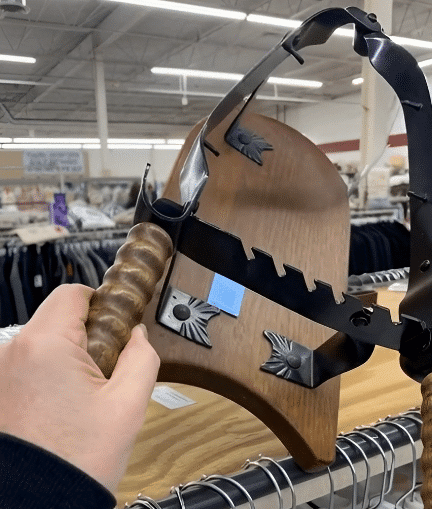
Some vintage objects look so unusual today that it is hard to imagine they once had a simple, practical purpose.
That is exactly why this strange-looking item has captured so much attention online. At first glance, it does not look like something from a kitchen. Some people guessed it might be a piece of medieval armor. Others thought it could be an old medical device, a farming tool, or a bizarre belt accessory from another century.
But for longtime food lovers, traditional butchers, and people familiar with European cured meats, the answer is much more familiar.
The object is a prosciutto holder, also commonly known in Spain as a jamonero.
Its purpose was simple but important: it helped hold a large cured ham leg steady while someone sliced thin pieces by hand.
A Tool Designed for a Specific Job
Before modern countertop slicers and commercial kitchen equipment became common, cutting cured meat by hand required skill, strength, and the right tools.
Large cured ham legs, such as Italian prosciutto or Spanish jamón, are heavy and awkward to handle. They are not easy to balance on a table, and slicing them safely requires the meat to stay firmly in place.
That is where a prosciutto holder came in.
The circular or gripping section of the device was designed to secure part of the ham, often near the hoof or end of the leg. The attached belt allowed the user to brace the setup against the body, helping stabilize the meat while carving.
To modern eyes, it may look strange.
But to someone slicing cured ham every day, the design made practical sense.
Why Thin Slicing Mattered
Cured ham is not usually eaten in thick chunks. The best way to enjoy prosciutto, jamón serrano, or jamón ibérico is often in very thin slices.
Thin slicing brings out the texture, aroma, and flavor of the meat. It allows the fat to soften quickly, making each piece delicate and rich without feeling heavy.
Achieving that kind of slice by hand takes patience and experience.
A skilled carver uses a long, sharp knife and smooth, controlled movements. The goal is to cut evenly without wasting meat or creating uneven pieces. In traditional butcher shops, delicatessens, restaurants, and European markets, this was considered a respected craft.
A holder like this helped make that craft safer and more efficient.
Common in Butcher Shops and Traditional Markets
Tools like this were especially useful in places where cured ham was sold or served regularly.
They could be found in butcher shops, delicatessens, old European kitchens, food markets, and restaurants that specialized in cured meats. In some settings, the ham was sliced in front of customers, making the process part of the experience.
The carver’s skill mattered.
The knife mattered.
And the holder mattered.
Together, they turned a large cured ham leg into beautiful, paper-thin servings ready for a plate, sandwich, appetizer board, or family meal.
Today, many restaurants and homes use countertop ham stands instead. These stands hold the ham on a table or counter, making the process easier and more stable. But older body-supported holders remain fascinating reminders of how food preparation looked before modern kitchen design changed everything.
Why People Mistake It for Something Else
Without context, specialized vintage tools can be extremely confusing.
A prosciutto holder does not immediately scream “kitchen item” to people who have never seen one used. Its metal parts, belt, and unusual shape can make it look like something connected to farming, medicine, armor, or even punishment.
That is one reason vintage mystery objects go viral so easily.
Modern life has changed quickly. Many tools that were once ordinary have disappeared from everyday use. People now buy pre-sliced meats in supermarkets, use electric slicers, or order prepared foods from delis. Because of that, older food tools may look completely foreign to younger generations.
But once the purpose is explained, the design becomes surprisingly logical.
A Reminder of Traditional Food Culture
The prosciutto holder is more than just a tool. It represents a time when food preparation was slower, more hands-on, and deeply connected to craft.
Curing meat was itself a long process. Families, butchers, and producers preserved ham using salt, air, time, and careful storage. Once ready, the ham was often treated as something special — not just everyday food, but a product of patience and tradition.
Slicing it properly was part of respecting that process.
In many cultures, cured ham remains connected to gatherings, holidays, hospitality, and regional pride. Italian prosciutto and Spanish jamón are not simply ingredients. They are symbols of local food heritage, skilled production, and generations of culinary knowledge.
A small tool like this tells that larger story.
Why Nostalgia Makes These Objects Special
Vintage objects often become meaningful because they remind people of places, people, and traditions that are fading from everyday life.
Someone might see a tool like this and remember a family butcher shop. Another person might think of an old European market, a holiday table, or a grandparent preparing food by hand. For collectors, these items carry both historical and emotional value.
They also remind us that convenience has changed how people interact with food.
Today, many consumers think about grocery budgets, food prices, restaurant costs, health insurance, family finances, and time-saving kitchen appliances. Pre-sliced and packaged products fit busy lifestyles. But older tools show a world where food preparation involved more time, touch, and skill.
Neither way is wrong.
But the older method carries a charm that many people still admire.
Could a Vintage Prosciutto Holder Be Valuable?
Like many antique kitchen tools, value depends on condition, age, material, rarity, and demand from collectors.
A common or heavily worn piece may be worth only a modest amount. A rare, well-preserved holder connected to a known maker, region, or historical period may attract more interest.
Anyone who finds one in an attic, basement, estate sale, or antique shop should avoid throwing it away before doing a little research. Vintage food tools, old butcher equipment, and traditional kitchen collectibles can sometimes surprise people.
As with other estate items, it is wise to check authenticity before selling. Old household objects can hold sentimental value, historical value, and occasionally financial value.
Why the Mystery Captured Attention
The reason this object fascinated so many people is simple: it looked mysterious until the answer was revealed.
That “aha” moment is what makes vintage identification posts so enjoyable. People guess, debate, joke, and imagine dramatic explanations. Then the truth turns out to be something practical from everyday life.
In this case, the strange belt-like device was not armor, a medical tool, or a farming invention.
It was part of a food tradition.
It helped people slice cured ham safely, evenly, and beautifully.
Final Thoughts
The unusual vintage object that confused so many people online is actually a traditional prosciutto holder, also known as a jamonero.
It was used to stabilize large cured ham legs while slicing thin pieces by hand. Though it may look strange today, it once served an important role in butcher shops, markets, restaurants, and traditional kitchens.
Its design reflects a time when food preparation required skill, patience, and specialized tools.
So the next time you see a strange object from the past, it is worth looking closer before guessing.
Sometimes the oddest-looking antiques are not mysterious at all.
They are simply forgotten pieces of everyday life — and in this case, a reminder of the timeless love of good food.