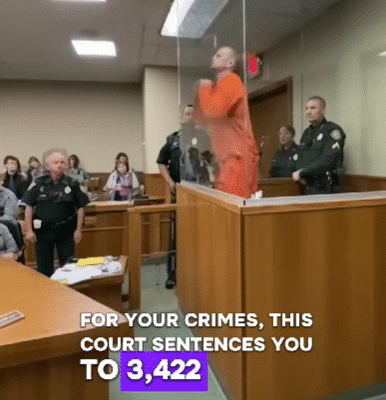
A courtroom video claiming to show defendants reacting to extremely long prison sentences has spread quickly across social media, drawing millions of reactions and intense debate.
The clip centers on a dramatic moment: a judge announcing a prison term so long that viewers immediately questioned whether it could be real. One figure mentioned in viral posts is 3,422 years, a number that sounds almost impossible at first.
Because the video has circulated mostly through social media pages and short clips, not every detail of the footage can be independently confirmed from the provided material. However, extremely long sentences do exist in real legal systems, especially when courts stack penalties across many charges or victims. One reported example involved Pakistan’s Supreme Court upholding a 3,422-year sentence connected to the Sakhi Sarwar shrine attack case.
That is why the viral clip has sparked more than shock. It has opened a larger conversation about how courts measure punishment, why sentences sometimes exceed a human lifetime, and what those numbers mean for victims, families, defendants, and society.
Why Long Sentences Shock Viewers
Most people understand a sentence of 10, 20, or 30 years.
Even life in prison, while severe, is familiar to the public.
But when a judge announces a sentence of hundreds or thousands of years, the reaction is different. It sounds unreal. It feels symbolic. It makes viewers wonder whether the court is making a legal decision or sending a public message.
That is why these clips go viral so quickly.
The courtroom is already an emotional setting. Defendants stand before the judge. Victims’ families may be present. Officers maintain order. Attorneys sit silently while the final decision is read. Every word carries weight.
Then, when an enormous sentence is announced, the atmosphere changes instantly.
People inside the courtroom may freeze. Some defendants appear visibly shaken. Family members may cry quietly, hold one another, or sit in silence. Viewers online often react with disbelief because the number is so large that it becomes difficult to process.
How Prison Sentences Can Reach Thousands of Years
A sentence lasting thousands of years usually does not mean a person is expected to literally serve every year.
Instead, these sentences often result from consecutive sentencing.
A consecutive sentence means one sentence begins only after a prior sentence ends. Cornell Law School’s Legal Information Institute explains that consecutive sentences are different from concurrent sentences, which are served at the same time; consecutive terms follow one another and add to the total duration.
This matters in cases involving multiple convictions.
For example, if a defendant is convicted of many separate offenses, a court may impose a sentence for each count and then order those sentences to run one after another. The final number can become extremely large.
In U.S. federal law, multiple terms of imprisonment may run concurrently or consecutively, and multiple terms are treated administratively as a single aggregate sentence.
The legal goal is often to make sure each offense is recognized separately.
Why Courts Use Consecutive Sentences
Courts may use consecutive sentencing for several reasons.
One reason is accountability. If a case involves multiple victims or repeated offenses, a judge may decide that one sentence does not fully reflect the harm caused. Adding sentences together can show that every charge matters.
Another reason is public safety. When the total sentence is far beyond a human lifespan, it can effectively ensure that the defendant will not be released.
A third reason is legal structure. If one conviction is later overturned on appeal, other sentences may remain in place. That can preserve the overall result of the case even if part of it changes.
For victims’ families, this can feel important. A sentence attached to each offense may help them feel that their loved one’s suffering was not reduced to a single line in a court file.
The Emotional Weight Inside the Courtroom
The most powerful part of these viral videos is often not the number itself.
It is the human reaction.
Courtrooms are places where legal decisions become personal reality. A sentence is not just a figure written on paper. It changes lives. It affects defendants, victims, children, parents, spouses, attorneys, officers, and entire communities.
When a judge announces an extreme sentence, the room often carries years of grief, anger, fear, and waiting.
For families affected by serious crimes, the moment can represent acknowledgment. It may not erase pain, but it can signal that the court heard the evidence and recognized the gravity of the harm.
For defendants, the sentence can represent the collapse of any remaining hope for release. That emotional impact is one reason these videos feel so intense to viewers.
Public Reaction Is Often Divided
As clips of long sentences spread online, public opinion usually divides quickly.
Some viewers support the judge’s decision. They argue that severe crimes deserve severe consequences and that extremely long sentences protect society. For them, the number represents justice, accountability, and recognition of every victim.
Others question whether sentences that exceed a human lifespan are meaningful. Critics argue that such rulings can become symbolic and may not contribute much to discussions about rehabilitation, prison costs, legal reform, or long-term justice policy.
Both reactions reflect a larger debate.
Should the justice system focus mainly on punishment and public protection?
Should it leave room for rehabilitation?
Should every offense receive a separate sentence, even when the final result becomes mathematically impossible to serve?
There are no simple answers, especially in cases involving serious harm.
Why Viral Courtroom Clips Need Context
Courtroom videos can be compelling, but they can also be misleading when shared without context.
A short clip may show only the defendant’s reaction, not the full case. It may not explain the charges, evidence, victims, sentencing laws, plea history, appeals, or jurisdiction. Sometimes social media captions exaggerate details to increase views.
That is why viewers should be careful before accepting every viral claim as complete fact.
A responsible report should explain what is verified, what remains unclear, and why a sentence was structured the way it was. Without that context, the clip becomes entertainment instead of information.
Legal cases involve real people and real consequences. They should not be reduced to shock value alone.
The Financial and Social Cost of Serious Crime
Extreme sentencing also reflects the broader impact of crime on society.
Serious criminal cases can involve enormous financial costs: legal fees, court resources, incarceration expenses, victim support services, insurance claims, medical bills, security upgrades, and long-term emotional care for families.
Communities may also face economic and emotional damage. Businesses, schools, public agencies, and neighborhoods can all be affected by major criminal cases.
That is why conversations about justice often connect to public policy, personal finance, insurance, government budgets, public safety, and long-term community trust.
A sentence is never just a number.
It is part of a much larger system.
Final Thoughts
The viral courtroom video showing people reacting to extremely long prison sentences has captured attention because the numbers are shocking and the emotions are unmistakable.
A sentence like 3,422 years sounds almost impossible, but sentences can reach that scale when courts stack penalties for multiple convictions. Consecutive sentencing allows courts to treat separate offenses individually rather than merging everything into one punishment.
Still, viewers should be cautious with viral courtroom clips. Not every social media caption provides full context, and not every dramatic video explains the legal facts behind the sentence.
What is clear is that these moments force people to think deeply about justice.
For some, extreme sentences represent accountability and protection.
For others, they raise questions about symbolism, reform, and how society should measure punishment.
Either way, the courtroom reaction reminds us that justice is not only about numbers. It is about harm, responsibility, victims, families, and the difficult balance between punishment, protection, and fairness.