The athlete had built his public image around power.
He was strong, confident, and used to being watched. His social media pages were filled with dramatic lifts, intense challenges, and bold videos designed to impress viewers. Every new clip had to be bigger than the last. More weight. More risk. More shock. More views.
So when he found himself standing near a gorilla enclosure, he saw an opportunity.
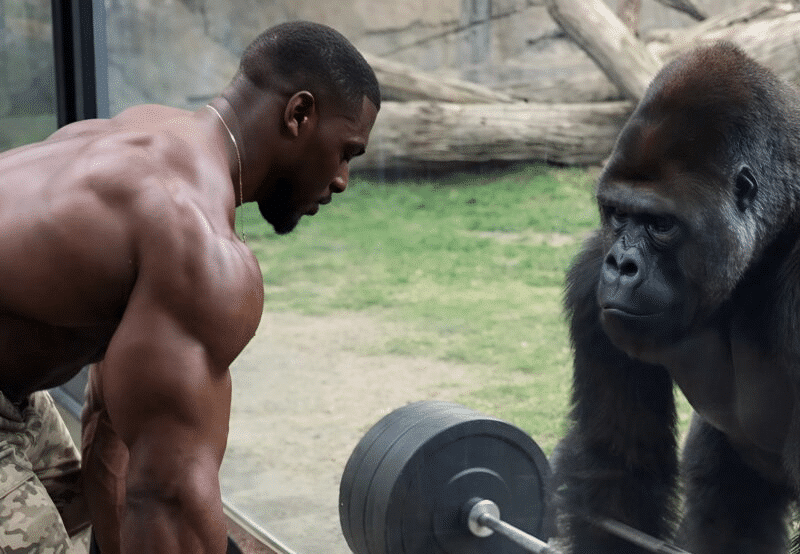
Behind the glass was a massive gorilla, calm and powerful, sitting with the quiet confidence of an animal that had nothing to prove. Its arms were enormous. Its chest was broad. Its eyes were steady and observant.
The athlete stared at the animal and imagined the video before it even happened.
He would lift a heavy barbell.
He would show off his strength.
Then he would challenge the gorilla to copy him.
In his mind, the idea was perfect. Strange enough to go viral. Dramatic enough to attract attention. Funny enough to make people share it. And if the gorilla reacted, the clip could bring millions of views.
But what happened next was not what he expected.
A Stunt Designed for Social Media
In today’s online world, attention can feel like currency.
Views can lead to followers. Followers can lead to sponsorships, advertising revenue, brand deals, and business opportunities. For creators, one viral video can change everything. It can grow a personal brand, increase income, and turn an ordinary moment into a digital asset.
The athlete understood that clearly.
His strength was not only part of his identity. It was part of his business. Every lift, every stunt, and every challenge helped build the image people followed online.
That was why the gorilla seemed like the perfect subject.
The animal was naturally powerful. The setting was unusual. The contrast between human strength and wild strength would immediately grab attention. To the athlete, it was not just a funny idea. It was content.
People nearby began to notice as he set up the barbell. Some whispered. Others pulled out their phones. Cameras started recording from different angles.
The athlete smiled.
He believed he was about to create the kind of video everyone would remember.
He was right — but not for the reason he thought.
The Lift That Started Everything
The athlete stepped toward the barbell with confidence.
He rolled his shoulders, tightened his grip, and took a deep breath. Then he lifted the weight with practiced control. His muscles strained, the crowd watched closely, and the cameras captured every second.
For a brief moment, the scene looked exactly as he had imagined.
He was strong.
He was in control.
He had everyone’s attention.
When he lowered the barbell, he turned toward the gorilla with a proud expression, almost as if saying, “Now it’s your turn.”
The crowd grew quiet.
On the other side of the glass, the gorilla slowly rose and moved closer.
Phones lifted higher.
People leaned forward.
The athlete’s smile widened.
It looked as if the animal might actually respond.
The Gorilla Walks Toward the Bar
The gorilla approached slowly, without excitement or aggression.
It did not rush.
It did not pound the glass.
It did not react like a performer stepping onto a stage.
Instead, it moved with calm authority, as if the entire crowd meant very little to it. The animal glanced at the barbell, then at the athlete, then back at the object lying near the enclosure area.
Everyone waited.
For a few seconds, it seemed like the impossible might happen. Maybe the gorilla would grab the bar. Maybe it would lift it. Maybe it would give the athlete exactly the viral moment he wanted.
The athlete stood frozen, watching.
Then the gorilla did something nobody expected.
It did not lift the barbell.
It did not compete.
It did not perform.
It simply nudged the weight lightly, as if the object had no importance at all.
Then it turned away and walked back toward its shelter.
The Crowd Realizes What Just Happened
For a moment, no one knew how to react.
The athlete stood beside the barbell, waiting for a spectacle that never came. The crowd had expected power, drama, maybe even a shocking display of animal strength.
Instead, they got indifference.
Then the laughter started.
Not cruel laughter at the animal — but laughter at the situation. The athlete had created an entire challenge around the idea that the gorilla would care. He assumed the animal would respond to human pride, human competition, and human performance.
But the gorilla had no interest.
It did not need applause.
It did not need validation.
It did not need likes, shares, comments, or sponsorship deals.
Its strength existed whether anyone recorded it or not.
That quiet refusal became the most powerful part of the entire scene.
The Lesson No One Expected
The athlete had planned to prove something.
He wanted to show that he was strong enough to challenge one of nature’s most powerful animals. He wanted attention, reaction, and a dramatic comparison between human training and animal strength.
But the gorilla’s response changed the meaning of the moment.
By refusing to participate, the animal made the contest look unnecessary. It reminded everyone watching that true strength does not always need to be displayed. Sometimes power is most obvious when it is not performed at all.
The gorilla did not lose the challenge.
It rejected the challenge.
And in doing so, it became the most respected figure in the entire scene.
Real Strength Does Not Always Need an Audience
Modern life often pressures people to prove themselves constantly.
People try to prove success through money, luxury cars, expensive homes, real estate status, fitness transformations, business achievements, banking milestones, and social media attention. Personal finance goals become public comparisons. Strength becomes a performance. Confidence becomes something measured by applause.
But real strength is often quieter than that.
It does not always announce itself.
It does not always compete.
It does not always need to dominate the room.
The gorilla’s calm reaction became a symbol of that truth. The animal had nothing to gain from lifting the barbell. It did not need to impress strangers. It did not need to turn its natural power into entertainment.
It simply walked away.
And somehow, that said more than any dramatic lift could have.
Why Animals Should Never Be Used as Props
The story also carries an important reminder about wildlife respect.
Gorillas are intelligent, emotionally complex, and incredibly powerful animals. They are not props for social media stunts. They are not performers waiting to entertain crowds. They should not be provoked, pressured, or treated as participants in human challenges.
Zoos, wildlife parks, and sanctuaries create barriers and rules for a reason. Those rules protect visitors, staff, and animals. Even when a glass enclosure makes people feel safe, the animal on the other side still deserves space and dignity.
The best way to experience wildlife is through observation and respect.
Not teasing.
Not challenging.
Not trying to force a reaction for views.
In this case, the gorilla’s natural behavior was more meaningful than anything the athlete tried to stage.
A Viral Moment for the Wrong Reason
The athlete wanted a video that made him look impressive.
Instead, the clip became memorable because the gorilla refused to play along.
That is why people connected with the story. It was funny, but also revealing. The animal’s calm dismissal exposed the difference between true power and the need to prove power.
The athlete came with a barbell.
The gorilla came with silence.
The athlete wanted attention.
The gorilla wanted nothing.
And in the end, the one who wanted nothing seemed stronger.
Final Thoughts
What began as a planned social media stunt turned into a lesson nobody expected.
A strong athlete tried to create a dramatic “competition” with a gorilla by lifting a heavy barbell and expecting the animal to copy him. Cameras were rolling, the crowd was watching, and everyone expected a shocking display of strength.
But the gorilla did not perform.
It looked at the barbell, pushed it aside like it meant nothing, and calmly walked away.
That simple response said everything.
Real strength does not always need to be proven. Real confidence does not always seek attention. And wild animals should never be treated as props for human entertainment.
Sometimes the most powerful one is not the one lifting the weight.
Sometimes it is the one wise enough to walk away.