In the quietest hallway of a hospital’s palliative care unit, time seemed to move differently.
The lights were soft. The machines beeped gently. Nurses walked with careful steps, speaking in low voices as families sat beside beds, holding hands, whispering prayers, and trying to make peace with what could not be changed.
In one room near the window lay 82-year-old Alden Pierce.
His body had grown thin after months of cancer treatment. Doctors had been honest with him and his family: the disease had spread too far, and medical options had been exhausted. The goal was no longer cure. It was comfort.
But Alden was not afraid of death in the way people expected.
What weighed on him most was not the machines, the medication, or the approaching silence.
It was Ritchie.
His dog.
His old friend.
The One Name He Kept Whispering
Every afternoon, Alden turned his head toward the window and watched the slice of sky beyond the glass. Sometimes it was blue. Sometimes gray. Sometimes golden with sunset.
And almost every day, he whispered the same name.
“Ritchie…”
The nurses heard it often.
Ritchie was a small, gray-muzzled dog who had been Alden’s companion for years. According to the story, Alden had rescued him when the dog was a frightened stray. Over time, Ritchie became more than a pet. He became routine, comfort, family, and a reason to keep going through lonely days.
They had shared quiet mornings, slow walks, warm afternoons, and evenings on the couch. Ritchie had slept near Alden’s chair, followed him from room to room, and greeted him with the kind of loyalty that never asks for anything except presence.
Now Alden was in the hospital.
And Ritchie was waiting at home.
That was the goodbye Alden could not bear to miss.
A Final Request
One afternoon, Nurse Elena entered Alden’s room to adjust his line and check on him. His hand, fragile and light, closed gently over hers.
“Please,” he whispered. “Let me see Ritchie. Just once.”
Elena paused.
Hospital rules were strict. Animals were not normally allowed in that unit because of infection control, patient safety, allergies, sanitation requirements, and liability concerns. Healthcare facilities must follow policies designed to protect many people at once.
But this request did not feel ordinary.
It was not a casual visit.
It was a final wish.
Elena looked at Alden’s face and understood that this was not simply about a dog. It was about peace. It was about dignity. It was about allowing a dying man to leave this world without feeling that he had abandoned the one loyal companion who had stayed beside him for years.
So she asked.
First the charge nurse.
Then the attending physician.
There were careful conversations. Conditions had to be discussed. Safety had to be considered. But eventually, compassion found a way.
“If it can be done safely,” the doctor said, “bring the dog.”
The Sound of Paws in the Hallway
Two hours later, the usual rhythm of the palliative care unit changed.
There was a soft sound in the corridor.
Claws tapping on tile.
A leash clipped to an old collar.
A quiet, uncertain whine.
Ritchie had arrived.
He was smaller than some of the staff expected. His fur was salted with age, his eyes gentle, and his steps cautious until he reached Alden’s door. Then something changed.
The moment Nurse Elena opened the room, Ritchie did not hesitate.
He moved straight toward the bed.
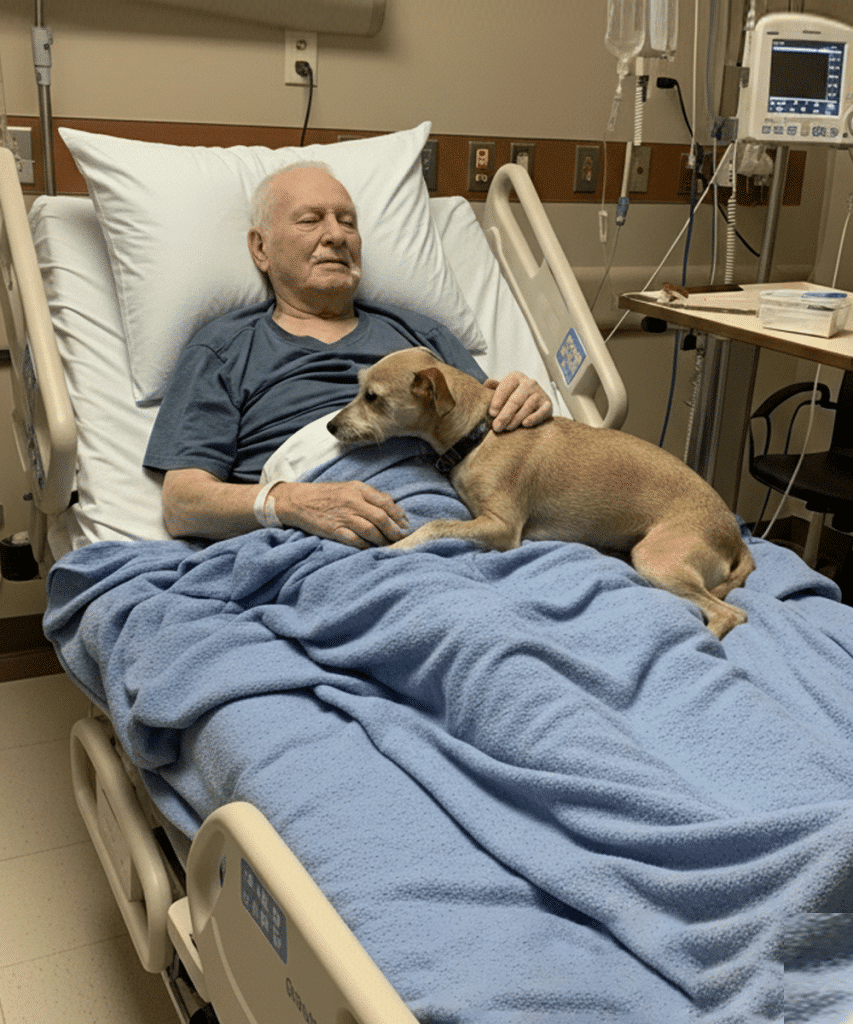
With help from the volunteer, the little dog climbed onto the blanket, circled once, and settled across Alden’s chest as if he had done it a thousand times before.
And perhaps he had.
Maybe not in a hospital bed, but on an old living-room couch. On cold nights. During quiet mornings. In all the small, ordinary moments that make up a life.
Alden’s face changed instantly.
For the first time in days, he smiled.
A Goodbye Without Words
Alden lifted one trembling hand and rested it on Ritchie’s back.
“Forgive me, boy,” he whispered. “I’m sorry I couldn’t come home.”
Ritchie pressed closer.
The room grew still.
No one rushed them. No one treated the moment like an inconvenience. Nurses adjusted their routine quietly, giving Alden and Ritchie the privacy and respect they deserved.
Alden spoke softly to the dog, thanking him for the years, the companionship, the walks, the patience, and the loyalty. His voice was weak, but every word carried meaning.
Ritchie did not answer with words.
He answered by staying.
His breathing settled against Alden’s chest. His head tucked near Alden’s shoulder. His body relaxed in the familiar way of a dog who had finally found his person again.
For a while, the hospital room no longer felt clinical.
It felt like home.
The Nurse Opens the Door
Evening came slowly.
The light through the blinds softened. The hallway quieted. Elena checked on the room once and saw Alden sleeping with his cheek resting against Ritchie’s head.
She could have interrupted.
She did not.
Some moments are too sacred to disturb.
Later that night, Elena returned with fresh saline and a quiet apology already forming on her lips. She turned the handle gently and opened the door.
Then she froze.
The chart slipped from her fingers and fell to the floor.
Alden was still.
His face was peaceful, softened by a faint smile. The monitor beside him showed what the staff had expected, but still never found easy to see.
He was gone.
But Ritchie had not moved.
The little dog remained curled against him, calm and steady, as though he had kept watch through the final breath.
A Peaceful Passing
Nurse Elena stood silently for a moment before calling the care team.
There was no panic. No rushing. No loud voices.
Only reverence.
Alden had passed peacefully, not alone, not frightened, and not separated from the companion he loved most. His final hours were not defined by machines or hospital policy. They were defined by comfort.
For families facing end-of-life care, that kind of peace matters deeply.
Palliative care is not only about medication and symptom management. It is also about emotional well-being, family connection, dignity, and honoring what matters most to the patient. Sometimes that means music. Sometimes it means prayer. Sometimes it means one last conversation.
And sometimes, it means a dog on the bed.
What Happened to Ritchie
The next day, arrangements were made for Ritchie.
A close friend of Alden’s arrived with a familiar leash and a promise that the old dog would not be left behind. The transition was handled gently, with care for both the animal and the memory of the man who loved him.
Ritchie went to a quiet home where sunlight warmed the kitchen floor and someone understood that he had lost more than an owner.
He had lost his person.
In the evenings, he would sometimes lift his head toward the window, as if listening for a voice he still remembered.
The Moment That Changed the Hospital
The story did not end in that room.
According to the account, Alden’s final wish led the hospital to reconsider its policies. Staff began discussing how carefully managed pet visits might help patients near the end of life. Infection control and safety remained important, but so did compassion.
Eventually, new guidelines were introduced allowing certain end-of-life pet visits under controlled conditions.
That kind of change matters.
Healthcare is built on science, training, insurance systems, legal responsibility, and strict procedures. But it is also built on humanity. A hospital can follow every rule and still miss the emotional needs of a patient. The best care recognizes both.
For seniors, families, caregivers, and those planning long-term care, this story also highlights the importance of discussing final wishes early. Healthcare planning, advance directives, palliative care options, insurance coverage, estate planning, and pet care arrangements are all part of preparing with dignity.
These conversations are difficult, but they can protect the people — and animals — we love.
Final Thoughts
Alden Pierce’s final request was simple.
He wanted to see Ritchie one more time.
The hospital could have said no. The policy could have ended the conversation. But Nurse Elena and the care team understood that end-of-life care is not only about extending time. It is about giving meaning to the time that remains.
Ritchie came.
He climbed onto the bed.
He rested against the man who had loved him.
And Alden left this world peacefully, with his loyal companion by his side.
The story is heartbreaking, but it is also beautiful.
Because sometimes compassion is not complicated.
Sometimes it is a nurse who asks one more question.
A doctor who bends a rule safely.
A dog who stays until the very end.
And a final goodbye that changes everyone who witnesses it.