A heavy silence filled the veterinary clinic that morning.
No one spoke above a whisper. Even the staff moved carefully, as if every sound might make the moment harder. Two patrol officers stood quietly against the wall, their hands folded in front of them. A veterinarian reviewed the test results one last time.
Then Officer Alex Voronov walked in carrying Rex, his German Shepherd K9 partner.
Rex had once been strong, alert, and fearless. For eight years, he had served beside Alex through dangerous arrests, search missions, long nights, and moments when trust could mean the difference between life and death.
But now, Rex could barely lift his head.
His breathing was weak. His body was exhausted. The dog who had once charged into danger now rested in his handler’s arms like a tired puppy.
Everyone in the room believed this was goodbye.
This story appears to be an unverified viral animal story rather than a confirmed news report. However, it carries a powerful emotional message about loyalty, veterinary care, and why sudden medical assumptions should always be handled carefully by professionals.
A Partner, Not Just a Dog
To outsiders, Rex may have looked like a police dog.
To Alex, he was family.
They had trained together, worked together, and trusted each other in situations most people never see. Rex had helped search wooded areas for missing people. He had detected hidden substances. He had stood beside Alex during high-risk calls when fear was real and hesitation could be dangerous.
A K9 partner is not simply a tool in uniform.
A dog like Rex learns the rhythm of his handler’s voice, body language, stress, and movement. The handler learns the dog’s signals, alerts, habits, fears, and instincts. Over time, that bond becomes something deeper than command and obedience.
It becomes trust.
That was why Alex could not let go easily.
Even after the veterinarian explained the situation, even after the paperwork was signed, and even after everyone accepted that Rex might be suffering, Alex kept one hand on his partner’s neck.
He knew every breath.
And that morning, the breathing felt wrong.
The Diagnosis No One Wanted
Dr. Elena, the veterinarian, had reviewed Rex’s tests more than once.
Her face was gentle but serious as she explained that Rex’s condition appeared critical. His organs seemed to be failing. Fluid was building in his lungs. His body was becoming too weak to continue.
Alex asked the question every loving pet owner asks when facing the worst moment.
“Is there anything else we can do?”
A surgery.
A new medication.
Another test.
Any chance.
The veterinarian shook her head slowly. If there had been a clear option, she would have offered it immediately. Based on what they believed at the time, continuing might only prolong Rex’s suffering.
The most humane decision, she explained, was to let him go peacefully.
The words landed heavily in the room.
Rex had saved lives.
Now no one seemed able to save his.
A Room Full of Goodbye
One by one, the officers stepped forward.
Each of them touched Rex gently. Some whispered thanks. Others said nothing at all, because there are moments when words feel too small.
Alex leaned close to Rex’s ear.
“You don’t have to fight anymore,” he whispered. “I’m here.”
The veterinarian prepared the injection.
Everything was ready.
Then Rex moved.
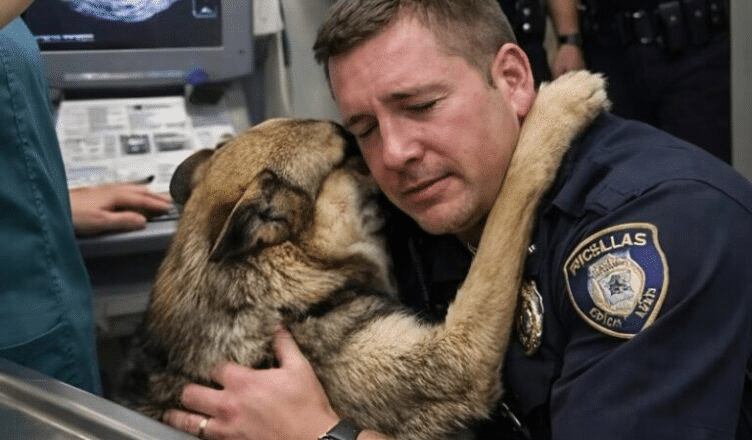
Using what seemed like the last of his strength, the German Shepherd lifted his front legs and placed them around Alex’s shoulders. His body trembled, but the gesture was unmistakable.
It was an embrace.
The room froze.
The officers stopped breathing for a moment. The vet lowered her hand. Alex held Rex tighter, tears filling his eyes.
Rex had never done anything quite like that before.
It felt intentional.
It felt urgent.
And to Dr. Elena, something about the moment did not feel right.
The Vet Notices Something Strange
As she moved closer, the veterinarian paused.
She studied Rex again, not as a patient whose case was already decided, but as a doctor noticing one more detail that needed attention. She placed her hands gently along his body and checked him again.
Then her expression changed.
“Wait,” she said quietly.
The room went completely still.
She asked for the ultrasound machine to be turned on again. The screen flickered to life as everyone watched, afraid to hope and afraid not to.
As she examined the image, her focus sharpened. What she saw did not match the conclusion everyone had accepted only minutes earlier.
According to the story, there was an irregular shadow inside Rex’s body.
Something foreign.
Something hidden.
Something that may have been causing symptoms that looked like organ failure.
A Hidden Cause, Not the End
The veterinarian carefully explained that Rex’s condition might not be the irreversible decline they had feared. Instead, the story suggests that a small metal fragment or foreign object had become lodged inside him, creating severe illness and confusing symptoms.
In real veterinary medicine, foreign bodies can make dogs dangerously sick depending on where they are located and how long they remain undetected. Cornell’s College of Veterinary Medicine notes that gastrointestinal foreign body obstruction in dogs can cause vomiting, loss of appetite, abdominal pain, diarrhea, dehydration, and lethargy, and severe cases can become life-threatening.
The Merck Veterinary Manual also explains that gastrointestinal obstruction in small animals may involve pain, vomiting, diarrhea, electrolyte problems, and serious complications.
That does not mean every case is treatable, and it does not mean a dramatic last-second discovery is common. But it does make the emotional turning point in this story easier to understand: sometimes symptoms can resemble one condition while another hidden cause is responsible.
In Rex’s case, the vet believed there was now a possible path forward.
Surgery.
Risky, urgent, but possible.
Grief Turns Into Hope
The room changed instantly.
Moments earlier, everyone had been preparing to say goodbye. Now the staff moved with urgency. The officers stepped back. Alex held Rex’s head gently, still stunned by what had just happened.
The dog’s paws remained near his shoulders, as if Rex had pulled himself close for one final reason.
Maybe it was comfort.
Maybe it was instinct.
Maybe he was simply reaching for the person he trusted most.
But in that moment, it felt like Rex had asked them not to give up yet.
The veterinarian made it clear: there were no guarantees. Surgery would be difficult. Rex was weak. His recovery would depend on what they found, how much damage had been done, and whether his body could survive the procedure.
But there was a chance.
And sometimes, when everything seems lost, a chance is enough.
Why This Story Touches So Many People
Stories like this resonate because they capture something every pet owner understands.
Animals may not speak our language, but they communicate constantly. They watch us. They sense our moods. They react to pain, fear, danger, routine, and change. Many owners believe their pets know when something is wrong before anyone else does.
A dog does not need words to say, “Stay with me.”
A service dog does not need a voice to show loyalty.
Rex’s embrace, whether viewed as instinct, love, or a final burst of strength, became the emotional center of the story.
It reminded everyone in the room that a working dog is not just a uniformed animal. He is a living partner with trust, memory, and devotion.
A Careful Reminder About Veterinary Decisions
The story is emotional, but it also offers a responsible reminder.
Veterinary decisions, especially end-of-life decisions, are deeply difficult. Families and handlers often face them when a pet is suffering and medical options are limited. These choices should always be made with licensed veterinary professionals, proper diagnostics, and honest conversations about pain, prognosis, quality of life, and treatment risks.
A viral story should never make pet owners feel guilty for making a humane decision when a veterinarian has clearly explained that an animal is suffering.
At the same time, the story reminds us why second opinions, repeated testing, and careful observation can matter in complicated cases.
Veterinary medicine is complex. Symptoms like weakness, breathing difficulty, vomiting, lethargy, pain, or collapse can have many causes. Diagnosis may require bloodwork, imaging, ultrasound, X-rays, physical exams, and sometimes exploratory procedures.
When uncertainty remains, asking questions is not wrong.
It is part of responsible care.
The Cost of Care and the Value of Preparation
Emergency veterinary care can also bring serious financial pressure.
Surgery, imaging, overnight monitoring, medication, and rehabilitation can be expensive. For police departments, K9 units may require budgets for training, equipment, veterinary insurance, liability protection, retirement planning, and emergency care. For families, pet insurance, savings, and preventive checkups can make a major difference when sudden illness strikes.
No one wants to think about medical emergencies before they happen.
But preparation can give owners more options when time matters most.
Rex’s story, though unverified, reminds readers that health care decisions for animals can carry emotional and financial weight. Love may drive the decision, but planning can help make treatment possible.
Final Thoughts
Officer Alex Voronov walked into the veterinary clinic believing he had reached the end with Rex, his loyal K9 partner.
The tests looked grim. The room was filled with goodbye. The final injection had been prepared.
Then Rex lifted himself with the last of his strength and wrapped his paws around his handler’s shoulders.
That gesture made the veterinarian stop, look again, and discover a possible hidden cause behind his condition.
Whether read as an inspirational fictional story or a symbolic reminder of loyalty, the message is powerful:
Do not underestimate the bond between a dog and the person he loves.
Do not ignore small signs when something feels wrong.
And never forget that sometimes, hope appears in the final moment — not loudly, but through one trembling embrace.
Rex did not speak.
He did not need to.
His final gesture said enough.