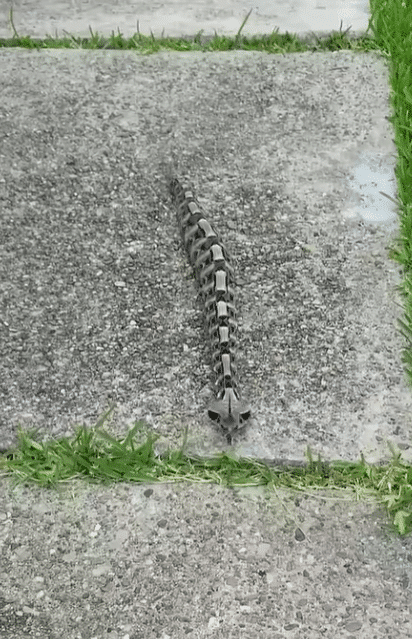
A quiet morning in the yard reportedly turned into a frightening wildlife encounter after a homeowner noticed something unusual lying motionless among the grass and leaves.
At first, the object did not look alive.
Its shape seemed strange. Its pattern looked almost artificial. From a distance, it could have been mistaken for a toy, a piece of fabric, or an oddly colored decoration left outside.
Curious, the homeowner stepped closer.
Then it moved.
That sudden motion changed everything. What had appeared to be a harmless object was actually a snake, perfectly blended into the ground. The person reportedly managed to record a short video before backing away quickly and later uploading the clip online to ask for help identifying the animal.
The answer left viewers stunned.
According to wildlife enthusiasts and reptile experts who commented on the footage, the snake appeared to be a Gaboon viper, one of Africa’s most recognizable and dangerous venomous snakes.
A Snake Almost Impossible to See
The Gaboon viper, known scientifically as Bitis gabonica, is famous for its incredible camouflage. Its body is covered in bold geometric patterns that can resemble dry leaves, bark, shadows, and forest debris. That natural disguise allows it to disappear almost completely on the forest floor.
Britannica describes the Gaboon viper as an extremely venomous but usually docile ground-dwelling snake found in tropical forests of central and western Africa. It can grow up to about 2 meters, or roughly 7 feet, and is considered the heaviest venomous snake in Africa.
That combination of size, stillness, and camouflage is what makes surprise encounters so unsettling. A person may not notice the snake until they are already dangerously close.
In the homeowner’s case, the snake reportedly remained still long enough to be mistaken for an object. Only when it moved did the danger become obvious.
Why Gaboon Vipers Are So Effective at Hiding
Gaboon vipers are ambush predators. Instead of chasing prey over long distances, they rely on patience. They stay motionless, blend into their surroundings, and wait for small animals to come within striking distance.
This strategy works because their camouflage is exceptionally effective. Their patterns break up the outline of the body, making them difficult to spot among fallen leaves and branches.
To humans, that can be dangerous. A snake that does not flee or make noise may go unnoticed in a yard, garden, trail, or wooded area. People can accidentally step too close simply because they never saw it.
That is why experts urge caution around unfamiliar wildlife. If something in the grass looks strange, it is safer to observe from a distance rather than approach or touch it.
Long Fangs and Powerful Venom
Beyond camouflage, the Gaboon viper is known for its long fangs and strong venom. Britannica notes that the species has the longest fangs of any snake, measuring up to about 4 centimeters, or 1.6 inches.
A bite from a venomous snake can be a medical emergency. Venom can cause pain, swelling, tissue damage, bleeding problems, shock, and other serious complications depending on the species, the amount of venom injected, and how quickly treatment begins.
The CDC’s workplace safety guidance for venomous snakes advises people to seek emergency medical care as soon as possible after a bite, take a photo of the snake only from a safe distance if possible, remain calm, and avoid driving themselves to the hospital because dizziness or fainting may occur.
The most important lesson is simple: do not try to handle, move, capture, or kill a venomous snake yourself.
Not Aggressive, But Still Dangerous
Despite their frightening reputation, Gaboon vipers are not known for chasing people. They are generally described as calm or docile unless disturbed. Their main defense is staying hidden.
That does not make them safe.
A snake that feels stepped on, cornered, touched, or threatened may strike quickly. Because the Gaboon viper is large and has long fangs, a defensive bite can be extremely serious.
Many snakebite incidents happen when people get too close, try to take photos, attempt to pick up the snake, or try to kill it. Panic can make a dangerous situation worse.
The safest response is to stop, back away slowly, keep children and pets away, and contact trained wildlife professionals or local authorities.
Why the Video Shocked So Many Viewers
After the homeowner reportedly uploaded the video, many viewers said they would have mistaken the snake for something harmless too. That reaction is understandable. The Gaboon viper’s pattern is so effective that it can appear almost unreal, especially when the snake is motionless.
The clip became fascinating because it showed one of nature’s most powerful survival tools: invisibility through camouflage.
It also frightened viewers because it revealed how close a person can get to danger without realizing it.
For homeowners, gardeners, hikers, and outdoor workers, the story is a reminder to stay alert. A yard may seem familiar, but wildlife can still appear unexpectedly, especially in areas near forests, fields, wetlands, or natural habitats.
What to Do If You See a Snake in Your Yard
If you encounter a snake and cannot identify it, assume it may be dangerous and give it space.
Do not touch it.
Do not throw objects at it.
Do not try to scare it away with a stick.
Do not attempt to capture it for a video.
Do not let pets or children approach.
If the snake is outside and not threatening anyone, it may leave on its own. If it is near a home, walkway, school, business, or area where people may be at risk, call a trained wildlife removal service or local animal authority.
For people living in areas where venomous snakes are present, it is also smart to keep yards maintained. Clear piles of leaves, brush, unused wood, and debris where snakes or rodents may hide. Seal gaps around sheds, garages, and foundations. Use outdoor lighting when walking at night.
Good home safety is part of responsible property care, just like maintaining insurance coverage, protecting real estate value, managing repairs, and planning for emergencies.
If a Snakebite Happens
If someone is bitten by a potentially venomous snake, treat it as an emergency.
Call local emergency services immediately. Keep the person calm and still. Remove tight jewelry or clothing near the bite area before swelling begins. Keep the bitten limb as still as possible while waiting for help.
The CDC advises against trying to capture or kill the snake and recommends seeking medical care quickly. It also warns not to drive yourself after a bite because symptoms can worsen suddenly.
Mayo Clinic similarly advises calling emergency services right away for a venomous snakebite, especially if the area changes color, swells, or becomes painful.
Do not cut the wound, suck out venom, apply ice, or use a tourniquet unless directed by medical professionals. These old methods can make injuries worse.
Why Snakes Still Matter in Nature
Even dangerous snakes play important roles in ecosystems. Gaboon vipers help control populations of rodents and other small animals. By doing so, they contribute to the natural balance of their habitats.
That does not mean people should welcome venomous snakes near homes. It means the safest and most responsible approach is professional removal, not panic or cruelty.
Wildlife should be respected from a distance.
Fear is understandable. But education is more useful than panic.
A Frightening Reminder Hidden in Plain Sight
For the homeowner, the encounter reportedly began with curiosity and ended with relief. They had stepped close to something they believed was harmless, only to learn later that it may have been one of the most dangerous snakes in the region.
The experience could have ended very differently.
But because they backed away instead of touching it, they avoided injury.
That is the real lesson of the story.
Nature is beautiful, but it is not always obvious. Some of its most dangerous creatures survive by staying unseen. The Gaboon viper’s camouflage is remarkable, but it also makes accidental encounters possible.
Final Thoughts
What looked like a strange toy in the yard turned out to be something far more serious. The patterned shape in the grass was reportedly identified as a Gaboon viper, a highly venomous snake known for its leaf-like camouflage, heavy body, long fangs, and patient hunting style.
The homeowner was lucky.
They noticed movement, recorded from a distance, and left before getting hurt.
The story is a powerful reminder to be careful around unfamiliar objects outdoors. If something looks strange, do not touch it. Step back, keep others away, and call professionals when needed.
Sometimes the most dangerous things in nature are not the ones that chase us.
They are the ones we almost do not see.