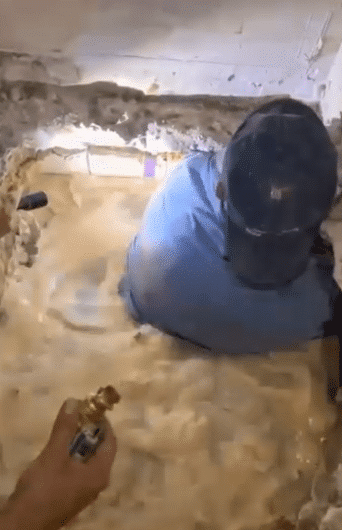
A routine sewer repair in a residential neighborhood reportedly turned into a frightening emergency after a plumber became trapped in thick mud while working inside a maintenance pit.
According to the account, the worker had been called to fix a blocked sewer line after residents reported drainage problems in the area. What appeared to be a standard repair job quickly became dangerous when the ground beneath him shifted, pulling him deeper into mud, water, and sludge.
Neighbors who witnessed the incident said the worker struggled to free himself as the mud tightened around his legs and waist. Within moments, the situation became serious enough for residents to call emergency services.
Fortunately, firefighters and rescue crews responded quickly. After a tense rescue effort using ropes, stabilization equipment, and coordinated extraction techniques, the plumber was pulled from the pit alive and conscious.
He was covered in sludge and visibly exhausted, but authorities reportedly said his injuries were not life-threatening.
The close call has since raised serious questions about underground infrastructure, storm-related soil instability, and the risks faced by utility workers who maintain the systems most people rarely think about.
A Routine Repair Becomes a Rescue Emergency
The incident reportedly began late Tuesday morning after residents noticed sewer and drainage issues on their street. A plumber, believed to be in his 40s, arrived to inspect and clear the blockage.
At first, nothing seemed unusual. Sewer repairs are common in older neighborhoods, especially after heavy rain or recurring drainage problems. Workers may need to access maintenance pits, pipes, or underground utility areas to remove debris and restore flow.
But conditions below the surface can change quickly.
According to witnesses, the plumber entered a deep maintenance pit where water, sludge, and mud had collected. As he worked to clear the obstruction, the soil around him appeared to give way.
One resident described the scene as terrifying, saying the worker started sinking almost immediately.
At first, he was trapped waist-deep.
Then the mud rose higher.
Soon, movement became nearly impossible.
Why Mud Entrapment Is So Dangerous
Being trapped in mud is more dangerous than many people realize. Thick mud can create suction around the body, making it extremely difficult to move or climb out without assistance. The more a person struggles, the more exhausted they can become.
In confined or unstable areas, the risks increase even more.
A worker trapped in mud may face dehydration, breathing difficulty, falling debris, contaminated water exposure, muscle strain, panic, or a secondary collapse of surrounding soil. In sewer environments, there may also be risks from toxic gases, bacteria, sharp debris, and limited oxygen.
That is why rescue crews must move carefully.
Pulling someone out too quickly can cause injury. Disturbing unstable soil can trigger more collapse. Entering the pit without proper equipment can put rescuers in danger too.
In this case, emergency responders reportedly treated the situation as a controlled rescue, not a simple pull-out.
Firefighters Arrive With Specialized Equipment
Residents called emergency services as soon as they realized the plumber could not free himself. Firefighters and rescue personnel arrived with ropes, stabilization tools, and equipment designed for hazardous or confined-space situations.
Rescuers first had to assess the ground around the pit. If the soil was still shifting, they needed to keep it from collapsing further. They also had to protect the worker’s upper body, keep him calm, and create a safe extraction plan.
Using ropes and coordinated support, crews slowly worked him free from the mud.
After roughly 20 minutes, the plumber was successfully removed.
Witnesses said the scene brought visible relief to the neighborhood. The worker was placed on a stretcher, checked by medical personnel, and taken to a hospital for observation.
Worker Expected to Recover
Authorities reportedly said the plumber was conscious and responsive after the rescue. He was expected to recover fully, though he may have suffered bruises, cuts, exhaustion, and possible exposure to contaminated water.
Even when injuries appear minor, medical evaluation is important after a sewer-related incident. Mud, sewage, and debris can expose workers to bacteria and other hazards. Muscle strain and crush-related injuries may also become more noticeable after adrenaline fades.
The outcome could have been far worse.
If residents had not reacted quickly, or if rescue crews had been delayed, the worker could have faced more serious harm.
What May Have Caused the Ground to Give Way
Preliminary explanations suggest that unstable soil, recent rainfall, and aging sewer infrastructure may have contributed to the incident.
Heavy rain can saturate the ground, making soil softer and more likely to collapse around pits, trenches, or underground structures. If a sewer line is old, cracked, leaking, or surrounded by eroded soil, the risk may increase.
Older neighborhoods often have infrastructure that was built decades ago. Over time, pipes can weaken, joints can fail, tree roots can grow through lines, and drainage systems can become overloaded.
When these problems remain unresolved, a routine repair can become a dangerous job.
Officials are reportedly reviewing whether the maintenance pit itself failed, whether surrounding soil collapsed, or whether long-standing drainage issues made the site unsafe.
Residents Say Problems Have Been Building for Years
The rescue has renewed frustration among homeowners who say sewer and flooding issues have affected the neighborhood for a long time.
Some residents described repeated drainage problems after heavy rain. Others said they worry that underground systems are being repaired only after emergencies happen instead of being upgraded before people are put at risk.
For homeowners, failing infrastructure can create major financial stress. Sewer backups, yard erosion, foundation damage, water intrusion, and flooded basements can lead to expensive repairs, insurance claims, mortgage concerns, and long-term property value issues.
When public infrastructure weakens, the impact reaches beyond city budgets.
It affects families, workers, homes, and neighborhoods.
Utility Work Is Essential but Dangerous
The incident is also a reminder of the risks faced by plumbers, utility crews, sewer workers, and maintenance teams.
Most people do not think about underground systems until something stops working. When drains back up, streets flood, or sewer lines fail, workers are expected to respond quickly. But the environments they enter can be dangerous.
Common hazards include unstable soil, confined spaces, low oxygen levels, toxic gases, contaminated water, electrical lines, falling debris, heavy equipment, and unpredictable collapses.
That is why proper safety procedures matter.
Workers should have harnesses, extraction systems, gas monitors, protective clothing, communication equipment, and emergency plans when entering hazardous maintenance areas. Employers and municipalities should also make sure crews receive training and that sites are inspected before work begins.
Worker safety should never be treated as optional.
Infrastructure Investment Is Prevention
Many communities across the country face similar concerns. Sewer systems, drainage pipes, roads, bridges, and underground utilities age quietly until failure becomes impossible to ignore.
Preventive maintenance may not make dramatic headlines, but it saves money and protects lives.
Regular inspections can identify weak structures before they collapse. Drainage upgrades can reduce flooding. Reinforced pits and trenches can protect workers. Emergency response planning can reduce rescue time when accidents happen.
For cities, this is also a financial planning issue. Delaying repairs can lead to larger costs later, including lawsuits, insurance expenses, emergency contracts, property damage, and public safety risks.
Infrastructure is not only concrete, pipes, and soil.
It is the hidden system that keeps neighborhoods livable.
A Community Grateful for a Safe Outcome
For the residents who watched the rescue unfold, the most important fact is that the plumber survived.
A normal workday could have ended in tragedy. Instead, quick-thinking neighbors called for help, emergency crews arrived fast, and a dangerous situation was brought under control.
The incident has left many people grateful, but also unsettled. They now want answers about how the collapse happened and whether other parts of the neighborhood may be at risk.
That concern is understandable.
A worker being pulled into mud during a sewer repair is not something any community wants to see repeated.
Final Thoughts
The reported rescue of a plumber trapped in mud during a sewer repair is a powerful reminder of how dangerous essential maintenance work can be.
What began as a routine call became a serious emergency when unstable ground trapped the worker inside a muddy pit. Thanks to fast action from residents and rescue crews, he escaped without life-threatening injuries.
But the incident should not be ignored.
It raises important questions about aging infrastructure, drainage problems, worker safety, emergency preparedness, and the need for preventative maintenance.
The plumber survived.
Now the community hopes the close call leads to real improvements before another worker is placed in danger.