In the wild, survival is rarely as simple as predator versus prey. Snakes are skilled hunters, known for their patience, speed, and ability to target animals such as rodents, frogs, birds, eggs, and sometimes small reptiles. Turtles, on the other hand, are often seen as slow and vulnerable.
But a viral story about a snake approaching a turtle has captured attention because it flips that expectation.
According to the account, the snake appeared ready to make the turtle its next meal. The turtle seemed trapped near a quiet pond, with little room to escape. But instead of simply hiding or waiting to be attacked, the turtle reportedly began moving in a strange, rhythmic way that caused the snake to hesitate.
The dramatic online version says the snake had to “beg for its life,” but that should be understood as viral exaggeration. Wild animals do not beg in the human sense. What the story really suggests is something more interesting: the turtle may have used a defensive behavior that confused or discouraged the predator long enough to survive.
That makes the encounter less like a cartoon battle and more like a lesson in animal adaptation.
A Quiet Pond Becomes a Survival Scene
The story begins near a forest pond, where a turtle rests close to the water. Nearby, a snake slowly approaches. The snake appears focused, cautious, and confident, as if it has found an easy target.
To many people, the outcome seems obvious. Snakes can be fast. Turtles move slowly on land. A turtle’s best-known defense is its shell, but if the snake can find an opening or attack a smaller turtle, the encounter can still be dangerous.
But nature often refuses to follow simple expectations.
As the snake moves closer, the turtle reportedly does not panic. Instead, it begins an unusual motion, almost like a vibration or repeated body movement. The sudden behavior appears to disrupt the snake’s approach, causing it to pause and reassess.
That moment is what made the story spread online.
People love wildlife encounters where the underdog survives—not through size or strength, but through instinct.
Can Turtles Really Defend Themselves?
Turtles are not helpless. Although they are slower than many predators, they have several defenses that help them survive.
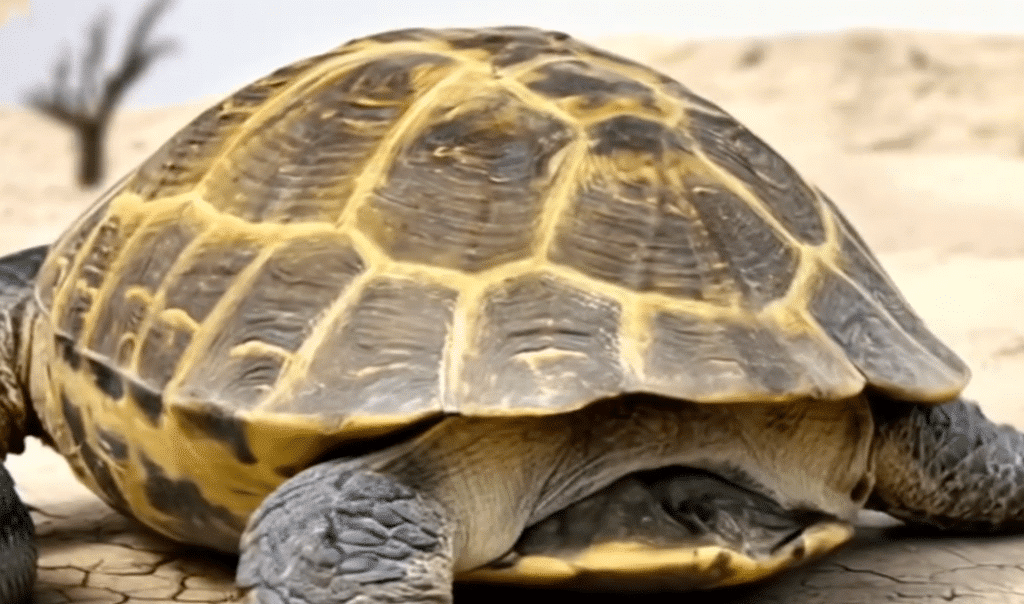
Their shells are the most obvious protection. As turtles grow, the hard shell can make them much harder for predators to eat. Sea turtle conservation groups note that adult turtles are generally better protected from predators because of their hard shells, even though hatchlings remain highly vulnerable.
Many freshwater turtles also use behavior to survive. Some retreat quickly into water. Others pull into their shells, hiss, bite, snap, scratch, or release unpleasant odors when threatened. Britannica notes that musk turtles and mud turtles can release a foul-smelling fluid that likely makes them less appealing to predators.
So while the viral version may dramatize the turtle’s reaction, the broader idea is true: turtles have more survival tools than many people realize.
Why a Snake Might Hesitate
Snakes do not always attack immediately. Like many predators, they assess risk. A potential meal that seems too difficult, too dangerous, or too unpredictable may not be worth the energy or injury risk.
Snakes are also sensitive animals that respond to movement, vibration, smell, heat, and visual cues. Research on snake behavior shows that snakes can display cautious and defensive behaviors such as freezing, hissing, fixation, head jerks, and other reactions when processing possible threats.
That means a sudden movement from a turtle could make a snake pause. The snake may not be frightened in a human emotional sense, but it may become uncertain. In the wild, uncertainty matters. A predator that misjudges a situation can be bitten, injured, or waste valuable energy.
For a turtle, even a brief hesitation can create a chance to escape into water or retreat into its shell.
The Viral Claim Needs Caution
The phrase “snakes eat turtles, but when they see a turtle doing this, they have to beg for its life” is designed to grab attention. It is dramatic, emotional, and easy to share.
But it is not scientific wording.
There is no reliable evidence that snakes “beg” turtles for mercy. That kind of language gives human thoughts and emotions to animals in a way that may be entertaining but not accurate. A more realistic explanation is that the snake paused, retreated, or decided the turtle was not worth attacking.
This distinction matters, especially for wildlife content. Nature is already fascinating without exaggeration. Animals do not need to behave like humans to be remarkable.
The true story is still powerful: a slower animal may survive because it has defenses predators must respect.
Nature’s Survival Strategies Are Full of Surprises
Predator-prey relationships are complex. Strength does not always guarantee success, and vulnerability does not always mean defeat.
Some animals survive through camouflage. Others survive by speed, venom, armor, group behavior, bad taste, loud sounds, or sudden movements. Even snakes use defensive strategies. Tail vibration, for example, is a known behavior in some snakes, where they rapidly vibrate the tail as a defensive response to a possible predator.
This shows that survival is not only about attack. It is also about communication, warning, confusion, and risk avoidance.
A predator does not want to get injured. A prey animal does not need to win a fight. It only needs to survive the moment.
That is what makes these encounters so interesting.
Why People Love Stories Like This
Wildlife stories often go viral because they challenge assumptions. People expect snakes to dominate. They expect turtles to hide. When the story reverses those roles, it becomes surprising.
There is also an emotional reason people connect with it. The turtle becomes a symbol of resilience. It appears smaller, slower, and less threatening, yet it finds a way to survive.
That kind of story resonates far beyond the pond.
In human life, people often admire those who overcome disadvantage through patience, intelligence, and timing. Whether in personal finance, business, real estate, banking, insurance, or long-term investing, success is not always about being the biggest or fastest. Sometimes survival depends on smart decisions, careful risk management, and knowing when to hold your ground.
Nature shows that lesson in its own way.
Respect Wildlife From a Distance
Stories like this can be fascinating, but they also remind us not to interfere unnecessarily with wild animals. Snakes and turtles both play important roles in ecosystems.
Snakes help control populations of rodents, frogs, and other animals. Turtles help maintain aquatic environments by feeding on plants, insects, carrion, and small organisms, depending on the species. Both are part of the natural balance.
If you see a snake and turtle interacting in the wild, the safest choice is to observe from a respectful distance. Do not pick them up, separate them, or attempt to stage a video. Interfering can harm the animals and may put people at risk.
Wildlife should not be treated as entertainment props.
The best way to appreciate nature is to let it remain natural.
The Bigger Lesson: Never Underestimate Adaptation
The most important takeaway from this story is simple: animals survive in ways we do not always expect.
A turtle may look slow, but it has armor, instinct, and defensive behaviors. A snake may be a skilled predator, but it still has to calculate risk. Every encounter in nature is shaped by energy, danger, timing, and opportunity.
That is why the pond scene fascinated so many people. It reminded viewers that the wild is not predictable. A creature that seems weak can still have a strategy. A predator that seems unstoppable can still choose caution.
Nature is not a simple contest of power.
It is a constant negotiation of survival.
Final Thoughts
The viral story of a snake approaching a turtle has captured attention because it turns a familiar predator-prey expectation upside down. While the claim that the snake “begged for its life” is clearly dramatic, the deeper idea is believable: turtles are not defenseless, and predators often retreat when prey becomes too difficult or unpredictable.
The turtle’s strange movement, shell, and defensive instincts may have been enough to make the snake hesitate.
And in the wild, hesitation can mean survival.
Sometimes the slowest creature in the scene is not the weakest.
Sometimes it is simply waiting for the right moment to prove otherwise.