What began as an urgent rescue in the waters off South Africa became a moment that stunned everyone involved.
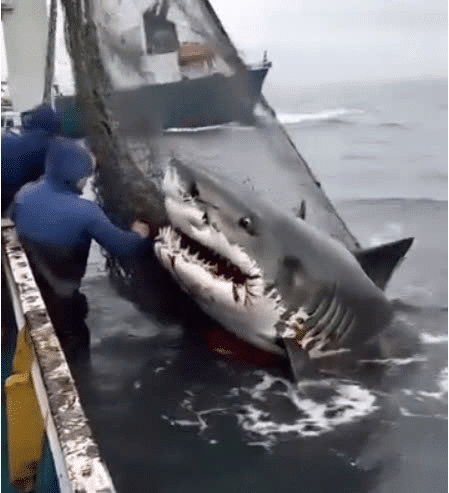
According to the account, a local fisherman first noticed something unusual in the distance. A large shark was struggling near the surface, tangled in a thick mass of discarded fishing net. Its movements were weak and uneven. Every attempt to escape seemed to pull the net tighter around its body.
The animal was reportedly a great white shark, nearly four meters long. In the open ocean, it would normally be one of the most powerful predators on Earth. But trapped in human-made debris, even its strength was not enough.
The fisherman quickly alerted a marine rescue team, and Dr. Emily Carter, a marine biologist experienced in shark behavior and ocean conservation, was called to help.
The mission was dangerous from the beginning.
The team had to save a distressed wild predator without injuring it, frightening it, or putting themselves in harm’s way. One wrong move could have turned the rescue into a tragedy.
A Powerful Predator Made Helpless
When the rescue vessel reached the area, the team saw just how serious the situation was. The shark was wrapped in heavy netting that had cut into parts of its body. Its dorsal fin struggled to stay above the water, and its movements appeared slow from exhaustion.
The scene was heartbreaking.
Sharks are often portrayed as frightening creatures, but this moment showed a different reality. The animal was not attacking. It was not hunting. It was trapped, tired, and fighting to survive.
For the rescuers, time mattered. If the net remained wrapped around the shark, it could cause deeper injuries, restrict movement, prevent normal swimming, or eventually lead to death.
But getting close was risky.
A shark of that size can react with incredible force, especially when scared. Even a sudden movement of its body or tail could seriously injure a person or damage a small boat.
A Careful Plan Before the Rescue
Before approaching, Dr. Carter reportedly briefed the team carefully. Their goal was not to overpower the shark. Their goal was to reduce stress, move slowly, and remove the net with as little disturbance as possible.
The team prepared cutting tools, long poles, ropes, and safety equipment. They launched a smaller dinghy so they could get closer without bringing the larger vessel too near the trapped animal.
Every person had a role.
One watched the shark’s movement.
One monitored the boat’s position.
Others prepared to cut the netting piece by piece.
There was no room for panic.
Wildlife rescue requires more than courage. It requires training, patience, risk management, and respect for the animal. In a situation like this, bravery without caution can be dangerous.
The Shark’s Strange Calm
As the dinghy moved closer, the rescuers expected the shark to thrash or attempt to escape. Instead, according to the account, the shark stayed unusually still.
Its eyes followed the team’s movements. Its body remained tense but controlled. The calm did not mean the situation was safe, but it gave the rescuers a chance.
They began cutting the net carefully.
Strand by strand, the heavy material started to loosen. The work was slow and stressful. The team had to avoid cutting the shark while also keeping their hands and tools away from danger.
Minutes felt much longer.
The ocean around them was quiet except for the sound of water against the dinghy and the sharp snap of netting being cut away.
Each piece removed brought the shark closer to freedom.
The Moment Everything Changed
Just as the final sections of netting were nearly gone, the shark suddenly exploded into motion.
Its body thrashed violently, sending water crashing against the dinghy. The small boat rocked hard as the crew grabbed the sides and struggled to keep their balance.
For a few terrifying seconds, everyone understood the risk they had taken.
This was the unpredictable moment every wildlife rescuer prepares for: a powerful animal regaining movement and reacting from fear, pain, or instinct.
The shark’s tail struck the water with tremendous force. Waves slammed into the boat. The team pulled back, giving the animal room.
Then, as suddenly as it began, the chaos stopped.
The shark was free.
What Happened Next Stunned the Crew
Most people would expect a freed shark to disappear immediately into deeper water. After all, it had just survived a terrifying experience.
But according to the story, the shark did not leave right away.
Instead, it slowly circled the dinghy.
Its movements were calm, smooth, and controlled. The rescuers watched in silence as the great white moved around them once, then again, before turning toward open water.
No one claimed to know exactly what the shark was thinking. Wild animals should not be treated as if they respond like humans. But to those who witnessed the moment, the behavior felt meaningful.
It felt almost like acknowledgment.
Then, with one powerful movement of its tail, the shark swam away into the blue water.
The rescue was over.
The Hidden Threat of Ghost Nets
Beyond the emotional moment, this story carries an important environmental message. Discarded fishing gear, often called “ghost nets,” is one of the most dangerous forms of ocean pollution.
These nets continue trapping marine animals long after they are abandoned. Sharks, dolphins, seals, turtles, rays, seabirds, and fish can all become tangled. Some suffer injuries. Others drown, starve, or become unable to hunt.
Ghost nets are especially dangerous because they are nearly invisible underwater and can drift for long distances. They do not stop catching animals simply because fishermen no longer use them.
This is why marine conservation groups continue to push for better waste management, responsible fishing practices, recycling programs, tracking of fishing gear, and stronger environmental policies.
The ocean may look vast, but human decisions reach farther than many people realize.
Why Shark Conservation Matters
Sharks play a critical role in marine ecosystems. As top predators, they help maintain balance by influencing the behavior and population health of other species. When shark populations decline, the effects can spread through the food chain.
Unfortunately, sharks face many threats, including bycatch, illegal fishing, pollution, habitat loss, and fear-driven misunderstanding.
Stories like this help change the way people see them.
A shark trapped in a net is not a movie monster. It is a living animal caught in a crisis created by human waste. Saving it is not only an act of compassion. It is part of protecting the health of the ocean.
Conservation Is Also a Long-Term Investment
Protecting marine life requires planning, funding, and accountability. Rescue missions depend on boats, fuel, equipment, trained experts, insurance coverage, emergency response systems, research, and public support.
In that way, conservation is similar to responsible personal finance or long-term investing. The decisions made today shape future outcomes. Ignoring environmental problems can create larger costs later, from damaged fisheries to reduced tourism, weakened coastal economies, and expensive cleanup efforts.
Healthy oceans support food systems, travel, local businesses, real estate values in coastal communities, and global environmental stability.
When marine ecosystems suffer, people eventually feel the impact too.
A Reminder About Human Responsibility
The most powerful part of this story is not only that the shark survived. It is that the crisis was caused by human debris—and solved by human compassion.
People created the danger.
People also stepped in to help.
That contrast is important. It shows that our actions can harm the natural world, but they can also repair some of the damage when we choose responsibility over neglect.
The rescue team did not see a predator to fear.
They saw an animal in distress.
That perspective made all the difference.
Final Thoughts
The rescue of the shark tangled in fishing nets began as a dangerous mission and ended as an unforgettable moment.
A powerful animal was trapped, exhausted, and running out of time. A team of rescuers approached carefully, cut through the netting, and gave it a second chance at life.
Then, after a violent burst of movement, the shark did something unexpected.
It circled the boat before swimming away.
Whether it was instinct, confusion, or something deeper, the moment left the rescuers emotional and amazed.
This story is a reminder that the ocean is full of life we still do not fully understand. It also reminds us that respect, caution, and compassion can change the outcome of even the most dangerous situations.
Sometimes rescue means stepping into uncertainty.
And sometimes, the wild answers back in a way no one forgets.