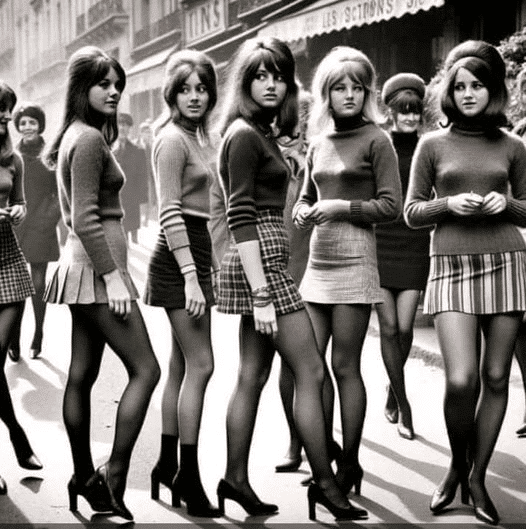
At first glance, the photo looks like a perfect snapshot from the 1970s. The colors feel soft and faded. The fashion looks relaxed and familiar. The overall mood carries the warmth of an old family album, the kind of image that makes people think about simpler days, vintage style, and memories captured long before smartphones and social media.
Nothing seems unusual.
Nothing appears shocking.
But then people looked closer.
What seemed like an ordinary throwback photo slowly turned into a viral mystery after viewers noticed one strange detail that did not seem to belong. It was not loud or obvious. It was not something most people caught immediately. But once someone spotted it, the entire image felt different.
That is what made the photo so fascinating.
It reminded people that sometimes the most interesting part of an image is not what you notice first. It is what you almost miss.
A Photo That Feels Completely Normal
Part of the reason this image caught so much attention is because it appears so natural. Photos from the 1970s often have a distinct charm. The lighting is softer. The clothing is more casual. The backgrounds tend to feel less staged than modern photos.
There is no heavy editing, no obvious filter, and no carefully curated social media pose.
That nostalgic quality makes viewers lower their guard. They expect to see a normal moment from the past: people standing together, a simple room, a family scene, or a casual outdoor snapshot.
And for the first few seconds, that is exactly what the image seems to be.
But viral photo puzzles work because they challenge that first impression. They invite people to slow down, scan the details, and ask whether everything in the scene truly fits.
The Detail That Makes People Look Twice
The strange part of the photo is reportedly subtle enough to escape notice at first. It may be something in the background, an object that does not match the time period, a reflection that seems wrong, a person’s posture, a shadow, or a modern-looking detail that appears out of place in a vintage setting.
Whatever the exact clue is, viewers say the effect is the same: once you see it, the image changes.
That is the power of a hidden-detail puzzle. The photo does not need to be dramatic. It only needs one element that disrupts the illusion of normalcy.
A 1970s image should feel consistent. The clothes, furniture, colors, technology, hairstyles, and surroundings should all belong to the same era. When one detail does not match, the brain notices the contradiction—even if it takes time.
That small inconsistency is what turns a regular throwback picture into an online mystery.
Why Hidden Details Go Viral
Images like this perform well online because they invite participation. Viewers are not simply looking at a photo. They are being challenged to solve something.
That makes people stay longer, zoom in, read comments, compare guesses, and share the image with others. Some people spot the odd detail quickly. Others stare for several minutes and still cannot find it.
That difference creates conversation.
People enjoy testing their observation skills. They like the feeling of discovery. They also like being part of a shared challenge, especially when the answer is hidden in plain sight.
This is why “spot the mistake” photos, hidden-object puzzles, optical illusions, and vintage-photo mysteries spread so quickly. They are simple, interactive, and easy to share.
Why the 1970s Setting Adds to the Mystery
A modern photo with one strange detail may be interesting, but a vintage-style image adds another layer. Viewers already have expectations about what belongs in the 1970s and what does not.
A smartphone, a modern logo, a certain type of shoe, a recent appliance, a digital watch, or an object from a later decade would immediately feel suspicious. Even small differences in design can stand out when placed in the wrong era.
That is why the time period matters.
The 1970s had its own visual language: patterned clothing, wood-paneled rooms, older cars, analog technology, warm color tones, and simpler household items. When a detail breaks that pattern, it creates a sense of unease.
It does not have to prove anything supernatural or dramatic. It simply makes people ask, “Wait… why is that there?”
Our Brains Often Miss What Does Not Fit
One reason these puzzles work is because humans do not notice everything in a scene equally. Our brains prioritize the main subject first: faces, bodies, bright colors, movement, and central objects.
Background details often get ignored.
That means something unusual can sit in plain sight while viewers focus on the obvious parts of the photo. Only after someone points out the odd detail does it become impossible to ignore.
This is similar to how people sometimes miss small but important details in everyday life. In personal finance, a hidden fee in a loan agreement can be easy to overlook. In banking, one unusual transaction may go unnoticed until later. In real estate, a small issue during inspection can become expensive if ignored. In insurance, fine print can matter more than people realize.
The lesson is the same: details matter.
A Simple Image With a Bigger Message
The viral reaction to this 1970s photo shows how powerful curiosity can be. People are naturally drawn to mysteries, especially when they feel solvable. A single photo can create debate, speculation, and excitement simply by making viewers question what they are seeing.
It also shows how nostalgia can make people less suspicious. When an image feels familiar and comforting, we may not examine it closely. We accept the scene because it matches what we expect from the past.
But one misplaced detail can break that comfort.
Suddenly, the photo is no longer just a memory.
It becomes a puzzle.
Final Thoughts
This viral 1970s-style photo proves that ordinary images can hide surprising details. At first, it looks like a simple throwback: calm, nostalgic, and completely normal.
Then viewers notice the one thing that does not belong.
That small clue changes the entire experience. It turns passive scrolling into active searching. It reminds us to slow down, look carefully, and question what we might have missed.
Sometimes the mystery is not in the center of the picture.
Sometimes it is tucked into the background, waiting for someone patient enough to find it.
So take another look.
The strange detail may be right there in front of you.