A simple photo of a parked SUV recently became the center of a heated online conversation after a Reddit user shared an image of a message written across the vehicle’s rear window. At first glance, there was nothing especially unusual about the SUV itself. It looked like any other vehicle parked in a public space.
But the words on the back window immediately caught people’s attention.
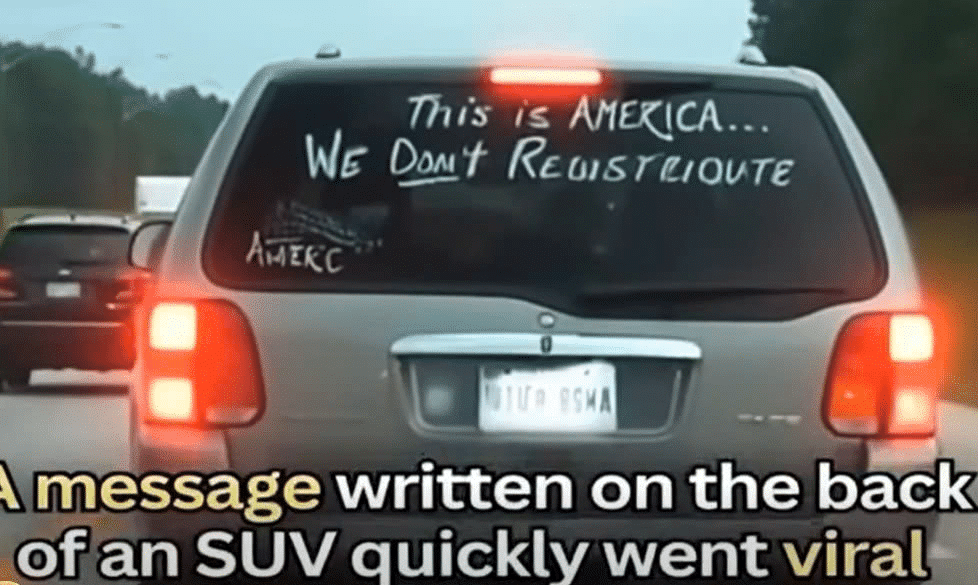
The message read:
“This is America… we don’t redistribute wealth — we earn it.”
That single sentence was enough to spark thousands of reactions. Some praised it as a strong statement about hard work and personal responsibility. Others criticized it as an oversimplified view of wealth, opportunity, and economic inequality.
What began as a photo of a vehicle quickly turned into a broader discussion about finance, personal success, social policy, and what people believe the American Dream should mean today.
Why the Message Got So Much Attention
Part of the reason the photo spread so quickly was the directness of the statement. It was short, bold, and easy to understand. It did not include a long explanation or context. It simply made a claim and allowed people to react.
That kind of message often performs well online because it invites disagreement. People do not just read it and move on. They respond emotionally, especially when the topic touches on money, taxes, wealth, business, banking, loans, personal finance, or government policy.
For many people, wealth is not an abstract topic. It affects their rent, mortgage, insurance premiums, grocery bills, credit card debt, retirement savings, student loans, and ability to build a stable future. So when a public message makes a statement about who “earns” wealth, people naturally connect it to their own lives.
That is why the SUV photo became more than a viral image.
It became a debate.
Supporters Saw It as a Message About Hard Work
Many people who agreed with the message said it reflected a belief in personal responsibility. To them, the statement represented the idea that people should work hard, build skills, take risks, and earn success rather than expect government systems to redistribute income.
Supporters connected the words to the traditional idea of the American Dream: the belief that anyone, regardless of background, can improve their life through effort, discipline, and determination.
Some commenters shared personal stories about working long hours, starting small businesses, paying off loans, saving carefully, investing wisely, or building real estate wealth over time. For them, the message felt like a defense of ambition and independence.
They argued that success should be rewarded, not punished. They also expressed concern that too much redistribution could reduce motivation, increase dependence, or place unfair pressure on people who have worked hard to build financial stability.
From that perspective, the SUV message was not offensive.
It was honest.
Critics Said the Message Ignored Unequal Starting Points
Others saw the message very differently.
Critics argued that the statement reduced a complicated issue into a slogan. They pointed out that people do not all begin life with the same resources, opportunities, education, family support, health, safety, or financial stability.
A person born into a wealthy family may have access to better schools, safer neighborhoods, professional networks, inheritance, investment guidance, and help with college tuition or a first home. Another person may begin adulthood with debt, medical bills, unstable housing, limited banking access, or no financial safety net.
To critics, saying “we earn it” ignores the structural differences that shape financial outcomes.
They also argued that many public systems already support wealth creation, including roads, schools, courts, emergency services, public universities, business incentives, tax benefits, mortgage programs, and financial regulations. In their view, the debate is not simply about taking from one person and giving to another. It is about how society creates fair opportunity and basic stability.
For them, the SUV message felt incomplete.
A Bigger Debate About Wealth and Fairness
The viral reaction shows how deeply divided people can be when discussing wealth. Terms like “redistribution” can mean different things depending on who is using them.
To some, redistribution means unfairly taking money from people who earned it. To others, it means using tax policy and public programs to support education, healthcare, infrastructure, housing, and economic opportunity.
These debates affect nearly every part of public life. They influence decisions about tax rates, social programs, student loans, healthcare costs, retirement benefits, business regulation, cryptocurrency policy, real estate affordability, banking access, and insurance coverage.
That is why a few words written on a car window could create such a strong reaction.
The message touched a nerve because it connected to one of the most personal questions in modern life:
What does a fair economy look like?
The American Dream Means Different Things to Different People
The phrase “American Dream” often appears in debates like this, but people define it differently.
For some, it means individual achievement. Work hard, take responsibility, avoid excuses, and build the life you want. This version emphasizes personal discipline and the freedom to rise through effort.
For others, the American Dream means fair access to opportunity. It means people should not be blocked by poverty, discrimination, unaffordable healthcare, poor schools, or inherited disadvantage before they even have a chance to succeed.
Both views are deeply emotional because both are connected to real experiences.
Someone who built a business from nothing may strongly believe success comes from sacrifice and persistence. Someone who worked just as hard but still struggled because of medical debt, low wages, or limited opportunity may see the issue differently.
That is why the online conversation became so intense.
People were not only reacting to the SUV.
They were defending their own understanding of life.
Why Viral Messages Can Be Powerful
The SUV photo is also a reminder of how modern media works. A statement that might once have been seen only by people walking through a parking lot can now spread across Reddit, Facebook, X, TikTok, and news-style websites within hours.
Once shared online, the message no longer belongs only to the person who wrote it. It becomes public content. People screenshot it, repost it, analyze it, criticize it, and use it to support larger arguments.
That is the power of a simple visual message.
It does not need a celebrity, a major event, or a formal campaign. Sometimes a few words on glass are enough to start a national conversation.
The Financial Reality Behind the Debate
Whether people agreed or disagreed with the message, the discussion revealed something important: many Americans are thinking seriously about money and fairness.
Households are dealing with inflation, rent increases, mortgage rates, credit card debt, student loans, insurance costs, medical expenses, and retirement planning. Business owners are thinking about taxes, payroll, loans, regulations, and long-term financial security.
In that environment, statements about wealth can feel personal.
People want to know whether hard work still leads to stability. They want to know whether the financial system rewards effort fairly. They want to know whether opportunity is truly open to everyone.
Those questions cannot be answered by one slogan. But one slogan can bring them to the surface.
Final Thoughts
The SUV window message went viral because it said something simple about a very complicated issue.
“This is America… we don’t redistribute wealth — we earn it.”
To supporters, it represented hard work, independence, and personal responsibility. To critics, it ignored inequality, unequal opportunity, and the realities of modern economic life.
Both reactions show how powerful money-related beliefs can be.
The SUV itself was just a vehicle. But the message on its window became a symbol of a larger debate about success, fairness, finance, and the American Dream.
Sometimes a conversation does not begin in a courtroom, a bank, a political debate, or a business conference.
Sometimes it begins with a few words written on the back of a car.