For many people facing serious illness, treatment is not only physically exhausting. It can also take an emotional toll that is difficult to explain. Chemotherapy, medical appointments, hospital bills, insurance paperwork, and the uncertainty of recovery can make daily life feel overwhelming.
But sometimes, one act of kindness can bring light into an otherwise painful moment.
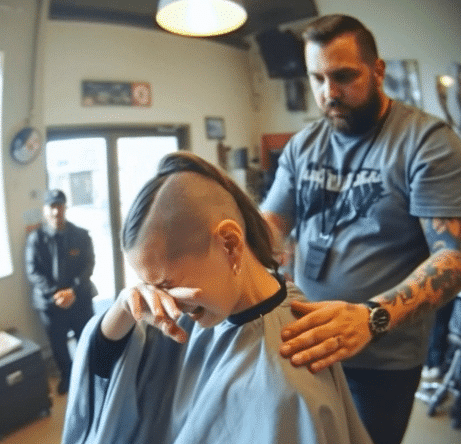
That is what happened when a young woman walked into a small barbershop after chemotherapy and quietly asked for her remaining hair to be shaved off. Her hair had already started falling out in clumps. Each morning, she saw more strands on her pillow, in her brush, and in her hands. The sight had become too painful to bear.
By the time she entered the shop, she was exhausted.
She sat in the chair, looked at the barber she had known for years, and whispered the request she had been dreading.
“I can’t bear it anymore. Please shave it all off.”
A Moment Filled With Pain
The barber, Jake, did not ask unnecessary questions. He simply nodded with quiet understanding.
He had known her long enough to understand that this was not just a haircut. It was a moment of grief, fear, and surrender. Losing hair during treatment can feel deeply personal. For many patients, it becomes one of the most visible reminders of illness.
As the clippers turned on, the room grew quiet.
The first strands fell to the floor.
Then more.
The young woman watched in the mirror as her reflection changed. Tears rolled down her cheeks. She tried to stay still, but her hands trembled in her lap.
This was not vanity. This was identity. It was the painful feeling of watching a familiar part of herself disappear because of a fight she never asked for.
Everyone in the barbershop seemed to feel the weight of the moment. Conversations faded. Customers stopped joking. The usual warmth and noise of the shop gave way to silence.
No one knew what to say.
The Barber’s Quiet Decision
Jake continued carefully, making sure to move gently and respectfully. When he noticed her crying, he paused and rested a hand on her shoulder.
It was a simple gesture, but it said what words could not.
Then he did something no one expected.
He picked up another pair of clippers, turned toward the mirror, and began shaving his own head.
There was no speech.
No announcement.
No attempt to draw attention to himself.
He simply stood beside her and let his own hair fall to the floor.
The message was clear: you are not alone.
For the young woman in the chair, the shock of that gesture cut through the sadness. She stared at him in disbelief as his hair disappeared just like hers.
A Chain Reaction of Kindness
Within moments, the other barbers understood what Jake was doing.
One looked at another.
Then another picked up clippers.
Soon, the sound of buzzing filled the shop again. But this time, the sound no longer felt like loss. It felt like support.
One by one, the barbers shaved their heads in solidarity. Hair of different colors and textures fell to the floor beside hers. Men who had spent years shaping the appearance of others were now giving up their own hair to make sure one woman did not feel alone in her most vulnerable moment.
Some smiled gently.
Some wiped their eyes.
Some said nothing at all.
But every action carried meaning.
The young woman’s tears continued, but they changed. They were no longer only tears of heartbreak. They became tears of gratitude, relief, and connection.
From Shame to Strength
When the clippers finally stopped, the room looked different.
The floor was covered with hair, but the atmosphere had shifted completely. What began as a painful reminder of illness had become a symbol of unity.
The woman looked into the mirror again.
At first, she had feared what she would see. She expected loss. She expected sadness. She expected to feel less like herself.
But now, surrounded by people who had chosen to stand with her, she saw something else.
She saw courage.
She saw survival.
She saw a person still worthy of love, respect, and dignity.
Jake, now bald like the others, smiled softly and said, “We’re all in this together.”
For the first time in a long while, she smiled too.
More Than a Haircut
That visit to the barbershop became much more than a grooming appointment. It became a turning point.
The young woman had walked in feeling broken by what illness had taken from her. She left knowing that even in the hardest moments, she did not have to carry everything alone.
The cool air touched her bare scalp as she stood up from the chair. Instead of feeling exposed, she felt lighter. The fear was still there. The treatment was still part of her life. The future still held uncertainty.
But something had changed.
She had been reminded that compassion can restore strength in ways medicine alone cannot.
Why Small Acts Matter During Illness
Serious illness affects more than the body. It affects confidence, relationships, work, finances, and emotional well-being. Families may have to manage health insurance claims, medical bills, transportation costs, lost income, loans, caregiving schedules, and personal finance decisions while also trying to stay hopeful.
In the middle of all that stress, emotional support matters.
A kind gesture may not change a diagnosis, but it can change how someone feels while facing it. It can remind them that they are more than their illness. It can help them feel seen instead of pitied, supported instead of isolated.
Jake and the other barbers did not need a grand plan. They did not need expensive gifts or perfect words.
They simply chose to stand with her.
And that was enough.
A Lesson in Human Connection
This story resonates because it shows the power of quiet compassion. The barber did not try to erase her pain or pretend everything was fine. He acknowledged her struggle by sharing a small part of it.
That kind of empathy is rare and powerful.
It reminds us that support does not always require advice. Sometimes it means sitting beside someone. Sometimes it means listening. Sometimes it means taking action in a way that says, “You do not have to go through this by yourself.”
In a world often focused on appearance, status, banking, real estate, career success, and financial achievement, moments like this bring us back to what matters most: kindness, dignity, and human connection.
Final Thoughts
The young woman entered the barbershop heartbroken, ready to remove the hair that chemotherapy had already begun taking from her. She expected the moment to be painful and lonely.
Instead, her barber turned it into a moment of solidarity.
Then the entire shop followed.
What could have been remembered only as a day of loss became a memory of love, support, and courage.
No dramatic speech was needed.
No perfect words were required.
Just clippers, compassion, and a room full of people willing to say through their actions:
You are not alone.