The first thing anyone noticed about Marnie was not her missing leg.
It was her energy.
Her curiosity.
And the bright expression that appeared whenever something interesting entered the room.
Marnie had lost her front left leg.
Her body moved differently from that of most cats.
But she never seemed interested in allowing that difference to become the center of her life.
She was far too busy exploring.
Following sounds.
Chasing toys.
And turning ordinary moments into small adventures.
Watch her for only a few minutes, and it became easy to forget she had ever faced a physical challenge at all.
Marnie was not a sad cat waiting to be admired for surviving.
She was playful.
Confident.
And wonderfully determined to enjoy every day placed before her.
A Life That Changed Before Safety Arrived
Life had not always been gentle with Marnie.
At some point before she found a safe home, she suffered a serious injury to her front leg.
No one could explain every detail of what had happened.
But the damage was severe enough that saving the limb was no longer the kindest option.
Veterinary care focused on protecting her comfort and giving her the best possible quality of life.
Removing a leg is never a decision made lightly.
It permanently changes the way an animal balances, lands, climbs, and walks.
But sometimes, letting go of an injured limb is what allows the rest of the body to heal.
For Marnie, the procedure marked the end of pain and the beginning of an entirely new way of moving through the world.
The Quiet Days After Surgery
The first stage of recovery was gentle and slow.
Marnie needed rest.
Her body needed time to heal.
Soft bedding was prepared where she could sleep without putting unnecessary pressure on the healing area.
Food and fresh water remained close.
Her caregivers checked her carefully, making sure she stayed comfortable and that recovery continued as expected.
At first, Marnie seemed uncertain.
When she tried to stand, her body shifted toward the space where her missing leg had once supported her.
She paused.
Adjusted.
And tried again.
Every movement required thought.
Something as simple as crossing the room had become unfamiliar.
But even during those early days, her curiosity remained.
She watched people move around her.
She followed toys with her eyes.
And whenever something caught her attention, she wanted to reach it.
Learning to Trust Three Legs
Marnie’s body needed to discover a new center of balance.
Her remaining front leg carried more responsibility.
Her back legs adjusted to support turns and jumps differently.
At first, she moved slowly.
One careful step.
A pause.
Then another.
Sometimes she leaned too far.
Sometimes she sat down before reaching her destination.
But Marnie did not stay discouraged for long.
She observed.
Repositioned herself.
And tried once more.
Her caregivers gave her time.
They did not rush to lift her every time she hesitated.
They remained close enough to help while allowing her the dignity of learning independently.
Each successful movement strengthened not only her body, but her confidence.
A Home Prepared for Her New Beginning
The space around Marnie was adjusted to make recovery safer.
Clear pathways helped her avoid obstacles.
Low resting places allowed her to climb without attempting difficult jumps too soon.
Soft rugs gave her paws better grip.
Food, water, and bedding remained easy to reach.
These changes were simple.
But they carried an important message.
Marnie did not need to prove that she could live exactly like a four-legged cat.
Her home would meet her where she was.
It would give her room to learn.
And it would celebrate every new ability without making her feel helpless.
For the first time, she had a place designed not around her injury—but around her future.
VIDEO: Three-Legged Marnie Learns to Run, Play, and Turn Every Day Into a New Adventure
The First Steps Toward Confidence
As the healing continued, Marnie began traveling farther from her bed.
At first, she explored only the closest part of the room.
She sniffed a blanket.
Investigated the edge of a food bowl.
Then returned to rest.
The following day, she went farther.
A doorway captured her attention.
A sound from another corner made her ears turn.
Her front paw moved first.
Her body followed in a small, careful hop.
Then another.
The movement looked different.
But it carried her exactly where she wanted to go.
Marnie had found her own rhythm.
And once she understood that rhythm, the room began to feel much smaller.
There were too many things waiting to be discovered.
The First Toy She Chased Again
A lightweight toy was placed near her.
Marnie watched closely.
The toy rolled across the floor.
Her eyes followed it.
One paw reached forward.
The toy moved again.
Marnie lowered her body and prepared to follow.
There was a brief pause.
Then she hurried after it.
Her movements were slightly uneven.
But her excitement was unmistakable.
She tapped the toy.
It rolled away.
She chased it again.
For those few moments, Marnie was not practicing balance.
She was not completing an exercise.
She was simply playing.
And play revealed something the difficult beginning had never been able to take from her.
Her joy.
A Playful Spirit Returns
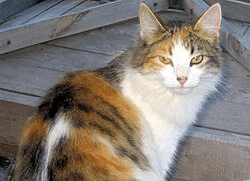
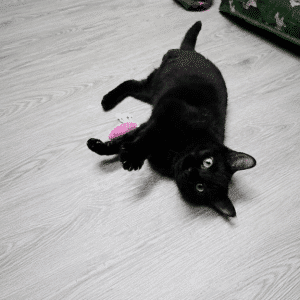
Once Marnie rediscovered play, there was very little slowing her down.
She chased moving toys.
Pounced with careful precision.
Rolled across the floor when something captured her attention.
The cautious cat from the early recovery days began disappearing.
In her place emerged a curious companion who wanted to know everything happening around her.
A bag placed on the floor needed inspection.
A cabinet left slightly open became a mystery.
A new sound demanded immediate attention.
Marnie began moving with growing confidence.
The home was no longer only somewhere to heal.
It had become her playground.
The Cat Who Found Adventure Everywhere
Marnie’s family soon discovered that keeping up with her could be more challenging than caring for her.
She seemed drawn to every place she was not expected to visit.
An open drawer.
A shelf within climbing distance.
A quiet corner someone had forgotten to check.
Nothing escaped her attention.
She approached each discovery with the seriousness of a tiny explorer.
Then, once she had satisfied her curiosity, she moved toward the next adventure.
Her missing front leg did not remove her natural feline instincts.
She still wanted to climb.
Investigate.
Hide.
And surprise the people around her.
She simply learned to do those things in her own way.
The Perfect Nickname Finds Her
Marnie’s playful habits eventually earned her a nickname.
“Mischievous Marnie.”
It suited her perfectly.
She had a talent for appearing in unexpected places.
She investigated household objects as though they had been left there specifically for her entertainment.
When a toy disappeared beneath furniture, Marnie remained determined to retrieve it.
When someone believed she was sleeping, she might suddenly appear nearby, ready to begin another game.
Her mischief was never about causing trouble.
It was an expression of confidence.
The more secure she felt, the more willing she became to explore.
Every playful moment showed that fear no longer controlled her life.
Strength Growing in the Legs That Remained
Regular movement helped Marnie’s remaining legs grow stronger.
Her single front leg learned to steady her body.
Her back legs adapted to provide more power during jumps and quick turns.
She became better at judging distances.
She learned how to land comfortably.
At first, climbing onto furniture required careful planning.
Later, it became part of her ordinary routine.
Her caregivers continued making sure her environment remained safe.
They watched her weight to reduce unnecessary pressure on her joints.
They provided accessible resting places.
And they kept up with veterinary care to protect the body working so hard to support her.
Marnie received help when she needed it.
But she was also given freedom.
That balance allowed her confidence to grow.
Learning to Jump Again
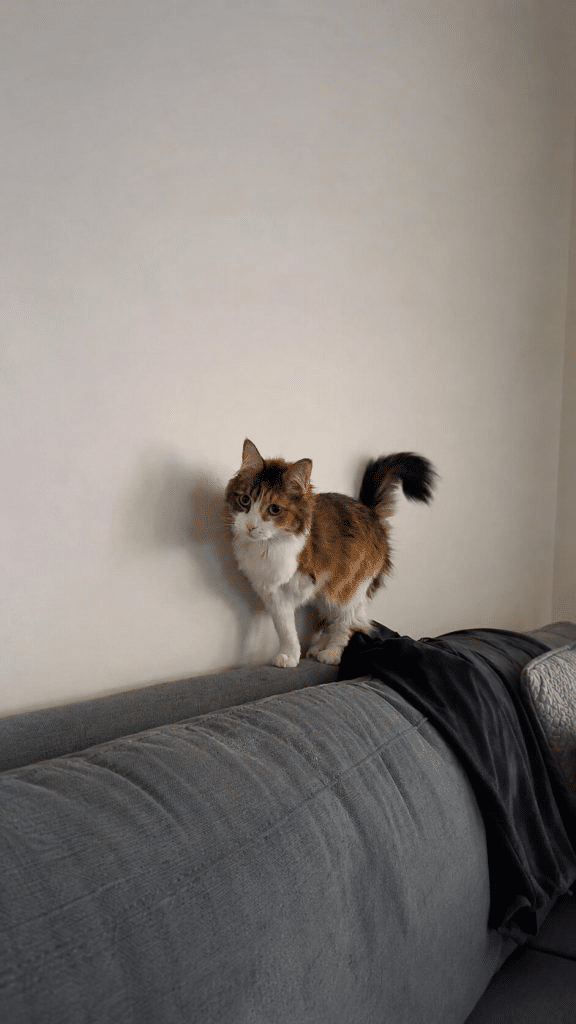
One day, Marnie stood beside a low piece of furniture.
She looked upward.
The surface was close enough to reach, but the jump required balance and trust.
Her body lowered.
Her back legs prepared.
Then she pushed upward.
Her front paw landed first.
She pulled herself onto the surface and stood there proudly.
The jump was small.
But it represented weeks of adjustment.
Marnie turned around and settled comfortably, almost as though the achievement had been completely ordinary.
Her family understood otherwise.
She had trusted her new body.
And that trust had carried her somewhere she wanted to be.
Confidence Replaces Hesitation
Each successful movement made the next one easier.
Marnie no longer paused before every turn.
She hurried across familiar rooms.
She climbed onto low furniture without needing encouragement.
She knew how to shift her weight and use the strength available to her.
Occasionally, she still misjudged something.
A jump might require a second attempt.
A quick turn might end in an awkward landing.
But Marnie did not remain embarrassed or frustrated.
She stood.
Looked again.
And continued.
Her progress was not perfect.
It was real.
And every imperfect attempt helped build the confidence that now seemed to fill her entire personality.
Trust Growing Alongside Strength
Physical recovery was only part of Marnie’s transformation.
She also needed to understand that the people around her were safe.
During the early days, she watched hands carefully.
Being lifted after an injury could feel frightening.
Her caregivers approached with patience.
They supported her body gently.
They never forced affection.
Food appeared every day.
Her bedding remained clean.
The same calm voices greeted her each morning.
Little by little, Marnie began seeking closeness.
She leaned into gentle touches.
Rested near familiar people.
And allowed herself to be held without becoming tense.
Trust grew through ordinary kindness repeated again and again.
The Joy of Being Understood
Marnie’s family never treated her as incomplete.
They understood that she had certain physical needs.
But they also recognized that she was a young cat with a complete personality.
She needed safe surfaces.
She also needed toys.
She needed time to rest.
She also needed freedom to explore.
Protecting Marnie did not mean preventing her from living.
It meant creating an environment where she could participate confidently.
Her family learned when to step in.
And when to step back.
Marnie learned that she could ask for help without losing her independence.
Together, they built a life around possibility rather than limitation.
A Home Filled With Her Personality
Before long, Marnie’s presence could be felt throughout the entire home.
Toys appeared in unexpected places.
Blankets carried the shape of her afternoon naps.
A slightly open cabinet often meant she was nearby investigating.
Her family learned to expect surprises.
Marnie brought movement into quiet rooms.
She turned routine into entertainment.
Even her resting moments carried personality.
Sometimes she stretched in a patch of sunlight.
Other times, she curled into a small circle after a long period of play.
The home had given her safety.
In return, she filled it with curiosity, laughter, and life.
Visitors Forget She Is Different
People meeting Marnie often noticed her missing leg at first.
Then she began to move.
She chased a toy.
Crossed the room.
Climbed onto a comfortable surface.
Or approached them with bright, curious eyes.
Within minutes, the missing leg stopped being the most interesting thing about her.
Her personality took over.
Visitors noticed how playful she was.
How quickly she adapted.
How little hesitation remained in her movements.
Marnie did not need to prove that she was capable.
She simply lived with such enthusiasm that people naturally began seeing her instead of her disability.
More Than a Story of Survival
It would be easy to describe Marnie only as a survivor.
She experienced a serious injury.
Lost a front leg.
And learned to move again.
But survival is only the beginning of her story.
Marnie became an explorer.
A playful companion.
A source of daily amusement.
And a deeply loved member of her family.
Her life is not meaningful only because she overcame something difficult.
It is meaningful because she enjoys it.
She feels the warmth of sunlight.
The excitement of a moving toy.
The comfort of familiar hands.
And the security of knowing she belongs.
Marnie is not merely surviving on three legs.
She is living fully.
What Her Missing Leg Never Took Away
The injury changed Marnie’s body.
It never touched her curiosity.
It did not remove her desire to play.
It did not take away her ability to trust, give affection, or form a deep bond with people.
She could still run.
Still climb.
Still investigate everything her family hoped she might ignore.
Still turn a quiet afternoon into an adventure.
The list of things she could do remained far longer than the list of things she could not.
And Marnie seemed to understand that instinctively.
She did not spend her days looking backward.
There was always something interesting ahead.
A Future Protected With Thoughtful Care
Marnie’s family understands that three-legged cats benefit from continued support.
Maintaining a healthy weight helps protect the remaining joints.
Secure surfaces can reduce slips.
Low steps or accessible furniture make favorite places easier to reach.
Regular veterinary checkups help monitor her long-term comfort.
These needs are not burdens.
They are simply part of caring for Marnie properly.
Her family is prepared to adjust as she grows older.
Because love does not stop when recovery appears complete.
It continues through every stage.
Marnie will always have people watching over her.
Not because she is helpless.
But because she is cherished.
A Life Filled With Ordinary Happiness
Today, Marnie spends her days doing what she loves.
She explores.
Plays.
Rests in warm places.
And stays close to the family who accepted her exactly as she was.
Her movements may look different.
Her enthusiasm does not.
She greets each new object as an opportunity.
Every room contains something worth investigating.
Every toy deserves a chase.
And every comfortable blanket deserves a long nap afterward.
The injury that once made her future uncertain is now only one chapter in a much larger story.
A story filled with confidence.
Mischief.
And joy.
A Gentle Reminder About Special-Needs Animals
Animals with disabilities do not need their lives to be viewed through sadness.
They need understanding.
Appropriate care.
Safe environments.
And the same opportunities for affection, play, and belonging that every animal deserves.
Marnie did not need people to tell her she was brave.
She needed people willing to give her time.
To protect her while she healed.
And to believe that life could still be full after her body changed.
Because she received that chance, she discovered her own balance.
Her own rhythm.
And her own wonderfully mischievous way of moving through the world.
A Message of Hope
Marnie’s story reminds us that disability does not define worth.
A missing leg does not make an animal incomplete.
It does not remove personality.
Love.
Curiosity.
Or the ability to experience happiness.
Marnie may move on three legs.
But she approaches life with more enthusiasm than many animals with four.
She runs toward the things that interest her.
Climbs toward the places she wants to explore.
And rests peacefully beside the people she trusts.
Her family does not love her despite her difference.
They love every part of who she is.
The brave survivor.
The playful companion.
The determined explorer.
And, of course, Mischievous Marnie.
Her missing leg is part of her story.
But it has never been the most important part.
The most important part is the joy she found afterward.
And the beautiful life she continues embracing—
one adventure,
one playful chase,
and one wonderfully mischievous day at a time.