It started like any ordinary school day.
Ethan, an 11-year-old boy, finished his classes, gathered his school things, and boarded the bus he normally took home. He expected the ride to be simple and familiar. Like always, he handed his ticket to the driver and waited to take his seat.
But this time, the driver looked at the ticket and frowned.
“This ticket isn’t valid,” he said. “The fare has gone up. Pay ten euros or get off.”
Ethan froze.
He did not understand what was happening. The ticket had been purchased earlier in the school year, and he had used it before without trouble. He did not have extra money with him. He was a child trying to get home, not someone trying to avoid payment.
Nervously, he tried to explain.
But the driver did not want to hear it.
A Child Left Alone in the Snow
According to the account, Ethan told the driver that he had no other ticket and no money to pay the difference. He tried to explain that the pass had been bought in advance and that he needed to get home.
The driver interrupted him.
Without showing patience or concern, he told Ethan to get off the bus.
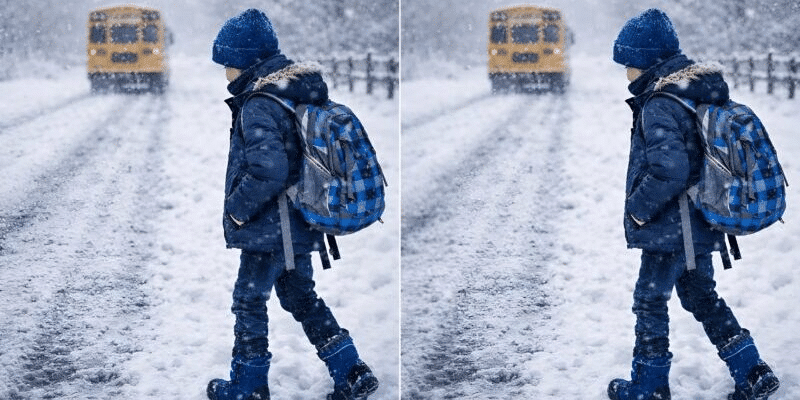
Moments later, the vehicle stopped in the middle of the road. The doors opened, and Ethan was forced to step outside into the freezing weather.
Then the doors closed.
The bus drove away.
Ethan stood alone in the snow, watching the vehicle disappear down the road. Around him, there were no houses, no stores, no people, and no one to ask for help. The cold air cut through his clothes, and fear quickly settled in.
Home was nearly six miles away.
He did not have a phone.
For an 11-year-old child, that distance was frightening enough. In freezing temperatures, it became dangerous.
A Walk No Child Should Have Faced
At first, Ethan stood still, unsure what to do. He called out, hoping someone might hear him.
No one answered.
Only the wind moved around him.
With no other choice, he began walking.
Step by step, he followed the road through the snow, trying to stay calm. But the cold quickly became harder to ignore. His hands grew stiff. His legs began to ache. His feet felt heavier with every minute.
After about fifteen minutes, the fear became worse. His body was already struggling against the cold, and daylight was beginning to fade. The road ahead seemed endless.
He kept walking because stopping felt even more terrifying.
Children should never have to calculate survival on the side of a snowy road. Ethan should have been safely inside a bus, on his way home like every other school day. Instead, because of a fare dispute, he was left to make a dangerous journey alone.
His Parents Realized Something Was Wrong
Back at home, Ethan’s parents began to worry.
He should have arrived already.
At first, they may have assumed the bus was delayed. But as the minutes passed, their concern grew into panic. They called people who might know where he was. Friends. Neighbors. Teachers. Anyone who might have seen him after school.
The response was the same each time:
Ethan had gotten on the bus.
That answer only made the situation more frightening.
If he had boarded the bus, why was he not home?
His parents contacted the police, fearing something had happened between school and home. For any parent, not knowing where your child is can feel unbearable. Every possible danger races through the mind at once.
Then the truth began to emerge.
Ethan had been removed from the bus because of his ticket.
A Community Left Shocked
When Ethan finally made it home, he was not simply late.
He was freezing, exhausted, and visibly shaken.
His body temperature had dropped dangerously low, and he showed signs of being close to hypothermia. What began as a minor ticket issue had become a serious safety incident that could have ended in tragedy.
The story spread quickly through the neighborhood.
Parents were furious. Neighbors were stunned. Many asked the same question: how could an adult leave a child alone in freezing weather over a fare problem?
The outrage was not just about the ticket. It was about judgment. It was about responsibility. It was about the basic duty adults have to protect children, especially when a situation becomes dangerous.
A formal complaint was reportedly filed against the driver and the transport company. The accusations centered on negligence and the abandonment of a minor in unsafe conditions.
Authorities began investigating, and the driver was suspended while the case was reviewed.
Rules Should Never Come Before Safety
Public transportation systems rely on rules. Tickets, fares, schedules, and procedures are necessary for daily operations. But rules are not supposed to replace common sense.
When the passenger is a child, the responsibility becomes even greater.
If a ticket is outdated, invalid, or affected by a fare change, there are safer ways to handle the problem. A driver could notify the transport company, contact a supervisor, allow the child to ride home and report the issue later, or ensure a parent or school official is contacted.
What should never happen is leaving a child alone on an isolated road in freezing weather.
This case sparked a wider conversation about transportation policies and child safety. Many parents called for clearer rules to prevent similar incidents. They argued that drivers should be trained to handle fare disputes involving minors with caution, compassion, and basic humanity.
No child should be placed in danger because of a technical issue.
The Emotional Impact on Ethan
Ethan survived the ordeal, but an experience like this does not disappear quickly.
Being forced off a bus, left alone, and made to walk miles through snow can deeply affect a child’s sense of safety. It can create fear, anxiety, and distrust. For Ethan, a routine school commute became a memory tied to panic and cold.
His parents, too, were left shaken. They had trusted the transport system to bring their son home safely. Instead, they spent hours searching, calling, and fearing the worst.
The incident became a painful reminder that safety depends not only on written policies, but also on the decisions people make in real time.
One adult’s lack of compassion can put a child in danger.
One better decision could have prevented everything.
A Lesson the Neighborhood Will Not Forget
Ethan’s story is not only about a bus ticket.
It is about the difference between enforcing a rule and protecting a life. It is about recognizing when a situation requires patience instead of punishment. It is about understanding that children depend on adults to make responsible choices.
The neighborhood’s anger came from a simple truth: this should never have happened.
Ethan was 11 years old. He was trying to get home. He was not a threat, not a criminal, and not someone who deserved to be abandoned in the snow.
He needed help.
Instead, he was left alone.
Thankfully, he made it home. But the outcome could have been far worse.
His experience now serves as a warning to schools, transport companies, drivers, and communities everywhere: rules matter, but safety matters more.
A fare dispute can be resolved later.
A child’s life cannot be replaced.