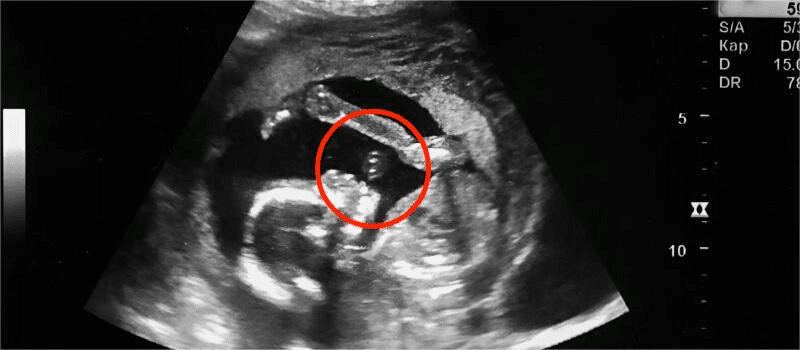
It was supposed to be an ordinary ultrasound.
Not the kind of appointment that changes your life. Not the kind that makes your heart race or leaves you replaying every second in your mind. It was meant to be routine — a quick check, a few reassuring words, and then a return to normal life.
I remember lying on the examination table, staring at the ceiling while the ultrasound machine hummed softly beside me. The room was dim, the air smelled faintly of disinfectant, and everything felt familiar in the way medical rooms often do: quiet, controlled, and slightly cold.
At first, nothing seemed unusual.
The doctor moved the probe carefully, watching the screen with professional focus. I tried to relax, telling myself this was just another step, another appointment, another moment to get through.
Then he stopped talking.
The Silence That Changed the Room
It was not a dramatic silence at first.
Just a pause.
But something about it felt different.
His hand slowed, then stopped. His eyes stayed fixed on the monitor. The machine continued making its soft sounds, but the atmosphere in the room shifted instantly. I could feel it before I understood it.
My stomach tightened.
“Is everything okay?” I asked, trying to keep my voice calm.
He did not answer immediately.
Instead, he adjusted the screen, leaned closer, and studied the image again. His expression did not show panic, but it also did not offer comfort. That was what frightened me most. The silence felt louder than any warning.
Finally, he took a breath and spoke carefully.
“This isn’t what we usually see.”
Those words stayed with me.
They were not the worst words a doctor could say, but they were enough to change everything. In that moment, the appointment was no longer routine. The room that had felt ordinary minutes earlier suddenly felt unfamiliar.
A Result No One Expected
The doctor explained that what appeared on the ultrasound was unusual. He did not say it was immediately dangerous. He did not say there was an emergency. But he also made it clear that it should not be ignored.
It was different.
Rare.
Something that needed more tests, more observation, and more time before anyone could fully understand what it meant.
That was the hardest part.
Waiting.
When you leave a medical appointment with a clear answer, even a difficult one, your mind has something to hold onto. But uncertainty is different. It follows you home. It sits beside you at dinner. It wakes you up in the middle of the night. It turns every small detail into a question.
When I walked out of the clinic that day, the world looked the same, but it did not feel the same.
The sky was the same color. Cars moved through the street. People passed by, carrying groceries, checking their phones, talking casually about ordinary things. But inside me, everything had shifted.
I had entered the room expecting reassurance.
I left carrying questions.
Living Between Fear and Hope
That night, I barely slept.
Every time I closed my eyes, I saw the doctor’s face. The pause. The way he leaned closer to the screen. The careful tone in his voice when he said the results were not what they usually saw.
I kept asking myself the same questions.
Was it a mistake?
Was something wrong?
Should I be preparing for bad news?
The mind can be cruel during uncertainty. It fills silence with possibilities, and most of them are frightening. I searched for answers, but every answer led to more questions. Medical terms became confusing. Online information only made the fear heavier. One article sounded reassuring, while another made everything seem terrifying.
Eventually, fear began to change into focus.
I started writing down questions before appointments. I listened more carefully. I asked for explanations instead of pretending I understood. I learned that sometimes medical uncertainty is not a final diagnosis — it is part of the process.
Still, the waiting was difficult.
Each day felt longer than usual. Every phone call made my heart jump. Every appointment became a bridge between what I feared and what I hoped.
The Second Ultrasound
Weeks later, I returned for another scan.
The room looked exactly the same. The same machine. The same dim lighting. The same clean, clinical smell.
But I was different.
The first time, I had entered without fear. This time, I walked in carrying every question from the weeks before. I tried to breathe slowly as I lay back on the table, but my body knew the truth: I was scared.
The doctor began the scan.
Again, the machine hummed.
Again, his eyes moved carefully across the screen.
Again, there was silence.
But this time, I did not let the silence swallow me. I watched him closely, waiting not only for his words, but for the meaning behind them.
Then something unexpected happened.
He smiled.
It was small, but I saw it immediately.
“It’s clearer now,” he said.
The Truth Behind the Fear
What they had seen before was not a serious problem.
It was not a sign that everything was going wrong.
It was a rare variation — something unusual, but not dangerous. My body had been adapting in a way that looked concerning at first, but with time and clearer imaging, the doctors could see the full picture.
For a few seconds, I could not process what he had said.
Then the relief hit me all at once.
I laughed. Then I cried. Then I did both at the same time.
I had carried fear for weeks, holding my breath without realizing it. In that moment, the weight finally lifted. The unknown that had followed me day and night began to lose its power.
Nothing about the experience had been easy, but the truth was finally clear.
Different did not mean broken.
Unusual did not mean hopeless.
And unexpected did not always mean dangerous.
What the Waiting Taught Me
The result changed everything, but so did the waiting.
Before that ultrasound, I thought strength meant staying calm because everything was fine. Afterward, I learned that real strength sometimes means staying steady when you do not yet know whether everything will be fine.
I learned to ask questions. I learned not to assume the worst from a pause. I learned that doctors sometimes need time, tests, and clearer images before they can explain what they are seeing.
Most of all, I learned that uncertainty can change a person.
It can make you more aware of your body. More grateful for ordinary days. More careful with your thoughts. More present in the small moments you used to rush through.
The most important transformation did not happen when the doctor smiled.
It happened during the weeks before that.
In the silence.
In the waiting.
In the space where fear could have taken over, but I kept going anyway.
A Beginning I Did Not Expect
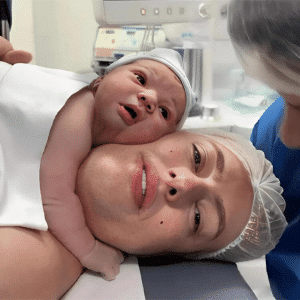
Months later, when I finally held the result of that journey in my arms — healthy, real, and breathing softly against me — I understood something I could not have understood in the examination room.
Not every unexpected moment is a warning.
Sometimes it is the beginning of a story you cannot fully see yet.
Sometimes the body adapts in ways that surprise even doctors.
Sometimes fear arrives before understanding, and silence comes before relief.
That ultrasound appointment started as routine, then became frightening, then became something else entirely: a reminder that life does not always explain itself immediately.
Some answers take time.
Some stories unfold slowly.
And sometimes, what first looks like uncertainty becomes the beginning of hope.