Every morning in Brookfield, Kansas, the little diner opened before the sun had fully climbed over the rooftops.
The routine rarely changed. Coffee brewed behind the counter. Pancake batter hissed on the griddle. The bell above the door rang as regular customers stepped inside, taking the same seats they had taken for years. Truck drivers ordered black coffee. Office workers grabbed toast and eggs before heading to work. Retired neighbors lingered over refills and quiet conversation.
Behind the counter stood Jenny Millers, a waitress with tired feet, kind eyes, and a smile that made people feel welcome even on difficult mornings.
Jenny’s life was not glamorous. She worked long shifts, counted her tips carefully, paid rent on a small apartment, and stretched every dollar as far as it would go. Like many working people, she understood personal finance not from books or banking advice, but from survival — choosing which bill to pay first, watching grocery prices, and hoping nothing expensive broke before payday.
Her days were simple, predictable, and often lonely.
Then one morning, she noticed the boy.
The Child in the Corner Booth
He came in at exactly 7:15 a.m.
He looked no older than ten. His clothes were clean but worn, and his backpack seemed too heavy for his small shoulders. He walked quietly to the farthest booth in the corner and sat with his hands folded on the table.
Jenny approached with a menu.
“What can I get you, sweetheart?”
The boy looked up. His face was serious in a way that made him seem older than he was.
“Just water, please,” he said.
Jenny paused.
Most children who came into the diner wanted pancakes, waffles, hot chocolate, or at least a small plate of toast. This boy asked for nothing but water.
She brought it to him without asking questions.
The next morning, he came back.
Again, 7:15.
Again, the same booth.
Again, just water.
By the end of the week, Jenny found herself watching the door before he arrived. She did not know his name. She did not know where his parents were. But she recognized something in him — the quiet dignity of a child trying not to be noticed.
And that hurt her heart.
A Plate of Pancakes “Made by Mistake”
On the fifteenth morning, Jenny made a choice.
She carried a warm plate of pancakes to the corner booth and placed it gently in front of him. Butter melted across the top, and syrup pooled along the edges.
The boy looked up quickly.
“I didn’t order this,” he said.
Jenny smiled like it was no big deal.
“The kitchen made too many by mistake,” she replied. “Wouldn’t want them to go to waste.”
He stared at the plate for a long moment.
Then he picked up the fork.
“Thank you,” he whispered.
Those two words stayed with Jenny all day.
From then on, breakfast appeared at his table every morning. Sometimes pancakes. Sometimes eggs and toast. Sometimes oatmeal on cold days. Jenny never made a scene. She never asked him to explain. She never embarrassed him in front of others.
She simply fed him.
And every morning, he said thank you.
A Secret Kindness
Jenny did not tell management.
The diner had rules. Food had costs. Inventory had to be counted. The owner watched margins closely, worried about rent, payroll, loans, insurance, taxes, and rising supply prices.
So Jenny paid for the meals herself.
A few dollars from her tips one day. A little extra from the change in her apron the next. It was not easy for her, but it felt necessary.
Some coworkers noticed.
“You’re going to get in trouble,” one warned.
Jenny only shrugged.
“He’s hungry,” she said.
To her, it was not charity. It was not a performance. It was not something she planned to post online or use for praise.
It was breakfast.
And sometimes breakfast is the difference between a child feeling invisible and a child feeling remembered.
The Boy Who Never Asked for More
Over time, Jenny learned small things about him.
He liked pancakes more than eggs. He always folded his napkin carefully. He read the same worn book while he ate. He never wasted food. He never asked for seconds, even when Jenny could tell he was still hungry.
He never stayed long.
After eating, he would wipe his mouth, place the fork neatly on the plate, and whisper, “Thank you, Miss Jenny.”
Then he would leave with the heavy backpack over one shoulder.
Jenny wanted to ask where he lived. She wanted to ask if someone was taking care of him. She wanted to ask why a child was eating alone in a diner every morning before school.
But she was afraid of scaring him away.
So she gave him patience.
And pancakes.
The Morning He Didn’t Come
Then one morning, the corner booth stayed empty.
At 7:15, Jenny glanced at the door.
At 7:20, she told herself he was running late.
At 7:30, she placed a glass of water on the table anyway.
By 8:00, the pancakes were cold.
He did not come the next day either.
Or the day after that.
Jenny tried not to panic. Children get sick. Families move. Schedules change. Maybe someone finally noticed he needed help. Maybe he was safe somewhere.
But the worry stayed with her.
For weeks, she kept looking at the door whenever the bell rang. She kept his booth clean. Some mornings, she still placed a small plate there before catching herself and taking it away.
The diner went on as usual.
But for Jenny, something felt missing.
Four Black SUVs
One afternoon, the usual noise of the diner was interrupted by the deep rumble of engines outside.
Jenny looked through the front window.
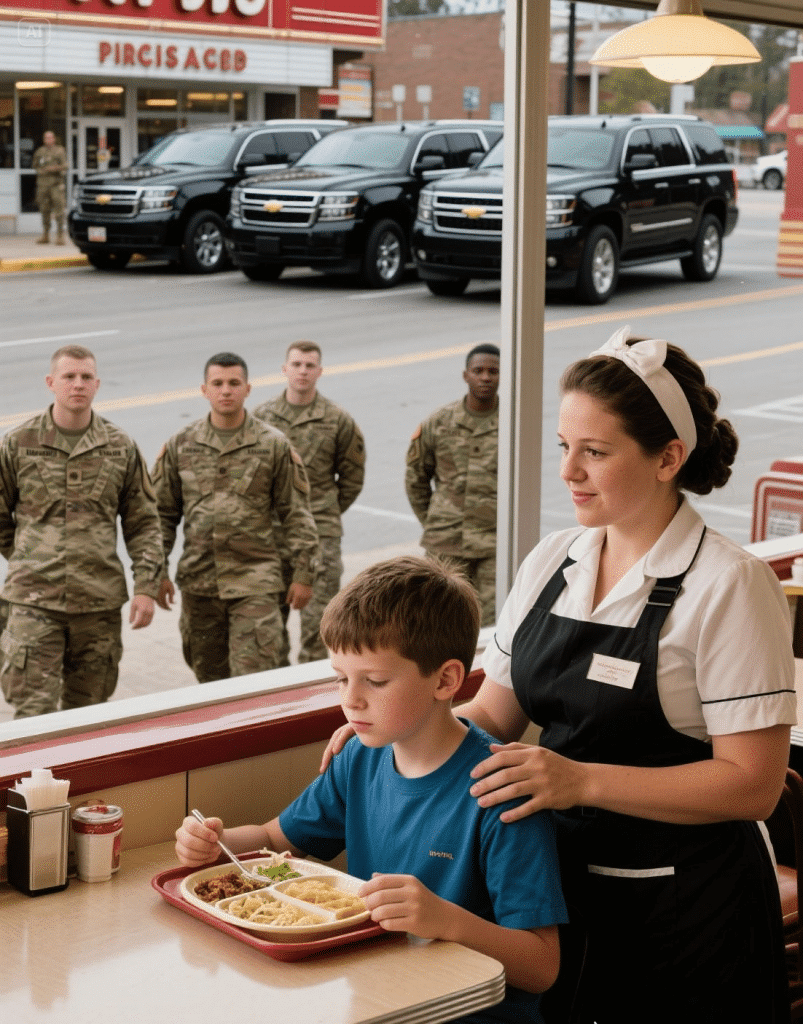
Four black SUVs had pulled up in front of the café.
The conversations inside faded. Customers turned in their seats. The bell above the door rang, and several uniformed soldiers stepped inside.
The room became still.
A senior officer walked to the counter. His expression was calm, but serious.
“Are you Jenny Millers?” he asked.
Jenny’s hands tightened around the coffee pot.
“Yes,” she said.
The officer removed an envelope from inside his jacket and handed it to her.
“This is for you.”
Jenny looked down at the sealed letter.
She did not know why, but her heart began pounding.
The Letter
Her fingers trembled as she opened the envelope.
The first line stopped her breathing.
The boy had a name.
Adam Thompson.
Jenny gripped the counter as she read.
Adam’s father, Master Sergeant James Thompson, had been serving overseas. His mother, overwhelmed by grief and hardship, had left months earlier. Adam had been living in silence, trying to survive without drawing attention to himself. He had walked to the diner every morning because it was warm, safe, and open before school.
And in letters to his father, Adam had written about Jenny.
He had written about the waitress who never asked too many questions.
The woman who gave him breakfast and protected his pride.
The stranger who made him feel less alone.
The letter Jenny held was from Master Sergeant Thompson. It had been written before his death and delivered after military officials discovered Adam’s situation.
In the letter, he thanked her.
Not only for feeding his son.
For seeing him.
For giving him dignity.
For offering kindness without making him feel small.
Jenny read the words through tears.
Then the plate she had been holding slipped from her hand and shattered on the floor.
No one moved.
No one spoke.
The Diner Falls Silent
The officer explained gently that Adam was safe.
Relatives had been contacted, and arrangements had been made for him to live with family who could care for him properly. The soldiers had come because Adam wanted Jenny to know what her kindness had meant.
He had not forgotten her.
He had asked that the letter be delivered in person.
Jenny covered her mouth, unable to speak.
For weeks, she had feared the worst. Now she knew the truth was heartbreaking, but not hopeless.
Adam had lost so much.
But somehow, in the corner booth of a small diner, he had found one person who treated him with care when the world had overlooked him.
A Community Begins to Change
The story spread through Brookfield quickly.
Not because Jenny wanted attention, but because people were moved by the quiet power of what had happened. Customers who had sat near Adam without noticing him began asking themselves how many other children might be struggling silently.
The diner owner, who at first might have worried about free meals and food costs, was deeply affected. He placed a small plaque near the corner booth:
Adam’s Booth — A Reminder That Kindness Matters
Local businesses began donating to support children from military families. A church organized grocery assistance. A school counselor helped identify students who might need meals, transportation, or emotional support. A small fund was created to help families facing medical bills, housing insecurity, or sudden financial hardship.
What began as one plate of pancakes became something larger.
A community started paying attention.
Why Small Acts Matter
Jenny never thought she had done anything extraordinary.
“I just gave him breakfast,” she would say.
But that was the point.
Kindness does not always look dramatic. It does not always come with a speech, a camera, or a large donation. Sometimes it looks like noticing the child who only orders water. Sometimes it means spending a few dollars from your own tips. Sometimes it means protecting someone’s dignity by pretending the kitchen made extra.
In a world where people are often overwhelmed by bills, work, rent, mortgages, insurance, debt, and daily pressure, it can be easy to stop seeing each other.
Jenny saw Adam.
And that changed everything.
A Lasting Bond
Months later, Adam returned to the diner.
This time, he was not alone. A relative stood beside him, one hand resting gently on his shoulder. He looked healthier, though still quiet. His backpack was lighter. His eyes were still serious, but not as heavy as before.
Jenny came out from behind the counter and knelt in front of him.
For a moment, neither of them spoke.
Then Adam smiled softly.
“Do you still make extra pancakes by mistake?” he asked.
Jenny laughed through tears.
“For you,” she said, “always.”
Final Thoughts
Every morning, Jenny Millers secretly fed a lonely boy who came into her diner and ordered only water.
She did not know his full story. She did not know his father was a soldier. She did not know that her small act of kindness was being written about in letters from a child to the parent he missed.
She only knew he was hungry.
So she helped.
Then one day, four black SUVs stopped outside the diner, soldiers walked in, and a letter revealed the truth.
Adam Thompson had been carrying more pain than anyone realized. But because one waitress chose compassion, he also carried proof that kindness still existed.
The lesson is simple:
You do not need wealth to change someone’s life.
You do not need power.
You do not need permission.
Sometimes, all it takes is one warm meal, one gentle voice, and one person willing to notice who the world has ignored.