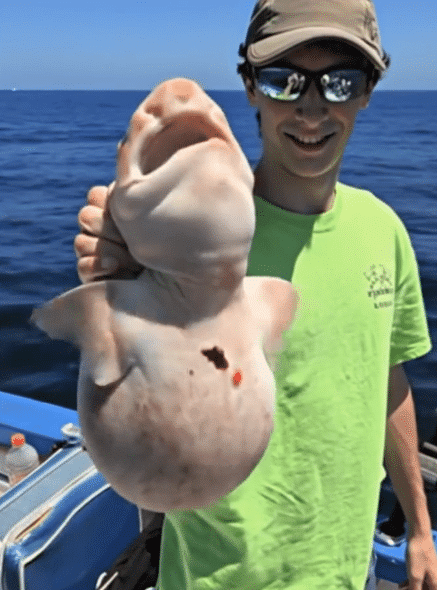
What first looked like a mysterious creature from another world has now been identified as something just as fascinating: a rare albino swell shark.
The unusual marine animal caught attention online after photos spread across social media showing a pale, swollen-looking fish with features many viewers described as “alien-like.” Its white and pinkish coloring, rounded body, and unusual shape led to wild speculation. Some people joked that it looked like a creature from outer space, while others wondered if it might be an unknown species pulled from the deep.
But after experts studied the images, the mystery became clearer.
The creature was identified as an albino swell shark — a rare color variation of a real shark species known for its unusual ability to inflate its body when threatened. Reports about the viral discovery trace the photos to Jaime Rendon, a fishing captain connected to the encounter off Mexico, and later updates said the shark was released alive.
For many ocean lovers, the explanation was even more exciting than the rumor.
It was not an alien.
It was a rare glimpse at one of the ocean’s strangest natural wonders.
A Strange Catch That Sparked Global Curiosity
The story began when photos of the unusual animal appeared online. At first, many viewers did not know what they were seeing. The creature’s body appeared inflated, its skin was extremely pale, and its overall shape looked different from the sharks most people recognize.
That is why the “alien fish” nickname spread so quickly.
Online audiences are often drawn to strange animal discoveries, especially when the images appear difficult to explain. In this case, the shark’s rare coloration and swollen appearance made it look unfamiliar even to people who had seen many fish before.
But marine experts recognized important clues.
The animal’s body shape, head, fins, and defensive inflation behavior pointed to a swell shark rather than an unknown species.
What Is a Swell Shark?
Swell sharks are small bottom-dwelling sharks found in parts of the eastern Pacific. The Florida Museum describes the swell shark, Cephaloscyllium ventriosum, as a species known for its remarkable defense mechanism: when threatened, it can bend into a U-shape, grasp its tail, and swallow water until its body expands. This swelling can make it harder for predators to bite or pull the shark from a rocky crevice.
Monterey Bay Aquarium also notes that a threatened swell shark can swallow a large amount of seawater and expand to roughly twice its normal size.
That explains why the shark in the viral photos looked so round and unusual. Its inflated body was not evidence of mutation, illness, or something supernatural. It was likely a natural defensive response.
In other words, the “alien” appearance was actually part of the shark’s survival strategy.
Why This Shark Looked So Pale
The second reason the shark looked so unusual was its color.
Experts identified it as albino, meaning it lacked normal pigmentation. Albinism is a genetic condition that affects pigment production, making an animal appear white, pale, or pinkish. In many animals, albinism is rare. In the ocean, it can be especially noticeable because coloration often helps marine animals blend into their surroundings.
A normally pigmented swell shark would typically have darker patterns that help it hide around rocks, reefs, and the ocean floor. A pale shark stands out more easily, which can make survival more difficult.
That is part of what made this discovery so remarkable. The shark was not only rare in appearance — it had survived long enough to be found, photographed, and released.
A scientific report has also documented albinism in the swell shark off Baja California, Mexico, noting a specimen with no skin pigmentation and golden-colored eyes.
Why Albino Marine Animals Fascinate Scientists
Albino marine animals attract scientific interest because they raise important questions about survival, adaptation, and genetics.
In the wild, color is often more than decoration. It can help animals hide from predators, ambush prey, communicate, regulate heat, or blend into their environment. When pigmentation is missing, the animal may become more visible and vulnerable.
That does not always mean an albino animal cannot survive. Some do. But each case gives researchers a chance to learn more about how rare genetic traits affect life in the ocean.
For a swell shark, camouflage can be especially important because the species often rests near rocky areas and relies on concealment. A pale individual may face different risks than normally colored sharks.
That is why clear photos and careful documentation matter.
Released Alive and Well
One of the most encouraging parts of this story is that the shark was reportedly released alive.
For many people, the release changed the tone of the story. Instead of becoming another example of a strange animal harmed for attention, the encounter became a positive reminder of responsible behavior around marine life.
Jaime’s decision to document the animal and return it to the ocean allowed people to learn from the encounter while giving the shark the best chance to continue living.
That matters.
Wildlife stories can go viral quickly, but the animals involved should not be treated like props. A rare animal may attract curiosity, but it still deserves careful handling, respect, and release when appropriate.
The Ocean Still Holds Countless Surprises
The popularity of the “alien fish” story reveals something important about how people view the ocean. Even in an age of advanced technology, satellites, underwater cameras, marine research, and global communication, the sea still feels mysterious.
That mystery is real.
The ocean covers most of Earth, and many marine environments remain difficult to study. New discoveries, rare sightings, unusual color variations, and unexpected animal behavior continue to remind scientists and the public that there is still much to learn.
A rare albino swell shark may not be an alien, but it does show how strange and beautiful real ocean life can be.
Sometimes the truth is better than the rumor.
Why Responsible Ocean Encounters Matter
This story also carries a conservation message.
Marine ecosystems face pressure from pollution, overfishing, habitat loss, climate change, abandoned fishing gear, and irresponsible tourism. Every encounter with unusual marine life should be handled with care.
For divers, fishermen, photographers, and boaters, responsible choices matter. Photographing an animal safely, avoiding unnecessary harm, following local regulations, and releasing wildlife when possible can make a meaningful difference.
Ocean conservation also requires long-term investment. Like personal finance, insurance planning, sustainable business, and responsible real estate development near coastlines, protecting marine environments depends on smart decisions made before damage becomes irreversible.
Healthy oceans support fisheries, tourism, coastal economies, food security, and biodiversity.
A single rare shark can become a reminder of that bigger picture.
From Viral Mystery to Marine Education
At first, many people clicked on the story because it looked bizarre. The phrase “alien fish” created curiosity and suspense.
But the real value came after the mystery was solved.
Viewers learned about swell sharks, albinism, marine camouflage, and defensive inflation. They also saw how expert identification can replace speculation with understanding.
That is one of the best outcomes of viral wildlife content. When handled responsibly, a strange photo can become a science lesson.
Instead of fear or misinformation, the story can inspire curiosity.
Final Thoughts
The so-called “alien fish” was not alien at all.
It was a rare albino swell shark — a real marine animal with an extraordinary appearance and an even more unusual defense mechanism. Its pale color came from albinism, and its swollen body likely reflected the natural behavior that gives swell sharks their name.
Thanks to Jaime’s photos and the decision to release the shark alive, people around the world got a rare look at one of the ocean’s most fascinating creatures.
The mystery may be solved, but the wonder remains.
Sometimes nature does not need fiction to amaze us.
It only needs to be seen.