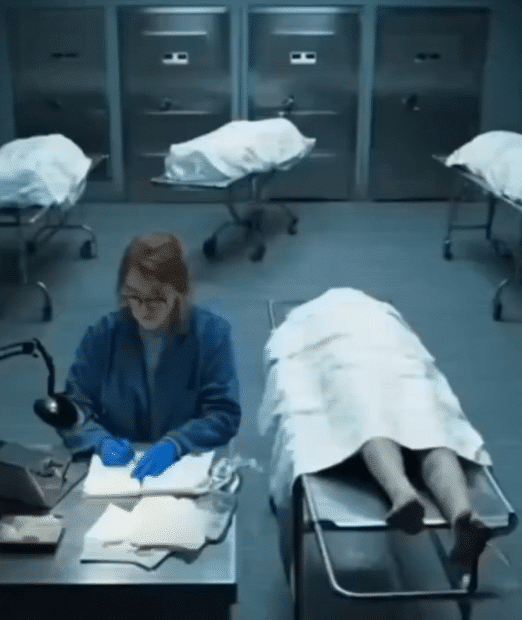
Moments after a person dies can be overwhelming for family members, caregivers, and witnesses. Grief, shock, and confusion can make every sound or movement feel deeply meaningful. In some rare situations, people report seeing a body twitch, shift, or make a small movement after death. For someone who is not familiar with the process, it can seem frightening—or even appear as though the person has somehow returned to life.
However, medical and forensic explanations show that these movements are not evidence of consciousness, awareness, or revival. They are usually natural physical responses that can happen as the body goes through its final biological changes.
This phenomenon is commonly described online as a “post-mortem jerk” or “post-mortem spasm.” In medical and forensic discussions, related processes may include post-mortem muscle contractions, reflex-like activity, or changes connected to rigor mortis. Research on post-mortem skeletal muscle contraction shows that muscles can still respond under certain conditions after death, even though the person is no longer conscious.
What Witnesses May See
People who witness post-mortem movement may describe several different reactions. Some report a sudden twitch in the hand or fingers. Others may notice the jaw tightening, the shoulder shifting, or an arm moving slightly. In some cases, the upper body may appear to lift or tense for a brief moment.
These events can be deeply unsettling because humans naturally connect movement with life. When we see motion, we instinctively assume intention, awareness, or response. That is why a small involuntary movement after death can feel so shocking.
But the body does not stop all at once. Death is not always experienced as a single instant at the cellular level. Instead, different systems shut down at different speeds, and the muscles, nerves, and tissues may still undergo chemical changes after the heart and brain have stopped functioning. Medical descriptions of postmortem changes explain that muscles go through stages after death, including relaxation, stiffening known as rigor mortis, and later secondary relaxation as decomposition progresses.
The Science Behind Post-Mortem Movement
Post-mortem movements are not caused by thoughts, pain, or a person trying to communicate. They are mechanical and biological.
After death, oxygen levels fall, normal circulation stops, and cells begin losing the chemical balance they need to function. Muscles depend on energy molecules, nerve signals, and chemical regulation to contract and relax. When those systems break down, the result can sometimes be a sudden twitch, tightening, or brief movement.
Rigor mortis is one of the best-known post-mortem changes. It occurs because muscles become stiff due to chemical changes in the muscle fibers after death. Forensic literature describes rigor mortis as a postmortem stiffening of body muscles that can help investigators estimate time since death and assess whether a body has been moved.
Muscle twitching in general is caused by small involuntary muscle contractions, often involving muscle fibers controlled by a nerve. While MedlinePlus discusses twitching in living patients, the basic concept helps explain why a tiny contraction can appear sudden and uncontrolled.
Why It Can Look So Disturbing
The emotional impact of these movements is often stronger than the movement itself. A small twitch may last only a moment, but for a grieving family member, it can create fear, confusion, or false hope.
Someone may think, “Did they just move?” or “Are they still alive?” In a hospital, hospice, funeral home, or emergency setting, trained professionals are usually prepared to explain what is happening. But when a family sees it without warning, it can feel terrifying.
This is why accurate information matters. A brief post-mortem movement does not mean the person is breathing again, feeling pain, or aware of their surroundings. It also does not mean medical staff made a mistake, though any uncertainty about death should always be addressed by qualified professionals immediately.
Social Media Has Made the Confusion Worse
Videos of bodies appearing to move after death often spread quickly online. Unfortunately, many of these clips are shared with misleading captions claiming that someone “came back,” “was not really gone,” or experienced a supernatural event.
Those claims can increase anxiety and spread misinformation. In reality, many of these moments have known biological explanations. Without medical context, a short clip can turn a natural post-mortem reaction into a viral mystery.
This is especially important for families making difficult decisions after a loss. Death already brings emotional stress, and many families must also manage practical responsibilities such as funeral planning, life insurance paperwork, medical bills, estate planning, banking matters, and personal finance decisions. Misleading information can make an already painful time even harder.
Post-Mortem Movement Is Not the Same as Revival
It is important to separate post-mortem movement from rare medical emergencies where a person may appear unresponsive but is not legally or medically dead. In those situations, immediate medical care is critical.
However, once death has been properly confirmed by medical professionals, small movements afterward do not mean the person has regained life. They are part of the body’s physical shutdown.
This distinction matters because viral stories often blur the line between medical uncertainty and post-mortem biology. A movement after confirmed death is not proof of consciousness. It is not a sign that the person is suffering. It is not a message from the person who died.
It is the body completing its final natural processes.
Why Understanding Helps Families
Knowing what can happen after death does not remove grief. It does not make loss easier. But it can prevent fear from being added to sorrow.
When families understand that post-mortem twitches or movements can occur naturally, they are less likely to panic or misinterpret what they saw. This knowledge can also help caregivers, hospice workers, funeral professionals, and medical teams explain these moments with compassion.
A calm explanation can bring comfort during one of life’s most difficult experiences.
Final Thoughts
A body moving after death can be shocking to witness, but it is not proof that someone has returned to life. In many cases, what people are seeing is a natural biological response involving muscles, nerves, and chemical changes that continue briefly after death.
The human body is complex, and its final processes can sometimes be surprising. Understanding post-mortem muscle activity helps replace fear with clarity and misinformation with truth.
What may look mysterious at first is often simply science—quiet, natural, and deeply human.