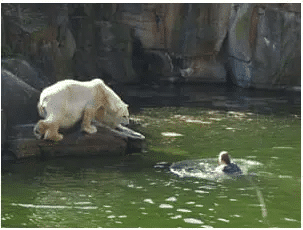
A frightening incident at the Berlin Zoo shocked visitors after a 32-year-old woman reportedly climbed into a polar bear enclosure and was attacked during feeding time. What should have been a normal day at one of the city’s most visited attractions quickly became a dangerous emergency involving zoo staff, rescue workers, and horrified witnesses.
According to the available account, the woman, identified as Mandy, bypassed several safety barriers before entering the enclosure. Reports say she climbed over a fence, crossed hedges, and made her way past a wall before jumping into the area where the polar bears were located.
The timing made the situation especially dangerous. The bears were reportedly being fed when she entered, a moment when wild animals can become highly alert, protective, and reactive. Within seconds, one of the polar bears noticed her presence and moved toward her.
A Dangerous Decision With Immediate Consequences
Visitors at the zoo watched in disbelief as the woman entered the enclosure. Many people initially appeared confused, unable to understand why someone would deliberately cross the protective barriers separating the public from one of the world’s most powerful land predators.
Polar bears may look calm from a distance, but they are wild animals with strong instincts. Even in a controlled zoo environment, they remain unpredictable and extremely dangerous when humans enter their space.
Shortly after the woman landed inside the enclosure, the situation escalated. One of the bears attacked, leaving the woman with serious injuries to her arms, legs, and back. Families nearby were reportedly horrified, with some parents trying to shield their children from the distressing scene.
The attack unfolded quickly, showing how little time zoo staff have to respond when someone enters a restricted animal area.
Zookeepers Act Quickly to Save Her Life
Zoo staff reacted immediately. Their training and fast response likely prevented the situation from becoming even worse. One keeper reportedly distracted the polar bear long enough for rescuers to reach the woman and pull her out of the enclosure.
Emergency responders arrived soon after, and the woman was taken to the hospital for treatment. Despite the seriousness of her injuries, doctors later confirmed that she survived and was expected to recover.
The rescue was a reminder of how critical emergency planning is in public spaces. Zoos, theme parks, airports, banks, real estate offices, and other public-facing institutions all rely on strong safety systems to protect both visitors and staff. In high-risk environments, preparation can make the difference between a controlled emergency and a tragedy.
Questions About Zoo Safety
After the incident, many people began asking how the woman was able to enter the polar bear enclosure in the first place. The case sparked public debate about zoo safety barriers, visitor monitoring, and whether additional security measures should be considered.
Zoo officials reportedly stated that the enclosure met safety standards and that the woman had deliberately crossed multiple restricted areas. This detail matters because safety systems are designed to prevent accidental entry, but a determined person may still find a way to bypass them.
The incident highlights an important reality: safety barriers are only effective when visitors respect them. Signs, fences, walls, and hedges are not decorations. They exist to protect people from serious harm and to protect animals from stressful or dangerous encounters.
For families visiting zoos, this story is also a reminder to pay close attention to posted warnings and restricted areas. A zoo can be educational and enjoyable, but it is still home to animals that require distance and respect.
Mental Health Concerns Behind the Incident
As more information emerged, reports suggested the woman may have been experiencing serious personal struggles at the time. According to the account, she had been dealing with emotional stress, difficulty finding stable employment, a recent breakup, and ongoing mental health challenges.
These details add a deeper layer to the story. While entering a wild animal enclosure is extremely dangerous and should never be encouraged, the incident may not have been simple recklessness. In some cases, extreme behavior can reflect emotional distress or a crisis that others may not see on the surface.
This is why mental health awareness remains so important. Financial pressure, unemployment, relationship problems, medical bills, insurance concerns, housing instability, and personal finance stress can all weigh heavily on a person’s emotional well-being. When people feel overwhelmed, they may make decisions that put themselves or others in danger.
The incident is a powerful reminder that communities need better ways to recognize warning signs and help people before a crisis occurs.
The Hidden Risk to the Animals
While much of the attention focused on the injured woman, animal welfare experts also pointed out another important issue: the polar bear was placed at risk, too.
When a person enters a dangerous animal enclosure, emergency responders may be forced to make difficult decisions to protect human life. In some cases, animals can be injured or even killed if they are considered an immediate threat during a rescue.
That means incidents like this can have consequences not only for the person involved but also for the animal acting according to its natural instincts.
The polar bear did not understand human rules or public safety expectations. It reacted as a wild predator would when a person suddenly entered its environment, especially during feeding time. This is why respecting zoo boundaries is not only about human safety. It is also about protecting animals from situations they did not create.
Why the Story Went Viral
The story spread quickly because it combines several emotional elements: danger, survival, public shock, and unanswered questions. Many people reacted with disbelief, asking why anyone would take such a risk. Others focused on the woman’s reported personal struggles and called for more compassion in discussing the incident.
Viral stories often move fast, but they can flatten complex situations into simple headlines. In this case, the truth appears to be more complicated. It is a story about public safety, mental health, animal welfare, and the consequences of crossing boundaries that exist for a reason.
The strongest lesson is not just that wild animals are dangerous. It is also that people in emotional crisis need support before their pain leads to life-threatening decisions.
Final Thoughts
The Berlin Zoo polar bear attack serves as a serious reminder that zoo safety rules must always be respected. Protective barriers are there to keep visitors safe, protect staff, and prevent wild animals from being placed in impossible situations.
The woman survived because zoo staff responded quickly and effectively. However, the incident could have ended far differently.
Whether viewed as a public safety failure, a mental health crisis, or a warning about respecting wildlife, one message is clear: wild animals must never be approached or entered into their space, no matter the circumstances.
Behind the viral headline is a real human story, a dangerous encounter, and a powerful reminder that both people and animals deserve protection.