The first thing anyone noticed was how small he looked against the rough road.
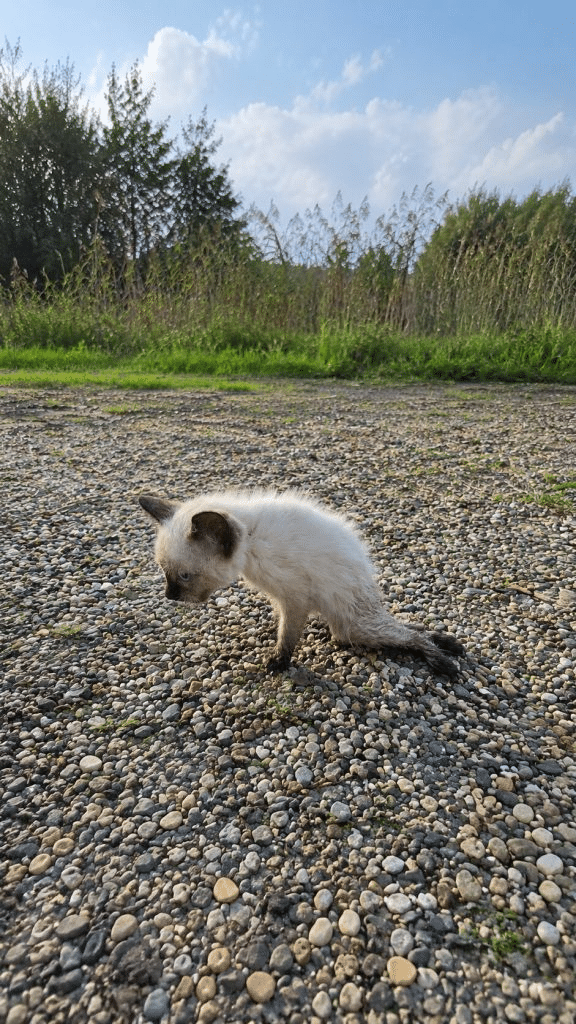
Alone on the gravel, a tiny kitten tried to pull himself forward using only his front paws.
His back legs trailed quietly behind him.
Each movement looked exhausting.
The uneven stones pressed beneath his fragile body, and even a short distance required more strength than such a young animal should have needed to give.
Still, he kept moving.
Slowly.
Determinedly.
As though somewhere ahead, safety might be waiting.
A Difficult Beginning No Kitten Should Face Alone
No one knew exactly what had happened to him.
Perhaps an earlier injury had affected his hind legs.
Perhaps he had been born with a condition that made movement difficult.
Without a full veterinary history, there was no way to know for certain.
What could be seen was enough.
The kitten could not use his back legs normally.
While other young cats might have been running, climbing and chasing anything that moved, he had to think about every inch of ground.
Finding food was difficult.
Reaching shelter was even harder.
If danger appeared, he could not quickly escape.
The outdoor world offered little kindness to an animal with limited mobility.
A small ditch could become a barrier.
A cold night could become overwhelming.
Even the rough surface beneath him could leave his body tired and uncomfortable.
Yet the kitten continued pulling himself forward.
He did not know that his life was different from the lives of other cats.
He only knew that he had to keep going.
The Moment Someone Chose to Stop
One day, a passerby noticed movement along the road.
At first, it may have looked like a small bundle lying among the stones.
Then the kitten lifted his head.
He placed his front paws beneath him and tried to move again.
That was when the truth became clear.
He was alive.
He was struggling.
And he was completely alone.
The stranger could have continued walking.
Instead, they stopped.
They watched the kitten make another difficult attempt to move.
His coat was dusty.
His body looked thin.
And his tired eyes seemed to carry the quiet uncertainty of an animal who had been surviving without help for far too long.
The person approached slowly.
A vulnerable kitten may not immediately understand that unfamiliar hands are kind.
So there was no rushing.
Only a gentle voice and careful movements.
When the kitten was finally lifted from the gravel, he did not have to drag himself forward anymore.
For the first time, someone else was carrying him toward safety.
VIDEO: A Tiny Kitten Dragging His Hind Legs Is Found Alone and Carried to Safety
The First Night Somewhere Warm
The kitten was brought to a secure place where the world immediately began to feel different.
A soft blanket replaced the rough road.
Fresh water was placed nearby.
A small meal was offered carefully so his tired body would not be overwhelmed.
There were walls around him.
Warmth beneath him.
And people close enough to notice every change.
At first, the kitten remained quiet.
He had spent so much energy surviving that rest seemed to be the only thing his body wanted.
His caregivers allowed him to sleep.
They did not expect trust immediately.
They simply made sure he was comfortable and no longer alone.
That first night, he did not need to search for shelter.
He did not need to pull himself across stones to find food.
He could close his eyes knowing that gentle people were watching over him.
Understanding What His Body Needed
Veterinary professionals examined the kitten and began assessing his condition.
They checked his hind legs.
They observed the way he moved.
They looked for signs of pain, weakness or injuries that might require treatment.
The goal was not only to understand why he could not walk normally.
It was to discover how his comfort and quality of life could be improved.
Some mobility conditions can change with treatment and rehabilitation.
Others require animals to develop new ways of moving.
Whatever the future held, the kitten now had something he had not possessed on the road.
Support.
His health could be monitored.
His surroundings could be adapted.
And every decision could be made with his safety in mind.
He no longer had to solve every challenge alone.
The Quiet Work of Healing
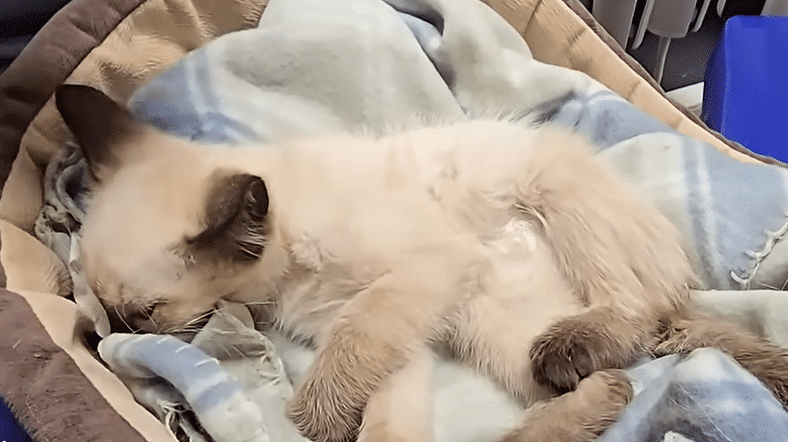
Recovery did not arrive in one dramatic moment.
It appeared through small routines repeated each day.
Nutritious food helped rebuild his strength.
Clean bedding protected his skin.
Gentle care kept him comfortable.
His caregivers watched the areas of his body that touched the floor, knowing that cats with limited hind-leg movement may need extra protection.
They encouraged him to move without forcing him beyond what he could manage.
At first, the kitten traveled only short distances.
He placed his front paws forward.
Pulled his body after them.
Then stopped to rest.
But the floor beneath him was smooth and safe now.
There were no sharp stones.
No passing vehicles.
No reason to use all his energy simply to survive.
Each day, he seemed a little less tired.
His appetite improved.
His eyes grew brighter.
And the frightened expression he had carried from the road slowly began to soften.
Learning to Move in His Own Way
As his strength returned, the kitten began exploring.
His hind legs remained weak, but his front legs became powerful.
He learned how to pull himself across the floor with greater control.
He discovered how to turn toward familiar voices.
He figured out how to reach his bowl and return to his bed.
At first, every movement appeared careful.
Then curiosity began replacing hesitation.
A sound from another room caught his attention.
A toy moving nearby made him lift his head.
A caregiver walking past became someone worth following.
The small kitten who had once struggled across the gravel began traveling through the house with purpose.
His movement looked different.
But it belonged to him.
And with every journey, his confidence grew.
When the Kitten Inside the Survivor Appeared
One day, a toy was placed near his front paws.
The kitten watched it carefully.
For a moment, he remained still.
Then he reached forward.
The toy moved.
So did he.
He pulled himself after it, paused and tried again.
That simple moment changed the feeling in the room.
The animal everyone had first seen as exhausted and vulnerable was beginning to play.
His personality had been there all along.
It had simply been hidden beneath hunger, fear and the effort of surviving outdoors.
Soon, he showed interest in everything around him.
He investigated blankets.
Followed moving objects.
Sought attention from the people he trusted.
He may not have been able to run like other kittens, but his curiosity was just as strong.
His desire for affection was just as real.
And his joy was impossible to miss.
A Home That Made Room for Him
The people caring for the kitten did more than provide medical attention.
They created a world he could navigate.
Food and water were placed within easy reach.
The floor was kept free of unnecessary obstacles.
Soft resting places allowed him to move in and out comfortably.
His caregivers supported him when needed but also gave him opportunities to do things independently.
They understood that protecting him did not mean preventing him from exploring.
It meant making exploration safer.
Every small success was celebrated.
The first time he crossed the room without stopping.
The first time he approached someone for affection.
The first time he became so interested in a toy that he forgot to be cautious.
These moments might have looked ordinary to others.
To the people who had seen him alone on the road, they meant everything.
Trust Growing With Every Gentle Day
The kitten slowly learned that hands could offer comfort.
At first, he may have remained uncertain when someone reached toward him.
Life outdoors had given him little reason to trust.
But the hands in his new home brought food.
They adjusted his blanket.
They supported his body when movement became tiring.
They never punished him for needing help.
Little by little, he began seeking those hands instead of shrinking away from them.
He rested near his caregivers.
He responded to familiar voices.
And when he felt safe enough, he allowed affection to become part of his day.
The road had taught him how to survive.
His new family was teaching him how to belong.
A Life Defined by More Than Mobility
It would have been easy to focus only on the kitten’s back legs.
But the people who loved him soon saw everything else.
His curiosity.
His determination.
His affectionate nature.
His interest in the world around him.
He was not a tragedy.
He was not a broken animal.
He was a young cat with specific needs and an enormous desire to live.
His disability changed the way he moved.
It did not change his ability to enjoy a warm afternoon.
It did not take away his love of toys.
It did not prevent him from forming bonds with the people who cared for him.
The most important parts of him had always remained intact.
He simply needed someone willing to see them.
From a Lonely Road to a Future Filled With Care
Today, the little kitten continues learning and adapting.
He explores at his own pace.
He rests when his body needs time.
He plays with the enthusiasm of a cat who understands that the world can hold good things too.
His future may include continued veterinary care, rehabilitation or mobility support designed around his individual condition.
But whatever comes next, he will not face it alone.
There will be people beside him.
People who notice when he is tired.
People who protect his comfort.
People who believe his life is valuable exactly as it is.
The tiny kitten once dragged himself across a gravel road because moving forward was the only choice he had.
Now he moves forward for a different reason.
There are familiar voices to follow.
Toys waiting to be discovered.
Soft places to sleep.
And a family ready to welcome him at the end of every small journey.
The Compassion That Changed Everything
This story began with one vulnerable animal on an ordinary road.
There was no large rescue team.
No dramatic equipment.
Only a passerby who noticed that something was wrong.
That person stopped.
Looked closer.
And decided that the kitten’s life was worth interrupting the day for.
That single choice opened the door to food, veterinary care, safety and love.
It transformed a lonely struggle into a hopeful beginning.
The kitten still moves differently.
But he no longer moves through the world unseen.
Every determined pull of his front paws now carries him across safe floors and toward people who care.
His journey reminds us that compassion does not always begin with knowing exactly how to solve a problem.
Sometimes it begins with simply refusing to leave a vulnerable life behind.
On the gravel road, the kitten kept moving because he had to survive.
In his new home, he keeps moving because there is finally a life ahead worth exploring.