The first thing anyone noticed was how hard the little orange cat tried.
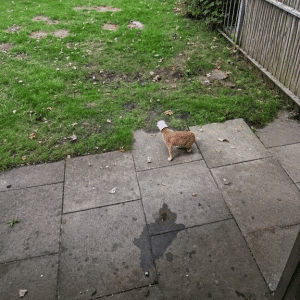
He could not use either of his hind legs.
They rested silently behind him as he pulled his body forward with his front paws.
Every movement demanded effort.
Every small distance became a journey.
Yet he did not remain still.
He kept reaching forward.
One determined step at a time.
A Small Cat Facing the Streets Alone
Life outdoors can be difficult for any animal.
For a cat unable to use his back legs, even the simplest parts of survival became overwhelming.
He could not run quickly from danger.
He could not climb easily to reach safety.
Searching for food required more strength than his small body should have needed to give.
A patch of rough ground could slow him down.
Cold weather could leave him exposed.
Even crossing a short distance meant dragging his hindquarters behind him while his front paws carried nearly all his weight.
Still, the orange cat continued.
He did not understand the word disability.
He only understood that he needed to move.
So he pulled himself forward again and again, refusing to let his silent legs decide where his life would end.
The Moment Someone Finally Saw Him
One day, compassionate rescuers noticed the struggling cat.
They did not look away.
They did not see only his paralysis or the unusual way he moved.
They saw a vulnerable animal doing everything he could to survive.
And they saw a life that deserved help.
The rescuers approached carefully, speaking softly so they would not frighten him.
After living without protection, the cat could not immediately know that these unfamiliar hands were gentle.
But he was exhausted.
And somewhere beneath his uncertainty, there seemed to be a quiet willingness to trust.
He was lifted carefully and carried away from the streets.
For the first time in a long while, he no longer had to pull himself toward safety.
Safety was carrying him.
A Gentle Examination and a New Plan
Veterinary professionals examined the cat and assessed the condition of his hind legs.
His mobility challenges were significant.
There was no instant treatment that could simply return everything his body had lost.
But that did not mean his future was empty.
The veterinary team and caregivers began focusing on what could be improved.
His comfort.
His strength.
His ability to move independently.
His chance to experience a full and happy life.
Sometimes healing does not mean returning a body to the way it once was.
Sometimes it means creating a new path forward.
For this little cat, that path would soon arrive on two wheels.
VIDEO: Paralyzed in His Hind Legs, This Rescued Cat Takes His First Steps With a Wheelchair
The First Time the Wheels Touched the Floor
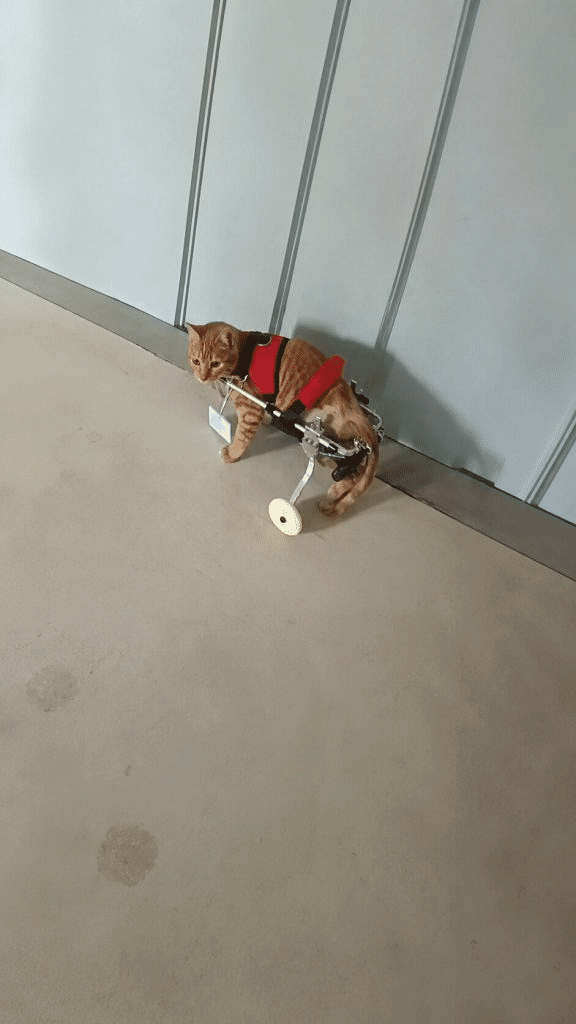
After careful preparation, the cat received a specially designed mobility cart.
The lightweight frame supported his hindquarters while leaving his front legs free to guide him.
To the people around him, it represented possibility.
To the cat, however, it was something completely unfamiliar.
There was a frame resting around his body.
There were wheels beside him.
When he moved his front paws, the rest of him moved differently than before.
At first, he paused.
He looked from side to side.
He seemed unsure whether to continue.
No one rushed him.
His caregivers remained close, offering encouragement while allowing him to explore the new sensation at his own pace.
Then he placed one front paw forward.
The wheels followed.
He tried again.
Another step.
Another gentle roll.
For the first time, his hindquarters were no longer dragging heavily along the floor.
His body moved with him.
It was only a short distance.
But it felt like the beginning of an entirely new world.
Learning to Move in a Different Way
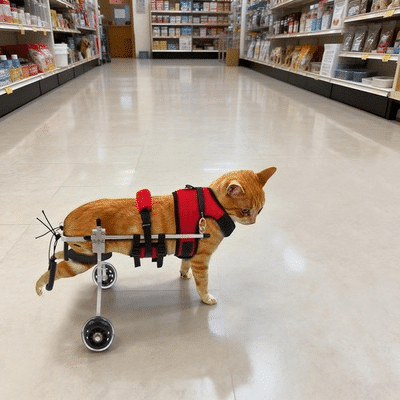
The transformation did not happen all at once.
The little cat had spent so long moving with only his front legs that the wheelchair required a new kind of balance.
He needed to learn how to turn.
How to slow down.
How to move across different surfaces.
Sometimes the wheels caught him by surprise.
Sometimes he paused and looked toward his caregivers for reassurance.
But just as he had done on the streets, he kept trying.
Each day brought a little more confidence.
His steps became smoother.
His turns became more controlled.
Soon, he was crossing rooms that had once seemed impossibly large.
He began following the people he trusted.
He moved toward his food bowl without dragging himself across the ground.
And when curiosity called him toward another corner of the room, he could answer.
The wheelchair was no longer a strange object attached to his body.
It was becoming part of his independence.
Small Victories That Filled the Room With Joy
To another cat, crossing a room might seem ordinary.
For him, it was worth celebrating.
A longer walk became a milestone.
A successful turn brought smiles.
The first time he moved quickly toward a toy, everyone watching understood how much had changed.
These moments were small.
But they carried enormous meaning.
The cat was not simply learning to use wheels.
He was discovering choices.
He could decide where to go.
He could follow a sound.
He could approach a familiar person.
He could explore instead of waiting for the world to come to him.
With every new achievement, the list of things he could do became longer.
And his confidence grew with it.
The Gift That Could Not Be Built From Metal
The wheelchair changed the way the cat moved.
But it was not the greatest gift he received.
That gift came from the people who refused to believe his life was less valuable because his body worked differently.
Caregivers gave him a safe place to rest.
Veterinary professionals guided his care.
Rescuers remained patient as he adjusted to his new routine.
They watched for signs of discomfort.
They encouraged his independence without asking too much too soon.
Most importantly, they treated him like a cat—not a tragedy.
He was allowed to be curious.
Playful.
Affectionate.
Sometimes stubborn.
Sometimes eager to explore a place he was not supposed to go.
His disability was part of his life.
But it was never the whole of who he was.
A Home Filled With Movement and Love
As the days passed, the frightened survivor began to settle into a safer life.
There was food he did not have to search for.
There were soft places where his tired body could rest.
There were people who noticed when he needed help and celebrated when he managed something on his own.
He learned that hands could offer comfort.
He learned that rooms could be explored without danger waiting outside.
He learned that movement no longer had to leave him exhausted.
With his wheels supporting him, the little orange cat could travel farther than he had in months.
But love carried him even further.
It gave him security.
Companionship.
And the confidence to look toward each new day with curiosity instead of fear.
Moving Forward on His Own Terms
Animals often adapt without questioning whether their lives look different from those around them.
They do not wait for perfection before choosing joy.
They use what they have.
They accept support.
And when they feel safe enough, they begin moving forward.
Today, the little orange cat rolls through his surroundings with growing confidence.
His front paws still guide each journey.
His hind legs remain supported gently behind him.
But now, instead of dragging himself toward survival, he moves toward the things that make life meaningful.
A favorite toy.
A warm resting place.
A familiar voice.
A person waiting to greet him.
His wheels carry his body.
But they also carry something that cannot be measured.
Freedom.
Trust.
And the quiet hope of a small cat who never stopped trying.
His journey reminds us that a disability does not make a life incomplete.
Sometimes all that is needed is someone willing to look beyond what an animal cannot do—and help him discover everything he still can.