Most drivers know the basic meaning of common road markings. Yellow lines divide traffic moving in opposite directions. White lines separate lanes traveling the same way. Crosswalks help guide pedestrians. Arrows show turning lanes, and stop lines tell drivers where to wait.
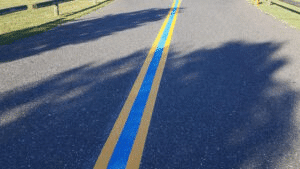
But in some communities, drivers have noticed something much less familiar: a thin blue line painted between the yellow center lines of certain roads.
At first glance, it can be confusing. Some people wonder whether it marks a special emergency route, a new traffic regulation, or a hidden warning drivers are supposed to understand.
In many cases, the blue line is not a traffic instruction at all.
It is usually a symbolic tribute to law enforcement officers, connected to the phrase “Thin Blue Line.” Some towns have painted blue lines near police stations or municipal buildings to show appreciation for officers and public safety workers. Reports from New Jersey communities described blue lines being added near police departments as a sign of support, though the markings also drew criticism from some residents.
What the Blue Line Represents
The blue road marking is often meant to honor police officers, including those who serve their local communities and those who have died in the line of duty.
The “Thin Blue Line” phrase is commonly used to describe police as a symbolic line between order and chaos. Supporters see the blue stripe as a sign of respect, sacrifice, and community gratitude.
In some towns, the line is painted directly in front of or leading toward a police department. For residents who support the gesture, it can feel like a visible reminder of the risks officers face while responding to emergencies, traffic crashes, crimes, medical calls, and public safety issues.
For local governments, these markings are often framed as memorial or appreciation projects rather than changes to traffic design.
It Is Not a New Driving Rule
The most important thing for drivers to understand is this: a blue line painted on the road generally does not change traffic laws.
It does not create a special lane.
It does not mean drivers should stop, yield, merge, or change direction.
It does not override yellow or white lane markings.
Drivers should continue following official signs, signals, lane lines, speed limits, and local traffic laws. If you see a blue line, stay focused on the standard road markings and drive normally unless an official sign or officer directs otherwise.
This distinction matters because road markings are supposed to be clear and consistent. Confusing pavement colors can distract drivers or cause people to misinterpret the roadway.
Federal Guidance Has Raised Concerns
Although local communities may support blue lines as symbolic tributes, federal traffic guidance has raised concerns about using blue pavement markings this way.
The Federal Highway Administration’s MUTCD interpretation states that blue pavement markings are limited to supplementing white markings for parking spaces reserved for people with disabilities. It also specifically says that using blue lines as part of centerline markings does not comply with MUTCD provisions.
That means a blue line between yellow center lines may be symbolic, but it is not a standard traffic-control marking under federal guidance.
For cities and towns, this creates a balance between public expression and roadway safety. A community may want to honor police, firefighters, veterans, or other public servants, but public roads must still remain clear and understandable for drivers.
Why Some Communities Support the Marking
Supporters often say the blue line is a simple way to show appreciation for law enforcement. In busy towns, tourist areas, and high-traffic communities, police departments handle a wide range of responsibilities, from traffic control and emergency response to public events and crime prevention.
For families of officers, retired law enforcement personnel, and residents who have positive relationships with local police, the marking can feel meaningful.
It can also serve as a memorial when a community has lost an officer in the line of duty. In those cases, the line may be part of a broader effort to remember public service and sacrifice.
Why Others Object
The “Thin Blue Line” symbol has also become controversial in some places.
Critics argue that the symbol can feel political or divisive, especially in communities where policing, civil rights, and accountability are already sensitive issues. Some residents question whether public roads should include symbolic markings that may be interpreted differently by different groups.
Others do not object to honoring officers but believe tributes should be placed on signs, memorials, buildings, flags, plaques, or designated public spaces rather than directly on active roadways.
That debate explains why reactions can vary sharply from one community to another. What one person sees as gratitude, another may see as a political message or an inappropriate use of public infrastructure.
Similar Symbolic Markings Exist Elsewhere
Blue lines are not the only symbolic markings communities have used. Some places have installed red lines to honor firefighters, rainbow crosswalks to support LGBTQ+ communities, green markings for bike lanes or environmental messages, and memorial signs for veterans, first responders, or local leaders.
These projects often reflect local identity and values. But when markings appear on public streets, officials must also consider safety, visibility, legal standards, maintenance costs, liability, and insurance risk.
Public roads are not just symbolic spaces. They are transportation systems that must work safely for drivers, pedestrians, cyclists, emergency vehicles, delivery workers, and visitors unfamiliar with local customs.
Road Safety Comes First
Whether someone supports or opposes blue road markings, the safety message remains the same: do not let unusual pavement markings distract you.
Drivers should watch the road, obey official lane lines, avoid sudden braking to look at markings, and never stop in traffic to take photos. In unfamiliar areas, rely on legal signs and signals rather than decorative pavement features.
Good driving habits also protect your personal finance. Traffic tickets, crashes, car repairs, insurance claims, injury costs, and higher premiums can all follow from one distracted moment behind the wheel.
A symbolic marking may be interesting, but it should never pull attention away from safe driving.
Final Thoughts
A blue line painted on the street is usually not a secret traffic signal or new driving rule. In many communities, it is a symbolic tribute to law enforcement officers and is connected to the “Thin Blue Line” message.
However, the marking has also sparked debate. Supporters view it as a sign of respect and appreciation, while critics question whether symbolic messages belong on public roads. Federal highway guidance also says blue pavement markings are generally reserved for accessible parking-related markings, not centerline decoration.
So the next time you notice a blue line on the street, you will know what it likely means.
It is a symbol — not an instruction.
Keep driving safely and follow the official road signs and markings.