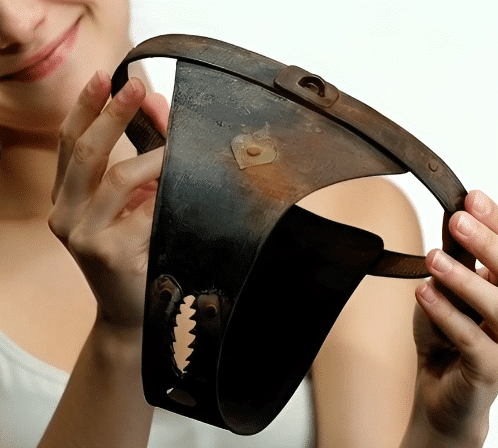
An unusual metal object found tucked away in a grandparents’ attic recently sparked intense curiosity online after photos of it were shared with one simple question:
“What is this?”
The item looked old, heavy, and unfamiliar. Its design immediately led people to guess everything from a medieval torture device to an antique medical tool, costume prop, or strange piece of household equipment. But as more people examined the photos, one explanation quickly became the center of discussion.
The object appeared to resemble what is commonly known as a chastity belt.
For many people, that answer was shocking. Chastity belts are often associated with medieval legends, harsh control, and stories of husbands locking away wives during long absences. Movies, books, museum displays, and internet posts have helped make the object one of history’s most recognizable — and most misunderstood — artifacts.
But historians have long warned that the popular story is far more complicated than it sounds.
A Discovery That Raised More Questions Than Answers
Attics often hold the forgotten pieces of family history: old photographs, military uniforms, letters, tools, clocks, jewelry, documents, and household objects from another era. Sometimes those items are easy to identify. Other times, they create a mystery.
This discovery fell into the second category.
The metal object was unusual enough to make people stop scrolling. Its shape and locking-style design immediately triggered strong reactions. Some commenters were fascinated. Others were uncomfortable. Many wanted to know whether the object was real, a reproduction, a prop, or something entirely different.
That uncertainty is what made the post spread.
People love mystery objects, especially when they appear to connect to history. But viral identification posts can also create confusion because guesses often move faster than facts.
Why People Thought It Was a Chastity Belt
A chastity belt is typically imagined as a metal device designed to restrict sexual activity. In popular culture, it is often described as a medieval object used to control women, especially during the Crusades or long periods when husbands were away.
The common image includes a metal waistband, locking parts, and a restrictive lower section with openings for bodily functions.
Because the attic object appeared to share some of those features, many online viewers quickly linked it to that idea.
But resemblance alone does not prove authenticity.
Objects can be replicas, theatrical props, novelty items, museum-style reproductions, or later inventions made to look older than they are. Without expert examination, materials testing, provenance, and historical context, it is impossible to know exactly what the object is or when it was made.
The Medieval Story May Be More Myth Than Fact
Although chastity belts are widely associated with the Middle Ages, many historians question whether they were commonly used in medieval Europe in the way modern audiences imagine.
Some references to chastity belts in older writings may have been jokes, moral warnings, satire, or symbolic commentary rather than descriptions of everyday reality. Over time, those references may have been repeated so often that they became accepted as fact.
Many surviving examples often described as “medieval chastity belts” are believed by scholars to be much newer — especially from the 18th or 19th century — or even museum curiosities created to satisfy public fascination with the supposed cruelty of the past.
That makes the object controversial.
It may be connected to a real historical idea, but not necessarily in the way people assume.
Why the Victorian Era Matters
One reason chastity belts became better known in later centuries is that the Victorian era had strict and often restrictive ideas about sexuality, morality, gender roles, and bodily control.
During that period, some doctors and moral reformers promoted harmful beliefs about sexual behavior, especially regarding women, girls, and young people. Devices resembling chastity belts or restraint devices were sometimes discussed in the context of discipline, morality, or preventing behaviors that were wrongly believed to be dangerous.
Today, those ideas are widely understood as outdated and harmful.
This is why historians treat these objects carefully. They are not just strange antiques. They are tied to broader conversations about gender, power, medical misinformation, and social control.
Authentic Artifact or Later Reproduction?
One of the biggest questions surrounding any attic discovery like this is authenticity.
An object found in a family home may look old, but that does not automatically mean it is ancient. Metal can be artificially aged. Reproductions can be made for collectors, theaters, museums, novelty shops, or private curiosity cabinets.
To evaluate an object properly, experts would usually ask several questions:
Where did it come from?
Is there any family documentation?
What type of metal was used?
Does the construction match a known historical period?
Are there tool marks that suggest modern manufacturing?
Was it designed for actual use, display, costume, or shock value?
Without that kind of review, the safest description is that the object resembles a chastity belt, not that it is definitely a medieval artifact.
That distinction matters for responsible storytelling.
Why These Finds Go Viral
Objects like this attract attention because they combine mystery, discomfort, history, and curiosity.
People are naturally drawn to items that seem to open a door into the past. When the object also carries a controversial reputation, the reaction becomes even stronger.
The internet makes that reaction immediate. A photo can be uploaded from an attic, basement, estate sale, or antique shop, and within hours thousands of people may be offering theories. Some guesses may be helpful. Others may be completely wrong.
That is why verification is important.
Just as people should carefully review legal documents, insurance policies, loans, banking records, real estate titles, and family estate paperwork, historical objects also require careful evaluation before big claims are made.
A viral answer is not always the correct answer.
Modern Chastity Devices Are Different
It is also important to separate historical claims from modern adult contexts.
Today, devices sometimes called chastity devices exist in consensual adult relationships, including some BDSM communities. In those contexts, the central principles are consent, communication, safety, and personal choice.
That is very different from the popular historical image of forced control or punishment.
Because the topic can be sensitive, responsible coverage should avoid graphic details and focus on history, consent, and cultural context rather than sensationalism.
The attic object may raise uncomfortable questions, but those questions can be discussed thoughtfully.
What the Discovery Teaches About History
Perhaps the most interesting part of this story is not the object itself, but the conversation it created.
The discovery became a reminder that history is often more complicated than the stories people inherit. Some “facts” are myths repeated for generations. Some museum objects are mislabeled. Some old items were created long after the time period people associate them with. Some artifacts reflect fear, satire, control, or imagination more than practical daily life.
History is not only about objects.
It is about interpretation.
That is why experts matter. A historian, museum curator, antique specialist, or materials expert can help separate evidence from assumption.
Final Thoughts
A strange metal object found in a grandparents’ attic quickly became an online mystery after people suggested it resembled a chastity belt.
At first, the discovery seemed to point toward a dark medieval story. But the truth behind such objects is far more complicated. Many historians question the popular claim that chastity belts were widely used in the Middle Ages, and many surviving examples may come from later periods or have been made as reproductions, curiosities, or symbolic objects.
Whether the attic find is authentic, modern, decorative, or misunderstood, it sparked a valuable conversation about myth, history, gender, and verification.
Sometimes the most fascinating discoveries are not only about what an object is.
They are about what we think we know — and what history asks us to reconsider.