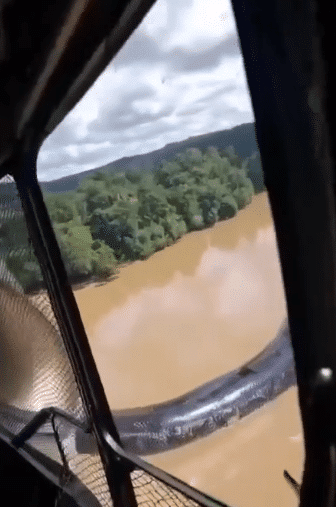
What began as a scientific expedition deep in the Amazon became one of the most remarkable wildlife discoveries in recent years: researchers identified a new species of giant green anaconda.
The snake, now known as the northern green anaconda and scientifically named Eunectes akayima, was documented during research in the Ecuadorian Amazon. The expedition involved Professor Bryan Fry from the University of Queensland, Indigenous Waorani guides, and a National Geographic film crew connected to Pole to Pole with Will Smith.
For viewers, the story sounds almost unreal: enormous snakes moving through dark water, scientists navigating remote rivers, and dramatic footage showing the scale of one of the world’s most powerful reptiles.
But behind the viral excitement is a serious scientific discovery — and an urgent warning about the future of the Amazon.
A Hidden Giant in the Rainforest
The expedition took researchers into remote waterways in Ecuador, including areas connected to Waorani territory. For generations, Indigenous communities had shared knowledge of massive anacondas living in the region’s rivers and wetlands.
Scientists followed that knowledge into the field.
During the expedition, researchers encountered enormous green anacondas, including a female reported by the University of Queensland to measure 6.3 meters, or more than 20 feet long. Professor Fry also noted anecdotal Waorani reports of even larger anacondas in the area, possibly more than 7.5 meters long, though those extreme sizes remain unverified by formal measurement.
That distinction matters. The confirmed snake was already enormous. The larger reports are fascinating, but they should be treated as local accounts unless documented scientifically.
Even so, the discovery has captured global attention because green anacondas are already considered among the largest and heaviest snakes on Earth.
A New Species Is Identified
For years, many green anacondas were grouped under one species, Eunectes murinus. But genetic research revealed that what people called the green anaconda was actually more complicated.
Researchers found a major genetic split between northern and southern populations. The northern form was identified as a separate species: Eunectes akayima, the northern green anaconda. The previously known southern green anaconda remains Eunectes murinus.
According to the University of Queensland, the northern and southern green anacondas diverged nearly 10 million years ago and differ genetically by about 5.5%. Professor Fry compared that difference to the genetic gap between humans and chimpanzees, which is much smaller by comparison.
That genetic difference is especially striking because the two anaconda species look very similar. Even experts may struggle to tell them apart by appearance alone.
In other words, one of the largest snakes on Earth had been hiding in plain sight.
Will Smith and National Geographic’s Role
Part of the expedition was filmed for National Geographic’s Pole to Pole with Will Smith. Newly released footage connected to the series shows researchers, Waorani guides, and Will Smith encountering and sampling a large anaconda in the Ecuadorian Amazon.
Some viral posts describe the snake as “launching from the water” or attacking from below, but the documented reporting focuses on researchers locating, restraining, sampling, and studying the snake rather than a confirmed attack. The real story is still dramatic without exaggeration: scientists were working at close range with an enormous wild constrictor in a remote rainforest river system.
Anacondas are not venomous. They are constrictors, meaning they kill prey by wrapping around it and overpowering it. They spend much of their lives in and around water, where their size and strength make them highly effective ambush predators.
Why This Discovery Matters
The northern green anaconda is not just a bigger snake with a new name. Its discovery changes how scientists understand biodiversity in the Amazon.
When two animals look almost identical but are genetically distinct, scientists call them cryptic species. These discoveries matter because conservation plans depend on knowing what species exist, where they live, and how vulnerable they may be.
If researchers assume one widespread species is healthy, they may miss the fact that separate populations are actually facing different threats. A newly identified species can already be at risk by the time science officially recognizes it.
That is why the northern green anaconda has become more than a headline. It is a reminder that the Amazon still contains life forms humans are only beginning to understand.
A Discovery With an Environmental Warning
The expedition also carried a serious conservation message. Researchers have used anacondas as indicator species to study environmental contamination in the Amazon, including pollution linked to oil extraction. Reuters reported that Bryan Fry’s team studied anacondas in Ecuador’s Yasuni region to assess damage from oil spills and found concerns involving petrochemical metals accumulating in wildlife.
That matters for animals and people. Pollution can move through food chains, affect fish and wildlife, and create risks for Indigenous communities that depend on local ecosystems for food and water.
The Amazon is often described as one of the most biodiverse places on Earth, but it faces pressure from deforestation, mining, oil extraction, illegal activity, fires, climate change, and expanding development.
A giant anaconda may look unstoppable, but even apex predators depend on healthy rivers, wetlands, prey populations, and intact habitat.
Indigenous Knowledge Was Essential
One of the most important parts of this discovery is the role of the Waorani people. Their knowledge of the region helped guide scientists to places where these giant snakes live.
Modern science often depends on local and Indigenous expertise, especially in remote ecosystems. Communities that have lived alongside rainforest wildlife for generations may understand animal movements, seasonal patterns, river systems, and habitat changes in ways outside researchers cannot quickly learn.
This collaboration shows why conservation must include local communities, not exclude them.
Protecting the Amazon is not only about saving animals. It is also about respecting the people whose lives, cultures, food systems, and futures are directly tied to the forest.
The Amazon Still Holds Countless Secrets
The northern green anaconda discovery proves that even large animals can remain scientifically misunderstood for a long time.
If a massive snake can hide in plain sight, imagine how many smaller species remain unknown. Insects, frogs, plants, fish, fungi, birds, and reptiles may still be waiting to be documented. Some may disappear before science ever names them.
That is what makes rainforest conservation so urgent.
Every destroyed habitat could contain species no one has studied. Every polluted river could affect an ecosystem scientists barely understand. Every short-term decision about land, oil, mining, real estate development, or infrastructure can have long-term environmental and economic consequences.
Just as personal finance, banking, insurance, and investment decisions require planning for the future, environmental decisions require long-term thinking. Once a rainforest ecosystem collapses, rebuilding it is far more costly — and sometimes impossible.
A Living Symbol of Rainforest Power
The northern green anaconda has captured attention because it represents the wild power of the Amazon. It is enormous, mysterious, and perfectly adapted to its watery world.
But it also represents something fragile.
A snake this large needs a functioning ecosystem. It needs clean water, prey, shelter, breeding habitat, and protection from human disruption. Its size may make it impressive, but size alone does not guarantee survival.
That is the paradox of the Amazon. It is vast, but vulnerable. It is ancient, but under pressure. It is full of life, but many of those lives depend on choices humans are making right now.
Final Thoughts
The discovery of the northern green anaconda is one of those rare stories that feels almost mythical — until science confirms it.
Researchers working in the Ecuadorian Amazon identified a genetically distinct giant anaconda species, Eunectes akayima, after studying snakes long known to Indigenous communities. The discovery was documented during a National Geographic expedition connected to Pole to Pole with Will Smith, bringing global attention to one of the rainforest’s most powerful animals.
But the deeper message is not only about size.
It is about responsibility.
The Amazon still holds extraordinary secrets, but those secrets are increasingly threatened by pollution, deforestation, and environmental damage. The northern green anaconda reminds us that the natural world is still capable of astonishing discoveries — if we protect it long enough to understand it.