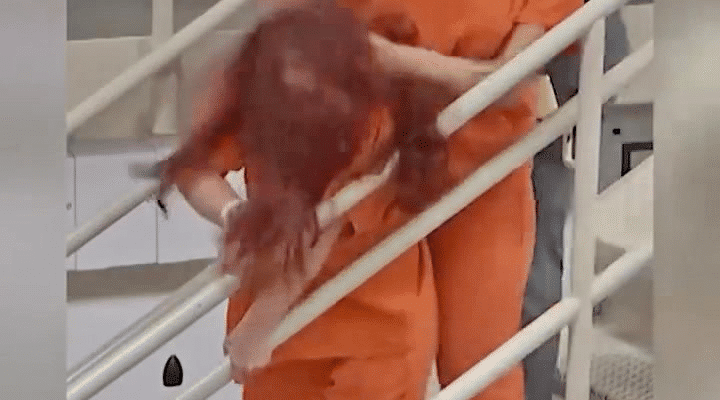
A routine day inside a women’s detention facility reportedly turned chaotic after an altercation between two inmates escalated quickly on an upper-level walkway. The incident, captured on internal surveillance footage and later shared online, has drawn widespread attention because it shows how rapidly tension can turn into danger inside a controlled correctional environment.
According to the account, two inmates wearing standard orange uniforms were being escorted through the facility when one suddenly turned on the other. What appeared to be an ordinary movement through the jail became a frightening struggle within seconds.
The video has since sparked public debate about supervision, officer response time, facility design, mental health concerns, and the ongoing pressure faced by correctional staff. While officials later said no serious injuries were reported, the incident has raised important questions about how detention centers can reduce risk before minor conflicts become violent.
A Routine Escort Takes a Dangerous Turn
The situation reportedly began during what looked like a normal inmate escort. Two women were moving along an upper-level walkway inside the facility, with a correctional officer nearby. At first, there appeared to be no immediate sign of trouble.
Then the mood shifted suddenly.
One inmate allegedly grabbed the other by the hair and pulled her backward toward a staircase. The victim appeared caught off guard and struggled to stay balanced as she was dragged toward the steps.
In any correctional facility, staircases are considered especially dangerous areas during a physical confrontation. A fall can cause serious injuries, including head trauma, broken bones, or long-term medical complications. In this case, the victim reportedly grabbed the metal railing and tried to steady herself while protecting her face with her other hand.
The attacker continued pulling her down several steps as the situation escalated.
Why the Staircase Made the Situation More Serious
A physical altercation in a hallway is already dangerous, but a fight on a staircase creates a much higher risk. Narrow steps, hard surfaces, limited space, and elevation all increase the chance of injury.
Correctional environments are designed around control and movement, but not every space is easy for officers to manage during an emergency. Stairs can limit visibility, slow intervention, and make it harder to separate people safely.
This is why risk management matters in jails and prisons. Just as businesses use risk assessments in banking, insurance, loans, real estate, and personal finance planning, correctional facilities must constantly evaluate where danger is most likely to occur. A poorly monitored high-risk area can create legal, medical, financial, and safety consequences for everyone involved.
Even when an injury is minor, the facility may still face internal review, medical costs, staff reports, liability concerns, and policy questions.
Guard Response Draws Online Debate
A correctional officer nearby reportedly noticed the struggle and moved toward the staircase. By the time the officer reached the inmates, the victim had already been pulled partway down the steps.
The officer intervened and separated the two women, bringing the situation under control. However, the delay shown in the footage led to debate online. Some viewers questioned whether staff should have reacted faster or whether another officer should have been positioned closer to the stairwell.
Others defended the officer, noting that correctional work is unpredictable and dangerous. Incidents can unfold in seconds, and officers must respond carefully to avoid making the situation worse or injuring themselves, the victim, or the aggressor.
Both points reflect a larger reality: correctional staff are expected to maintain order in environments where tension can rise quickly, often with limited resources and high emotional pressure.
Injuries and Immediate Action
Facility officials later confirmed that the victim was taken to the medical unit for evaluation. According to the account, she was treated for minor injuries, including bruising and hair-related trauma. There were no reports of fractures or serious head injuries.
The inmate accused of initiating the attack was reportedly placed in administrative segregation while the incident was reviewed. This is a common procedure after a violent episode, allowing officials to separate the individuals involved, investigate the cause, and determine whether further disciplinary action is necessary.
Administrative segregation is also used to reduce the risk of retaliation or another confrontation while officials gather information.
Staffing Pressures Inside Detention Facilities
The incident has renewed discussion about staffing levels in jails and prisons. Many correctional facilities across the country face pressure from staff shortages, overtime demands, burnout, and increasing security needs.
When staffing is limited, officers may be responsible for monitoring multiple inmates, hallways, housing areas, and movement zones at the same time. Even a well-trained officer can struggle to respond instantly if several things are happening at once.
Staffing shortages can also create financial strain for institutions. Overtime costs, workers’ compensation claims, medical expenses, insurance issues, and potential legal disputes can all place pressure on public budgets. These challenges make correctional safety not only a public safety concern, but also a financial and operational issue.
Mental Health and Conflict Prevention
Another major concern is mental health. Detention facilities often house individuals dealing with trauma, addiction, anxiety, untreated psychiatric conditions, or emotional instability. The stress of confinement can make conflicts more likely, especially in overcrowded or understaffed environments.
Experts often argue that reducing violence requires more than punishment after an incident occurs. It also requires prevention. That may include mental health screening, counseling access, conflict resolution programs, better classification systems, and staff trained in de-escalation.
When inmates with known conflicts or behavioral risks are moved together, the chance of confrontation may increase. Stronger communication between officers, medical teams, and mental health professionals can help identify warning signs earlier.
Training and Facility Design Matter
This incident also highlights the importance of correctional officer training. Officers need skills in de-escalation, safe intervention, emergency response, and recognizing high-risk situations before they escalate.
Facility design also plays a role. Staircases, blind spots, narrow walkways, and poorly monitored areas may require extra cameras, better lighting, or additional staff coverage. Surveillance footage is useful after an incident, but prevention depends on active monitoring and quick response systems.
Correctional safety is built through layers: staffing, training, technology, mental health care, classification, and clear policies. If one layer fails, the risk increases.
Final Thoughts
The reported altercation inside the women’s detention facility did not result in serious injuries, but it still serves as a warning. A controlled environment can become dangerous in seconds, especially when a confrontation happens near a high-risk area like a staircase.
The video has sparked debate because it shows the difficult reality of correctional work. Officers must respond quickly, inmates must be protected, and facilities must constantly review whether their safety systems are strong enough.
This incident is not only about one fight between two inmates. It is about the broader need for better supervision, stronger training, improved mental health resources, and smarter risk management inside detention facilities.
In the end, correctional institutions must do more than react after violence occurs. They must build systems designed to prevent it.