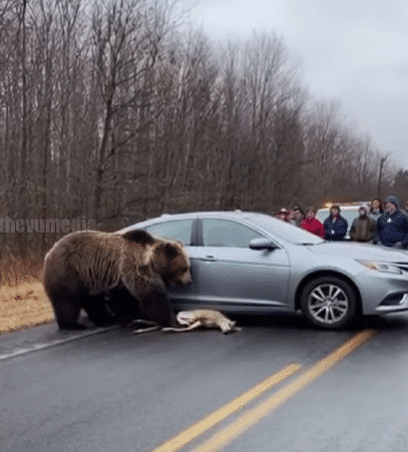
A dramatic video claiming to show a grizzly bear rescuing a trapped deer in Jasper National Park has captured widespread attention online. At first glance, the scene looks like something pulled from a rare wildlife documentary: a small buck trapped beneath a vehicle, frightened bystanders watching from a distance, and a massive grizzly bear emerging from the trees to do the impossible.
But there is one important detail viewers need to know from the start.
The video is AI-generated, and the story is fictional. It was created for entertainment purposes, not as a real wildlife report.
Even so, the clip has sparked curiosity, emotion, and discussion because of how convincing and cinematic it appears. It also highlights a growing reality of the digital age: artificial intelligence is making it easier than ever to create videos that look real, even when the events never happened.
A Fictional Scene Set in the Canadian Wilderness
According to the video’s description, the story is set on October 14, 2025, along a remote mountain pass in Jasper National Park, Canada. The setting immediately adds atmosphere. Dense trees, quiet roads, and rugged wilderness create the perfect backdrop for a dramatic wildlife encounter.
The video begins with a small buck wedged beneath a stationary sedan. The deer appears frightened and unable to escape. A few bystanders can be seen or heard nearby, but they keep their distance. In a real-world situation, that caution would make sense. Wild animals can be unpredictable, and approaching a trapped animal can be dangerous for both the person and the animal.
For a few moments, the scene feels tense and helpless.
Then the story takes an unexpected turn.
A large grizzly bear emerges from the tree line.
At first, the bear’s arrival seems to increase the danger. Viewers expect the situation to become worse. A grizzly bear is a powerful predator, and a trapped deer would normally be vulnerable in such a moment.
But in this fictional video, the bear does something completely unexpected.
The “Rescue” That Made the Video Go Viral
The bear approaches the vehicle calmly, places its front paws against the car, and appears to lift the sedan just high enough for the deer to escape. The buck quickly scrambles free and runs back into the forest.
Then, as if understanding exactly what it has done, the bear gently lowers the vehicle and walks away into the trees.
The moment is emotional, surprising, and almost magical. It turns the idea of predator and prey upside down. Instead of danger, the video presents compassion. Instead of fear, it gives viewers relief.
That emotional reversal is one reason the clip spread so quickly. People love stories that surprise them, especially when the ending feels hopeful. In a world filled with stressful headlines about the economy, insurance costs, real estate pressure, banking uncertainty, loans, cryptocurrency volatility, and personal finance struggles, even a fictional moment of kindness can feel refreshing.
The video gave viewers something simple and powerful: a reason to feel amazed.
Why So Many People Wanted to Believe It
Even though the video was labeled as AI-generated entertainment, many viewers still reacted as though they had witnessed a real event. Some called it beautiful. Others described it as one of the most heartwarming wildlife clips they had ever seen. Many compared it to an animated movie or a nature miracle.
That reaction says a lot about human nature.
People are drawn to stories where the unexpected happens. A grizzly bear helping a deer feels impossible, but emotionally satisfying. It suggests that even in nature, where survival is often harsh, mercy can appear in surprising ways.
Of course, the real world does not work like a scripted scene. Wild animals do not follow human ideas of kindness, fairness, or heroism. A grizzly bear lifting a car to rescue a deer is not realistic behavior. But because the video is visually convincing and emotionally powerful, it still feels meaningful to viewers.
That is the strength of AI storytelling. It can create scenes that may never happen in real life but still connect deeply with human emotion.
The Role of AI in Modern Viral Content
Artificial intelligence is changing how stories are created and shared. Creators can now produce realistic images and videos that look like news footage, security camera clips, wildlife documentaries, or personal recordings.
This opens exciting creative possibilities. AI can be used for short films, fictional news-style stories, educational visuals, advertising concepts, fantasy scenes, and entertainment content. It can help creators bring imaginative ideas to life without needing expensive film crews, special effects teams, or real-world risk.
At the same time, it creates new challenges.
When an AI video looks real, viewers may mistake fiction for fact. A dramatic clip can spread quickly before people read the caption or understand the source. That can lead to confusion, misinformation, and emotional reactions based on events that never happened.
This is especially important when content involves public safety, wildlife, crime, medical issues, financial warnings, real estate claims, insurance alerts, or legal matters. In those areas, misleading content can affect real decisions.
That is why clear labeling matters. When creators identify a video as AI-generated or fictional, they help viewers enjoy the story without being misled.
Why the Story Still Works as Entertainment
The fictional grizzly bear rescue works because it follows a strong storytelling structure.
First, it creates tension: a deer is trapped and helpless.
Second, it introduces danger: a grizzly bear appears.
Third, it reverses expectations: the bear helps instead of attacking.
Finally, it ends with emotional relief: the deer escapes safely, and the bear disappears back into the forest.
This structure is simple, but effective. It gives viewers suspense, surprise, and satisfaction in a short amount of time.
The best viral stories often work this way. They do not need long explanations. They create one unforgettable image and one emotional question: “Did that really happen?”
In this case, the answer is no. But the emotional experience is still real for the audience.
A Reminder to Watch Carefully Online
The popularity of this AI-generated video is also a reminder that viewers should approach viral content with curiosity and caution. Not every realistic video is real. Not every emotional story is based on actual events. Not every caption provides full context.
Before sharing dramatic content, it helps to pause and ask a few simple questions. Is the video labeled as AI-generated? Is there a credible source? Are there official reports? Does the event seem physically or behaviorally realistic? Are people sharing it as entertainment or as fact?
These questions can prevent confusion while still allowing people to enjoy creative content.
Final Thoughts
The viral video of a grizzly bear lifting a car to rescue a trapped deer in Jasper National Park is not real. It is an AI-generated fictional story made for entertainment.
But its popularity shows how powerful modern digital storytelling has become. With the right visuals, setting, and emotional twist, a fictional scene can capture millions of people’s attention and spark real conversations about technology, nature, and trust online.
There was no real rescue. No real deer trapped under a sedan. No real grizzly bear gently lowering a car.
Still, the story resonated because it offered something viewers wanted to feel: wonder.
And in the age of AI, that may be the most important lesson of all. The line between what we see and what is real is becoming thinner, so the responsibility to think carefully has never been more important.