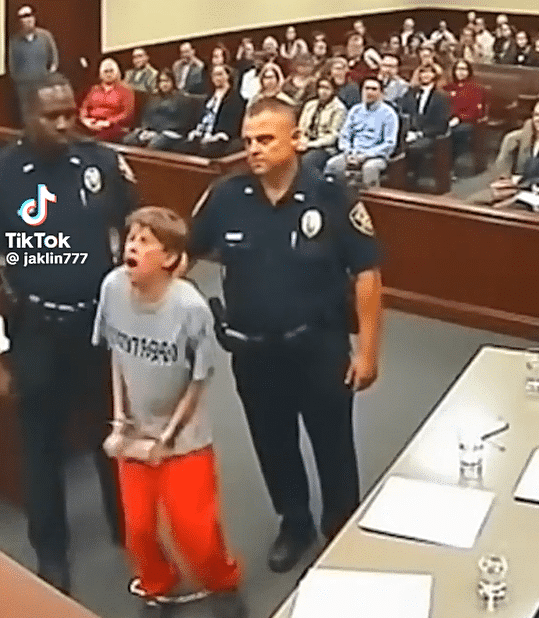
Some courtroom moments pass quietly. Others leave behind a silence that people remember long after the hearing is over. According to the account, this was one of those moments.
A 12-year-old boy stood before a judge in a tense courtroom as a sentence was read aloud—50 years in prison. The number was difficult for many in the room to process. It was not just a punishment measured in years. It was a sentence longer than the child had been alive several times over. It represented lost birthdays, missed milestones, and a future that suddenly seemed to disappear in front of everyone.
The courtroom was quiet before the judge spoke. Family members sat close together, some holding back tears, others staring forward as if they were still hoping for a different outcome. Officers stood nearby. Attorneys waited in silence. The air felt heavy with the kind of tension that only comes when a life-changing decision is about to be made.
Then the judge delivered the sentence.
Fifty years.
For a moment, the boy did not react. He stood still, almost frozen, as though his mind could not immediately understand what the words meant. At 12 years old, most children are still learning how to navigate school, friendships, rules, emotions, and family expectations. They are not yet prepared to understand the full weight of decades behind bars.
But then the meaning of the sentence seemed to hit him all at once.
A Child’s Reaction Stuns the Courtroom
According to the story, the boy suddenly broke down. His face changed from confusion to panic. He began crying and pleading, struggling to understand how he could be sent away for so long.
His reaction was not angry in the way people often expect from courtroom outbursts. It was fearful. It was raw. It was the reaction of a child who had just realized that the life he knew might be gone forever.
He reportedly repeated that he was “just a kid,” words that cut through the formal language of the courtroom. In that moment, the legal process no longer felt distant or procedural. It became deeply human.
Officers moved toward him carefully, not because he appeared dangerous, but because he seemed overwhelmed. Family members reportedly cried as they watched him collapse emotionally under the weight of the sentence. Some people in the room looked away. Others remained frozen, unable to process what they were witnessing.
A courtroom is built around rules, order, and authority. But moments like this show that behind every legal decision is a person living through the consequences in real time.
A Sentence Longer Than His Entire Childhood
A 50-year sentence for a 12-year-old raises painful questions. For some, serious crimes must bring serious consequences, regardless of age. Victims and their families deserve justice. Communities deserve safety. Accountability matters.
But when the person being sentenced is still a child, the conversation becomes more complicated.
At 12, a young person has not yet reached adulthood. The brain is still developing. Emotional control, judgment, impulse management, and the ability to understand long-term consequences are still forming. That does not erase responsibility, but it does make the question of punishment more difficult.
A sentence of 50 years does not only remove freedom. It removes nearly every ordinary milestone most people expect to experience. It can mean missing high school, a first job, college, career training, family life, financial independence, and the chance to build a stable future.
It can also affect practical matters most children have not even begun to understand, such as personal finance, banking, insurance, loans, housing, employment, and long-term planning. While adults may understand how one decision can affect a mortgage, a career, or a legal record, a child may not fully grasp how one moment can change everything for decades.
That is why this story has sparked such strong reactions.
When Justice and Childhood Collide
The case forces readers to consider one difficult question: what should justice look like when the defendant is still a child?
Some believe the sentence reflects the seriousness of the offense and the need to protect the public. From that point of view, age does not erase harm, and the justice system must respond firmly when a serious crime has occurred.
Others believe that a sentence this long leaves no meaningful room for rehabilitation. They argue that children are still capable of change and that the justice system should recognize the difference between a child and an adult.
This does not mean ignoring victims. It does not mean pretending harm did not happen. It means asking whether punishment should also allow the possibility of growth, accountability, and transformation over time.
The emotional power of the boy’s reaction comes from that tension. The courtroom saw both the seriousness of the sentence and the young age of the person receiving it.
The Family’s Pain
According to the account, the boy’s family was devastated. Watching a child receive a sentence that could take away most of his life is a pain few people can imagine.
For parents, siblings, and relatives, a sentence like this does not affect only the person going to prison. It changes the entire family. Visits, phone calls, legal costs, emotional trauma, and years of uncertainty can become part of daily life.
At the same time, the families of victims also carry deep pain. Their lives may have been changed forever by the events that led to the case. Any fair discussion must remember that multiple families can be suffering at the same time.
That is what makes these cases so difficult. Justice is not simply a number spoken by a judge. It is a process that touches everyone connected to the harm.
Why the Story Resonates Online
This story has spread because it captures a painful collision between innocence and consequence. People are shaken not only by the sentence, but by the reaction that followed.
The boy’s breakdown reminded viewers that even in a courtroom, where legal language can feel cold and formal, the emotional reality is unavoidable. A child heard a sentence that sounded larger than life itself—and responded with fear, confusion, and heartbreak.
That moment stayed with people because it felt painfully understandable.
It also serves as a warning about how quickly life can change. One choice, one conflict, one mistake, or one tragic event can create consequences that last far beyond the moment itself.
Final Thoughts
This courtroom story is powerful because it raises questions that do not have easy answers. It asks us to think about justice, accountability, childhood, rehabilitation, and the long-term consequences of legal decisions.
A 50-year sentence is more than a number. For a 12-year-old, it represents a future placed behind walls before adulthood even begins.
Whether people believe the punishment was justified or too severe, one thing is clear: the boy’s reaction revealed the human weight of the moment.
And when he cried that he was “just a kid,” the courtroom was left facing a question that continues to echo far beyond that day:
How should society punish a child while still recognizing the possibility that a child can change?